

Rituals are the engine behind every strong run in Absolum. Pick the right ones and your build snowballs into something that can tear through bosses. Pick the wrong ones, or ignore how they interact, and you'll hit a wall well before the final encounters. This guide covers every Ritual family, how the four Ritual types work, and the stacking and leveling mechanics that separate good runs from great ones.
What are Rituals in Absolum?
Rituals form one of Absolum's core build-crafting and roguelike systems. They're physical objects crafted from crystals mined beneath The Citadel. A skilled wizard refines these crystals to trap magical energy, then carries them into a run to channel their power. You're not the only one who uses them — Azra and his Crimson Wizards, Crimson Crystallomancers, and even some Exiled enemies interact with Rituals throughout the world.
Choose wisely at each reward
How do you get Rituals during a run?
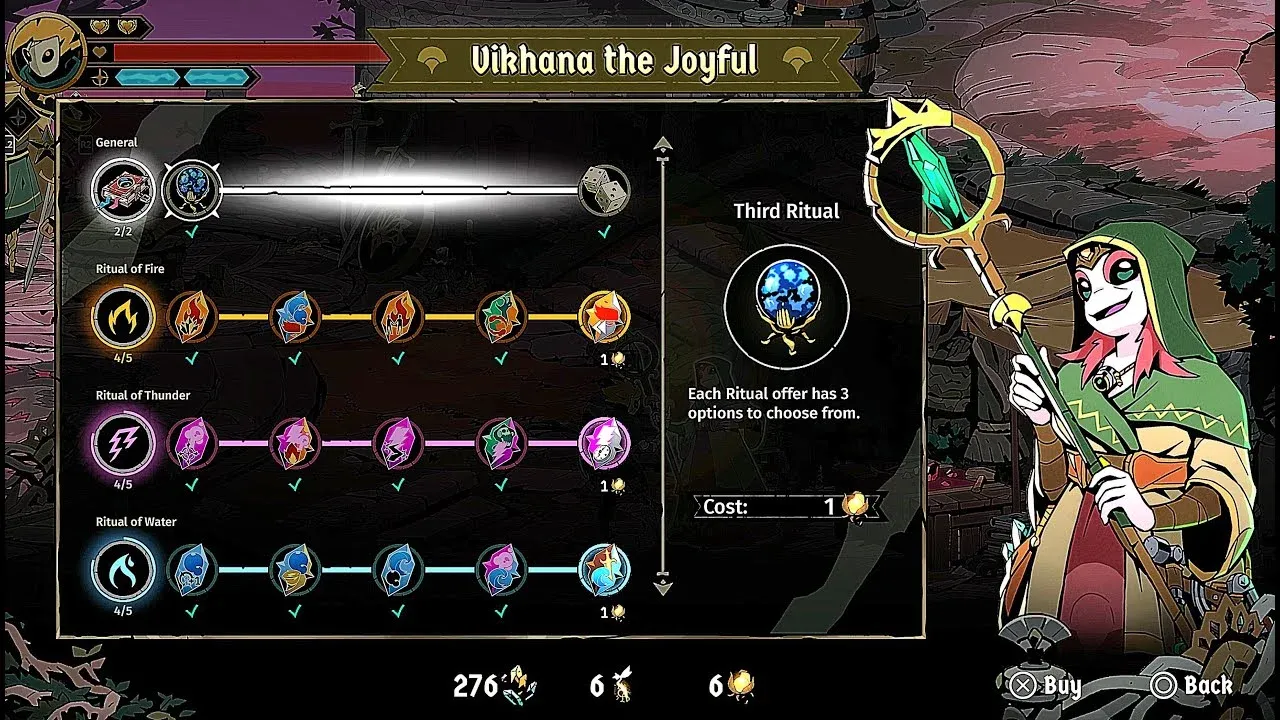
The standard way to pick up a Ritual is at the final scene of a non-Boss, non-Story Location. You'll see a crystal you can interact with or shatter with attacks, revealing a choice of 2 Rituals. With the Vikhana upgrade from the Soul Tree, that choice expands to 3 options.
p>Beyond the standard reward, several other acquisition routes exist:- Fallen Hunters can drop Rituals when defeated
- Certain shops, including the one in Misty Grove, sell them
- NPCs that appear during a run can offer them
- Exiled enemies found dead as a random event can yield Rituals, though acquiring one this way costs HP
The game naturally limits you to up to 3 different Ritual families per run. You can break this cap by purchasing a Ritual outside your current run's selection, which adds that family to your pool.
What are the four Ritual types?
Every Ritual belongs to one of four categories, and understanding the difference changes how you evaluate each offer.
Core Rituals are your foundation. General Rituals pad out your power regardless of what else you're running. Enhancement Rituals are where builds get specific — they demand you already have the right pieces in place. Twin Rituals are the highest ceiling options but require deliberate setup across two families.
Four Ritual types at a glance
How do Ritual levels and stacking work?
All Rituals except Twin ones can be acquired multiple times, raising their Level up to a maximum of 3. The scaling is consistent across the board: Level 2 is roughly 50% stronger than the base value, and Level 3 is 100% stronger.
By default, you build toward Level 3 by picking the same Ritual three times. Certain Soul Tree upgrades let you encounter Level 2 or Level 3 Rituals immediately, skipping the grind.
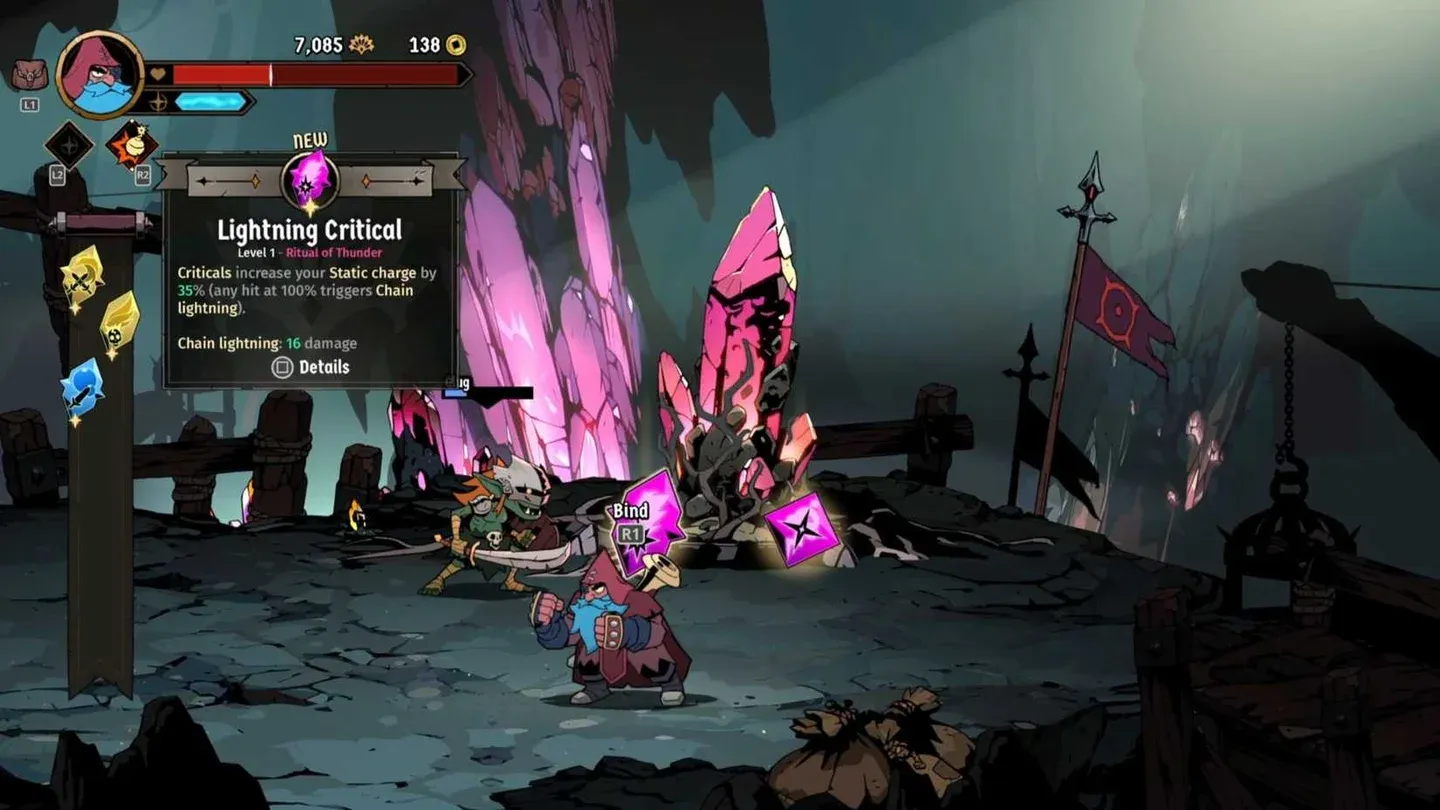
Stacking is a separate mechanic. When you hold multiple Rituals that enhance the same mechanic — even if they're different Rituals — their power increases beyond what their individual levels would suggest. A concrete example: holding both Wave Dash and Wave Landing at Level 1 raises Small Tidal Wave damage from 4 to 6, and pushback distance from 20% to 30%. That's roughly the same boost as gaining one full Level.
Stacking increases are usually equivalent to one Level, but this can fluctuate significantly depending on the mechanic involved.
What is Ritual Power and how does it scale?
Ritual Power is a hidden stat tied to each Ritual family. It defines how strong that family's mechanics are, typically expressed as damage output or effect amount. The only way to increase it is through Trinkets, specifically the Moxes and the Crown of Harmony.
The scaling is multiplicative, not additive. Two copies of Fire Mox don't give +20% twice for a flat +40%. Instead, they multiply together for a x1.21 Fire Ritual Power result. Values in Ritual descriptions that respond to Ritual Power are marked with the Crown of Harmony icon.
All eight Ritual families explained
At the start of a run, only the Ritual of Fire is available. Every other family requires a specific unlock condition, detailed in the table below.
Ritual of Fire
The starting family and the one most players know best. Fire builds around the Burn status effect and area denial through Blazing Trails and Flame Rings. Rituals like Burning Strike and Blazing Dash apply Burn directly through your attacks and movement, while Enhancement Rituals like Flash Fire and Persistent Burn extend its reach and duration. Spreading Burn and Explosive Death can turn single-target Burn into room-clearing chain reactions.
Ritual of Water
Water centers on Tidal Waves for displacement and Splash Bubbles for projectile-based pressure. Wave Dash and Wave Landing are the two Rituals that stack their Tidal Wave output, as shown in the stacking example above. Bubble Throw, Bouncing Bubble, and Bubble Finisher build toward a projectile-heavy playstyle. Rupture is a General Ritual here, making it loadout-agnostic and worth considering in almost any Water run.
Water stacking with Wave Dash
Ritual of Wind
Wind operates through Tornadoes and Sonic Booms, with a strong emphasis on mobility and aerial play. Tornado Jump and Strike High reward aggressive vertical movement. Sonic Barrage, Sonic Force, and Sonic Clash build toward a high-frequency hit pattern that benefits from stacking multiple Sonic Boom sources.
Ritual of Thunder
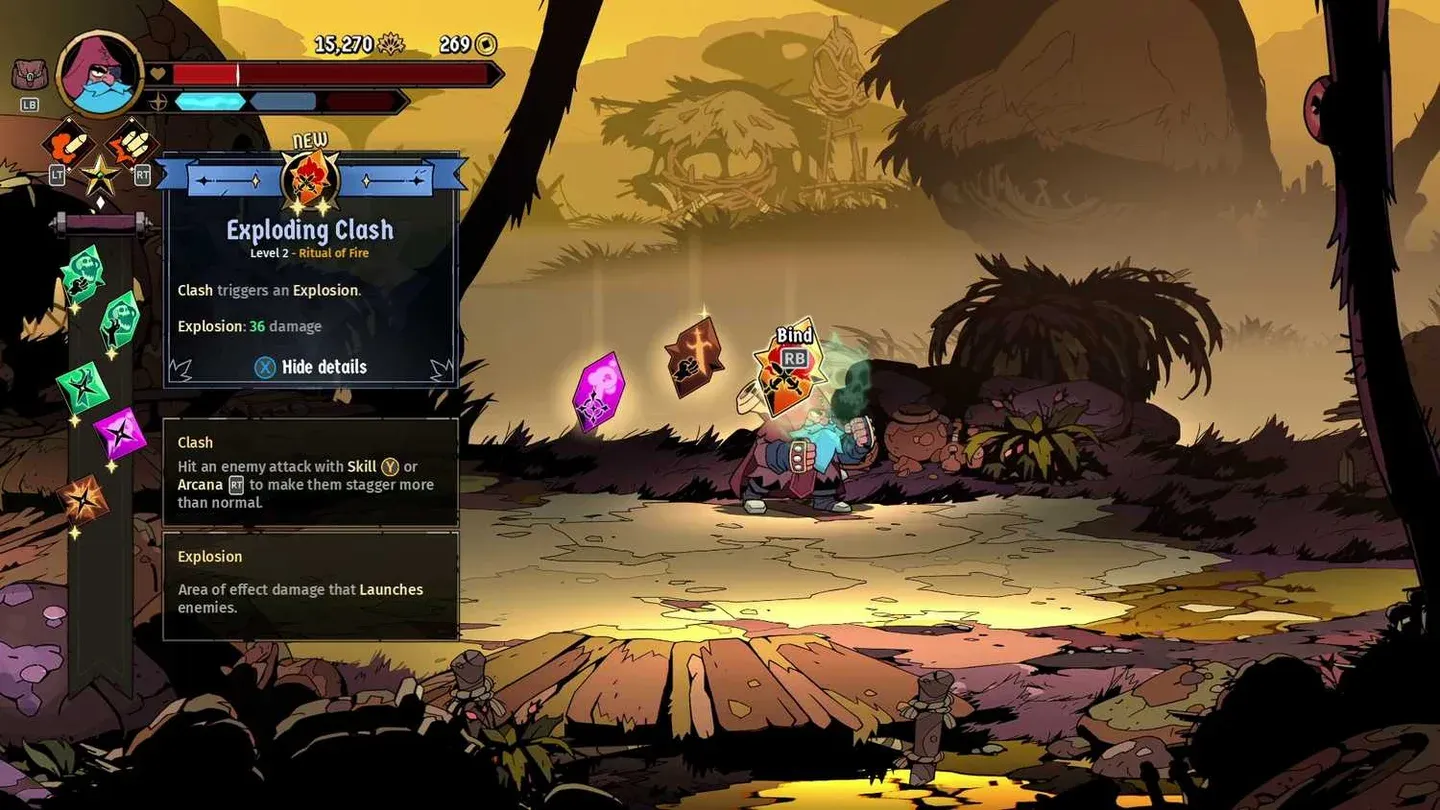
Thunder is built around Chain Lightning and Proximity Sparks, with a crit-focused identity. Lightning Critical increases your Static charge by 35% on every crit, and at 100% charge, triggers a Chain Lightning dealing 16/24/32 damage (scaled by Ritual Power via Crown of Harmony). Charging Spark, Quick Spark, and Spark Storm all feed the Static charge loop. Critical Overload is the Enhancement that pushes this family into high-damage territory.
Ritual of Bramble
Bramble deploys Thorn Daggers, Rose Darts, and Rose Turrets to create persistent damage zones and projectile spam. Piercing Thorn and Momentum Thorn reward aggressive movement. Rose Frenzy and Thorn Spread scale the turret and dart output. Rose Resilience offers a defensive angle that makes Bramble viable in longer, attrition-style runs.
Ritual of Necromancy
Necromancy runs on Spectral Armor, Skeletons, and Revenge Bones. The Spectral line (Spectral Strike, Spectral Skill, Spectral Deflect, Spectral Boon) builds up your armor layer. The Skeleton line (Skeleton Dodge, Skeletal Clash, Super Skeleton) deploys minions that absorb hits and deal damage. Bone Revenge and Bone Enthusiasm trigger off taking damage, making this family unusually rewarding in aggressive, high-risk play.
Ritual of Time
Time is a late-unlock family, available only after defeating Azra, The Sun King for the first time. Its mechanics revolve around Chrono Lock, Unstable effects, and Past Echoes. The Echo line (Echoing Arcana, Echoing Skill, Echoing Finisher, Multiple Echoes, Powerful Echoes) repeats your actions with a delay, effectively doubling output on key moves. The Unstable line introduces risk through Greater Instability and Spreading Instability, but pairs with Enhancement Rituals to convert that volatility into damage. Backtrack and Roll Back Time are utility-oriented and can bail you out of bad positions.
Ritual of Chaos
Chaos is the last family to unlock, requiring both the Otherworldly Rift location and a first kill on The Interloper. It operates through Cosmic Accidents, Cursed Life, and Luck mechanics. The Cursed line (Cursed Finisher, Cursed Skill, Cursed Mana Gain, Cursed Luck) trades safety for power. Ancient Luck and Treasure Hex manipulate run economy. Cosmic Cataclysm is an Enhancement that sits at the high end of the family's damage output.
How do Twin Rituals work?
Twin Rituals sit at the intersection of two families. To be offered one, you need Rituals from both corresponding families already in your possession. You need Rituals of both families, not necessarily the specific Rituals that the Twin Ritual references.
Every pair of families has exactly one Twin Ritual. A few standout examples from the full matrix:
- Fire + Thunder: Spark Combustion
- Fire + Necromancy: Fiery Skeleton
- Water + Thunder: Magnetised Waves
- Wind + Thunder: Chain Tornadoes
- Bramble + Necromancy: Blooming Skull
- Time + Chaos: Chaos Echo
- Necromancy + Chaos: Cosmic Pillar
Twin Rituals cannot be leveled up. They sit at a fixed power level, which means their value comes from the unique effect they provide rather than scaling through repetition.
Building around Rituals: practical priorities
A few principles hold up across runs, based on how the mechanics interact:
- Stack before leveling where possible. Two different Level 1 Rituals that share a mechanic can match the output of a single Level 2 Ritual while also providing two separate effects. The Tidal Wave example above makes this concrete.
- Enhancement Rituals need prerequisites. Don't pick an Enhancement unless you already have the Ritual it upgrades, or you're confident you'll get the prerequisite before the Enhancement becomes relevant.
- Ritual Power is multiplicative. Two Moxes of the same type give x1.21, not x1.40. If you're running multiple Moxes, diversify across families rather than doubling up on one unless the math specifically favors it.
- The family cap of 3 per run is a soft ceiling. You can break it by purchasing off-pool Rituals, which is worth doing if a Twin Ritual justifies the investment.
- Time and Chaos are power-spike families. Both require specific boss kills to unlock, meaning you won't see them in early runs. When they do become available, they tend to have higher individual ceilings than the base families.
For more build strategies and roguelike guides, browse the latest guides on GAMES.GG.