

Dotemu's Absolum was already one of the stronger indie roguelikes to come out of 2025, and the Threads of Fate update makes a convincing case that the post-launch roadmap is worth paying attention to. This first major update adds corrupted areas that shake up every run, a dedicated post-game mode called Mystic Ordeals, new Soul Tree content to spend your crystals on, fresh skins for every character, and a full Ritual system that forms the backbone of every build you'll ever put together. Here's everything you need to know.
What are corrupted areas and how do they work?
Corrupted areas are the most immediately noticeable change to standard runs in Threads of Fate. These zones spawn randomly on the map, marked by a distinctive blue glow. Step into one and portals tear open, flooding the arena with powerful enemies pulled from later sections of the game. You'll face late-game elites well before your build is ready for them under normal circumstances.
This mechanic reworks the portal system that appeared in the base game after you took down Sun King Azrah, but with one critical difference: you can't disable them anymore. They're baked into every run now, which means ignoring them isn't a strategy — you need to decide whether to push through or route around them based on your current strength.
The trade-off is simple. Corrupted areas drop more crystals and higher-quality Rituals than standard encounters. The elite enemies that pour through the portals hit harder than their base-game versions, so you're gambling real danger against better loot. If your build isn't ready, skipping them is the smart move. If you're snowballing and want access to the best Rituals available, corrupted areas are where you go.
What are Mystic Ordeals and how do you unlock them?
Mystic Ordeals are the dedicated post-game mode added by Threads of Fate. To access them, you need to have cleared the game's final true boss at least once, then speak to the hooded figure in the bottom right of the hub. That's your gateway to the Ordeal system.
Each Mystic Ordeal is a run built around specific modifiers, ranging from lifesteal restrictions to increased enemy counts to buffed attack types that force you into a particular playstyle. They're designed to be challenging, and finishing them with each character or without using certain tools like companions earns you medals on top of the standard rewards.
If the difficulty becomes a wall rather than a challenge, Assist Mode remains available during Ordeals. You can still adjust your damage output up or down, which keeps the content accessible without removing it entirely.
Clearing Ordeals also expands the Soul Tree with new sections, which is where the long-term progression loop lives. You'll need to finish a significant number of Ordeals to see all the new content, but the payoff includes some genuinely useful unlocks.
Mystic Ordeal condition select
What's new in the Soul Tree?
The Soul Tree additions are gated behind Ordeal completion. New sections appear after you've beaten your first Ordeal run, which typically means clearing the final boss again as part of that Ordeal. From there, each additional Ordeal you finish opens up more of the tree.
The new unlocks include:
- Two skins per character, the first of which requires at least two Ordeal completions
- Character-themed emote sets
- Ordeal modifiers that let you adjust future runs
- Upgrades that buff Heathroot effectiveness or increase attack strength
- The ability to start a run with an Inspiration that would normally only drop from bosses
That last one is significant. Boss Inspirations are some of the strongest run-starters available, and being able to begin with one changes how you approach early routing.
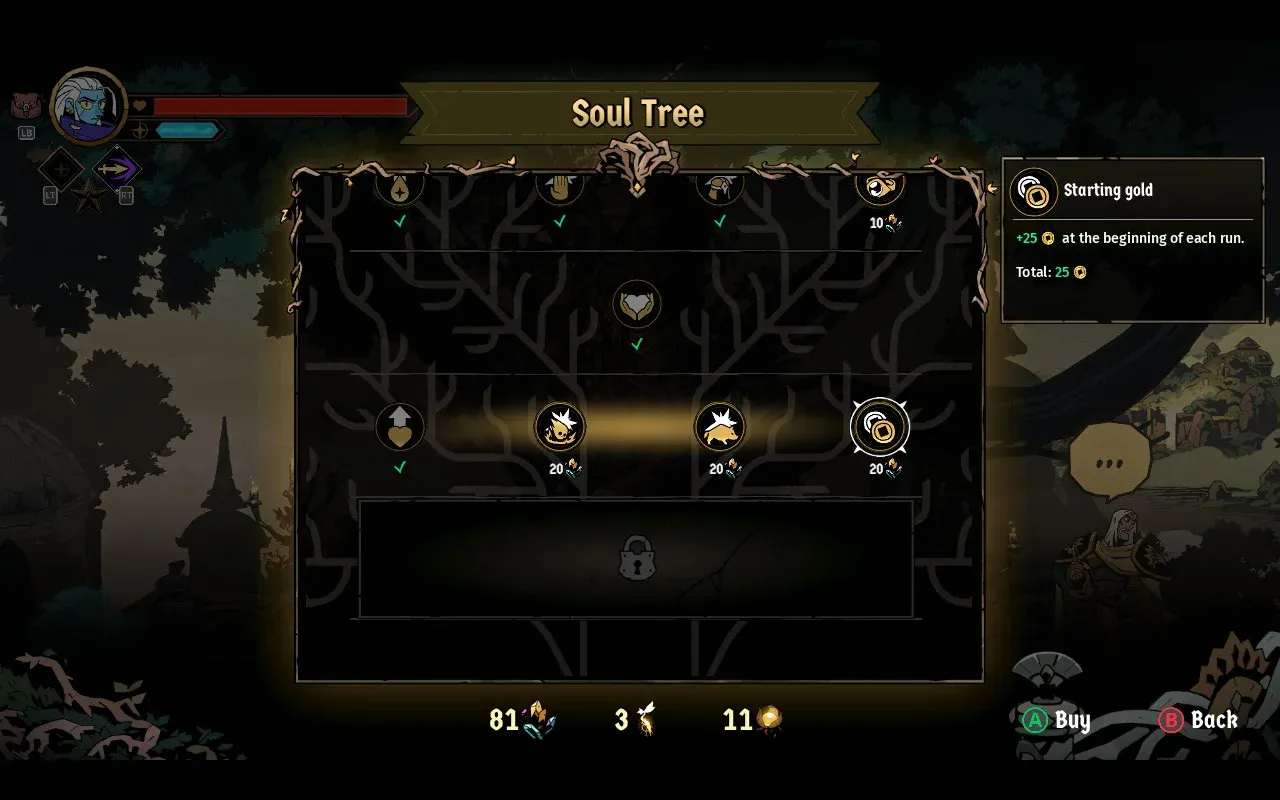
Soul Tree new node layout
How does the Ritual system work?
Rituals are the core build-crafting mechanic in Absolum, and understanding them is what separates runs that fall apart in the mid-game from runs that snowball into something unstoppable. Rituals appear as choices at the end of non-boss, non-story locations, presenting 2 options by default (or 3 with a specific Vikhana upgrade). You pick one and it modifies your character for the rest of that run.
There are 8 Ritual families in total, each with its own elemental identity and mechanical keywords:
A single run will naturally offer up to 3 different families, but you can expand your pool by purchasing Rituals outside your current selection.
What are the four Ritual types?
Every Ritual falls into one of four categories, and knowing which type you're picking matters for how your build develops:
- Core Rituals attach the family's main mechanic directly to your attacks (Lightning Strike, Blazing Dash, etc.)
- General Rituals give global upgrades that work regardless of loadout, while staying thematically tied to their family (Rupture, Tornado Jump)
- Enhancement Rituals upgrade a specific family mechanic and usually require you to already have a related Ritual before they appear
- Twin Rituals belong to two families simultaneously and require you to have Rituals from both families to unlock them
Twin Rituals are where some of the most powerful interactions live. Combinations like Spark Combustion (Fire + Thunder), Fiery Skeleton (Fire + Necromancy), and Cosmic Thunderstorm (Thunder + Chaos) represent the kind of cross-family synergy that can define a run.
How does Ritual leveling and stacking work?
Most Rituals can be picked up multiple times, increasing their Level up to a maximum of 3. The scaling is straightforward: Level 2 is roughly 50% stronger than the base value, and Level 3 is 100% stronger. Certain Soul Tree upgrades can make Level 2 and Level 3 versions appear immediately, skipping the upgrade process.
Stacking is a separate mechanic that kicks in when you hold multiple Rituals that enhance the same underlying mechanic. For example, holding two Level 1 Rituals that trigger Tidal Waves (Wave Dash and Wave Landing) pushes Small Tidal Wave damage from 4 to 6 and increases pushback distance from 20% to 30%. The power increase from stacking is roughly equivalent to one full Level, though it varies between mechanics.
Ritual Power is a hidden stat that scales the damage and effects of a given family's mechanics. It's boosted exclusively through Trinkets, specifically Moxes and the Crown of Harmony. Crucially, Ritual Power increases are multiplicative: two copies of Fire Mox result in x1.21 Fire Ritual Power rather than a flat +20%.
Where do you find Rituals outside of standard rewards?
The main source is the end-of-scene reward, but several alternative acquisition paths exist:
- Fallen Hunters can drop Rituals as a random event (sometimes at a cost in HP)
- Certain shops, including the one in Misty Grove, stock Rituals for purchase
- NPCs that appear during runs can offer Rituals as part of their interactions
This matters because buying a Ritual from a shop that isn't in your current run's family pool is how you manually add a fourth or fifth family to a single run, opening up Twin Ritual combinations that wouldn't otherwise be available.
For more guides covering Absolum and other games worth your time, browse more guides at GAMES.GG.