The combat medic just got a lot more dangerous
Lifeline has been in Apex Legends since day one, and for most of that time she carried a reputation as the safe pick — the legend you chose when you wanted to help teammates without thinking too hard. That reputation is now completely outdated. Following her Season 23 rework, Ajay Che plays more like an aggressive frontline enabler than a passive heal-bot, with real aerial mobility, a deployable dome that doubles healing speeds, and a hands-free revive that lets her keep her gun up while D.O.C. does the heavy lifting. If you haven't revisited her since the rework, you're missing one of the strongest support legends on the roster.
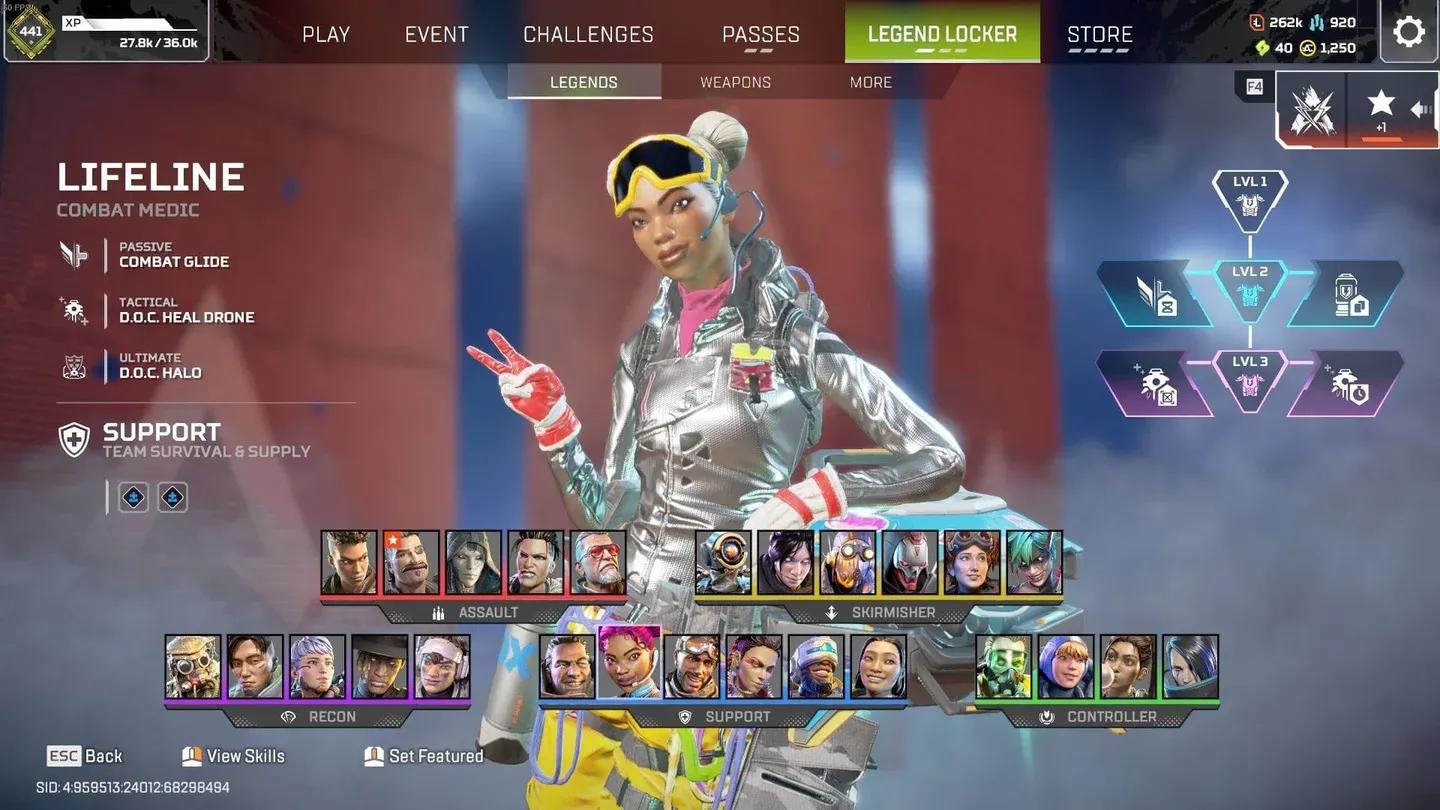
Lifeline's reworked ability kit


What are Lifeline's abilities after the rework?
Lifeline's kit was overhauled in Season 23, replacing her old revive shield and care package with a completely different set of tools. Here's how everything breaks down.
Passive: Combat Medic and Combat Glide
Combat Medic is the core of her support identity. Press the interact key near a downed teammate and D.O.C. (Drone of Compassion) handles the revive automatically, freeing Lifeline to move, shoot, or reposition. The drone can revive up to 2 teammates simultaneously. Revived players also receive health regeneration automatically once they're back on their feet.
The passive also covers blue extended supply bin access, granting 2 additional healing or utility items per bin (knockdown shields excluded). As a Support class legend, Lifeline gets further perks: full movement speed while using healing items, 25% faster manual revives, and the ability to craft banners at a replicator to automatically produce a Mobile Respawn Beacon.
Combat Glide is the new addition that changes how Lifeline moves entirely. Hold the jump button mid-air and D.O.C. carries her in a glide for up to 4 seconds. The speed of that glide scales with your existing momentum, so slide-jumping or hitting a launch pad before gliding lets you cover serious ground. Angle your camera slightly off-center during the glide to extend distance and make yourself harder to track.
Tactical: D.O.C. Heal Drone
Lifeline's tactical holds up to 3 charges and summons D.O.C. to heal nearby allies within a 6-meter radius at 8 HP per second. The drone lasts 20 seconds, has an infinite healing pool, and carries a 45-second cooldown (reducible to 35 seconds with the Tactical Cooldown+ Level 3 perk).
The most underused feature here is assignable healing. You can direct D.O.C. to follow a specific teammate, meaning your entry fragger gets continuous health regen during a push without you being anywhere near them. Drop the drone on yourself right before a duel and you can absorb more damage than your HP bar suggests — enemies who expect a one-shot will find you regenerating mid-fight.
A few interactions worth knowing: Caustic's Nox Gas disables the drone's healing entirely, and Crypto's EMP destroys it outright. The drone can also be attached to a Trident for mobile healing during rotations.
Ultimate: D.O.C. Halo
The old care package is gone. The D.O.C. Halo throws D.O.C. forward, which then projects a ring-shaped energy shield roughly 10 meters tall that blocks all incoming and outgoing bullets. Everyone inside, including enemies, uses health and shield consumables 50% faster. A Shield Battery drops from 4 seconds to 2.5 seconds. A Phoenix Kit goes from 10 seconds to 5 seconds.
The Halo charges in 3 minutes, so timing matters. Deploy it defensively to hold a doorway or reset after a tough fight, or throw it aggressively into open ground to create instant cover during a push. The fast-heal buff alone can swing a 3v3 fight if your squad pops batteries while the enemy scrambles to respond.
The one real weakness: the top is completely open. Grenades, arc stars, thermites, and abilities like Bangalore's Rolling Thunder or Gibraltar's Defensive Bombardment drop straight in. If you're using the Halo in a contested area, watch the high ground.

D.O.C. Halo in active deployment
Which perks should you choose?
Lifeline's upgrades unlock at Evo Shield Levels 2 and 3, and the right choice depends on how aggressively you play.
| Level | Perk Option A | Effect | Perk Option B | Effect | Recommended Pick |
|---|---|---|---|---|---|
| 2 | Battpack | Carry 3 Shield Batteries per stack; ping batteries from death boxes | Extended Flight | Glide time increases from 4s to 5.5s | Battpack for ranked/passive; Extended Flight for aggressive |
| 3 | Enhanced Radio | D.O.C. Heal Drone assignment range +50% | Tactical Cooldown+ | Drone cooldown reduced from 45s to 35s | Tactical Cooldown+ in most situations |
Battpack is the inventory economy pick. Stacking 3 Shield Batteries per slot and being able to ping them off death boxes at range is genuinely valuable in ranked, where resources are tight and every inventory slot counts.
Extended Flight suits players who want to take off-angles, chase knockdowns, or keep pace with mobile teammates like Octane or Ash. The extra 1.5 seconds of glide time is more meaningful than it sounds when you're using it to reach high ground mid-fight.
Tactical Cooldown+ is the Level 3 default for most situations. Cutting 10 seconds off the drone cooldown means more frequent healing windows, which directly translates to winning drawn-out fights. Enhanced Radio has niche value for Lifelines who play at safer distances, but the cooldown reduction wins most of the time.
How should you position during a revive?
The old revive shield gave Lifeline a physical barrier to hide behind. Without it, positioning is everything.
Before triggering a D.O.C. revive, check enemy positions and sight lines. Downed teammates should crawl toward hard cover before you initiate. Once D.O.C. starts the revive, your job is to either create space or apply pressure:
- Use suppressive fire to prevent enemies from pushing the vulnerable teammate
- Throw grenades to zone enemies away from the revive location
- Reposition to a flanking angle so enemies have to split attention
- Deploy the D.O.C. Halo over the revive to speed up post-revive healing and provide cover
The tactical dilemma you create is real: if enemies focus D.O.C. and the downed teammate, you have a free angle. If they focus you, the revive completes. Neither outcome is good for them.
For the full breakdown of Lifeline's ability interactions and passive mechanics, the Apex Legends Wiki has detailed documentation on D.O.C.'s behavior in edge cases.
What weapons work best on Lifeline?
Lifeline's weapon needs are straightforward: reliability and versatility across ranges. She's not trying to out-frag Ash or Octane. She needs to defend herself, provide covering fire during revives, and stay alive long enough for her abilities to matter.
| Playstyle | Primary | Secondary | Why It Works |
|---|---|---|---|
| Dedicated support | R-301 Carbine or Nemesis Burst AR | EVA-8 Auto or Mastiff | Low recoil AR for suppressive fire; shotgun for close defense |
| Aggressive medic | Flatline AR or R-301 | R-99 SMG or Volt SMG | Hip-fire AR paired with high-DPS SMG for confident pushes |
| Backline support | 30-30 Repeater or Bocek Bow | Peacekeeper | Poke from distance; burst damage if enemies close in |
The R-301 is the safe choice for almost any Lifeline build. Low recoil, consistent mid-range damage, and easy to use while managing ability timing. The Flatline suits aggressive Lifelines who need reliable hip-fire in close-quarters. Pair either with an SMG for short-range situations.
What are the best team compositions for Lifeline?
Lifeline slots into almost any squad, but she peaks in two distinct archetypes.
Aggressive compositions use her drone to sustain entry fraggers during pushes. Assign D.O.C. to Octane, Ash, or Wraith and let them push while Lifeline provides Combat Glide follow-up and deploys the Halo offensively. Ash's Phase Breach can teleport the full squad into a new position, where Lifeline immediately fortifies with the Halo. Ash's Arc Snare also locks down enemies trying to rush a revive.
Defensive compositions pair Lifeline with Gibraltar or Newcastle to create layered protection. Gibraltar's Dome of Protection directly counters the Halo's biggest weakness by covering the open top against grenades. Caustic or Wattson traps around an active Halo turns the zone into a genuine fortress. This setup excels in final rings where holding ground matters more than mobility.
For a full look at how Lifeline fits into the broader Apex Legends support meta, you can browse more guides on games.gg covering the current roster.
What makes Lifeline viable in ranked?
The Season 23 rework addressed every legitimate complaint about her old kit. The static heal drone that required everyone to huddle in one spot is now a mobile, assignable tool. The revive that locked Lifeline in place is now handled by D.O.C. while she stays active. The care package that sometimes felt like a coin flip is now a deployable dome that actively controls fights.
The result is a legend who rewards positioning and game sense rather than just button timing. Knowing when to deploy the Halo offensively versus defensively, when to assign the drone to a flanker versus keeping it on yourself, and when to glide for a better angle rather than staying grounded — those decisions separate average Lifeline players from genuinely dangerous ones.
Her S-tier ranking in Season 25 reflects that the rework landed well. For detailed stats and passive ability specifics, the Apex Legends wiki at apexlegends.wiki.gg tracks her current numbers including Combat Glide duration, drone healing rates, and Halo charge times.
The bottom line: Lifeline is no longer a legend you pick because you want to play it safe. She's a legend you pick because you want your squad to be almost impossible to finish off, and because you want the tools to turn a fight that looks lost into one you walk away from.