Search games, articles, guides...CtrlK
Sign InGet Started
Learn how Balatro's interest system, economy Jokers, and Vouchers work together to fund winning runs from Ante 1 to Gold Stake.

Written by Nuwel
Content Writer
See more GAMES.GG guides on Google
Add us as a preferred source and our guides show up first in your results.

Blueprint and Brainstorm in Balatro: Master the Joker Copy Combo
Learn how to position Blueprint and Brainstorm for maximum effect in Balatro, including Mime and Reserved Parking setups.

Balatro Planet Cards Guide: Level Up Every Poker Hand
Master Balatro's Planet Cards to power up your poker hands, score massive multipliers, and build winning runs every time.

Balatro Spectral Cards: Effects, Strategy, and Optimal Uses
Master every Spectral card in Balatro, from Ectoplasm to Ouija. Learn when to use them and how to build around their effects.
Balatro's scoring gets all the attention, but the real engine powering every successful run is your economy. Without a steady cash flow, you cannot reroll shops, buy key Vouchers, or afford the Jokers that push you past Ante 8. Whether you are playing your first White Stake run or grinding toward Gold Stake completions, understanding how money compounds in this game separates players who scrape by from those who cruise to victory.
At the end of every Blind, the game pays you interest based on how much cash you are holding. The default cap is $5 per round, awarded when you hold $25 or more. That means for every $5 you hold (up to $25), you earn $1 back, for a maximum of $5 interest per round.
This sounds modest, but it compounds fast. If you can maintain $25 from Ante 2 onward, you are effectively earning an extra $5 every single round on top of your normal payouts. Over a full run of 24 Blinds, that adds up to roughly $120 in free income, enough to fund several extra rerolls or a critical Voucher.
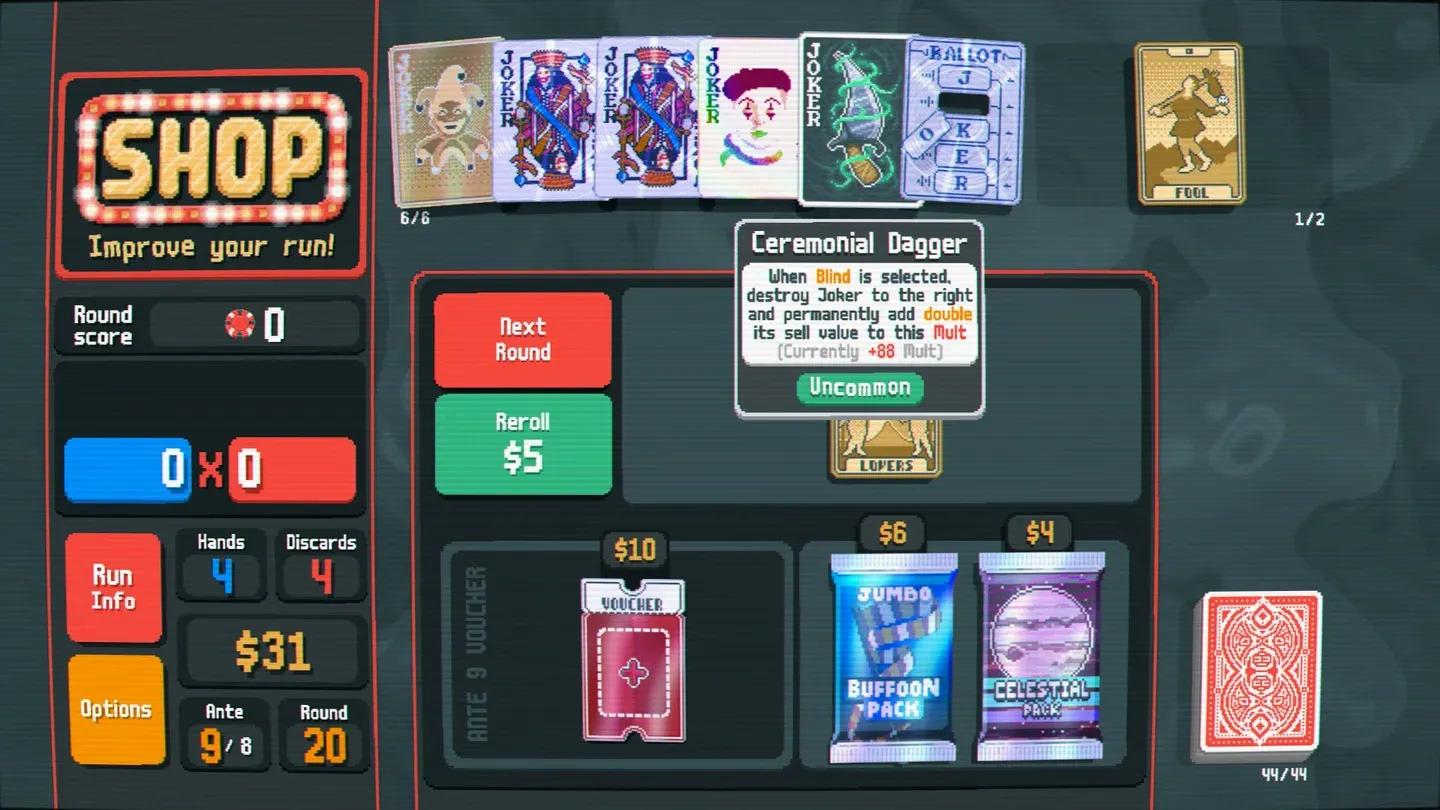
Interest cap tooltip in-game
The base $5 cap can be extended with two Vouchers that the wiki breaks down in full detail:
| Voucher | Interest Cap | Cash Threshold |
|---|---|---|
| Seed Money | $10 per round | Hold $50+ |
| Money Tree | $20 per round | Hold $100+ |
Seed Money is rated A-tier and is worth buying the moment you have a stable mid-game economy. Money Tree, its upgrade, pushes your passive income to $20 per round when you are sitting on $100 or more. Combined with the To The Moon Joker, which adds $1 of interest for every $5 held, you can stack interest income to $40 per round at the ceiling.
To unlock Money Tree, you need to max out your interest revenue for 10 consecutive rounds, so committing to the interest strategy early is what unlocks the biggest payoff later.
Not every run will hand you the perfect interest setup, which is why knowing the best money-generating Jokers matters. Here is how the top options stack up:
| Joker | Effect | Best Used For |
|---|---|---|
| To The Moon | +$1 interest per $5 held | Stacking with Seed Money/Money Tree |
| Golden Joker | Earn $4 at end of round | Reliable passive income, no conditions |
| Satellite | $1 per unique Planet card used this run | Late-game runs heavy on Planet cards |
| Bull | +2 Chips per $1 held | Doubles as your Chips Joker when wealthy |
| Bootstraps | +2 Mult per $5 held | Strong Mult scaling when cash is high |
| Rocket | $1 per round, +$2 per Boss Blind defeated | Scales across the run automatically |
| Egg | Gains $3 sell value per round | Temperance value and emergency cash |
Bull deserves special mention because it pulls double duty. On the Plasma Deck, where Chips and Mult are balanced together, a large cash reserve translates directly into massive Chips output, potentially freeing up a Joker slot that would otherwise go to a dedicated Chips card.
Bootstraps is similarly powerful for the Nest Egg trophy path, where accumulating $400 or more is the explicit goal. With $200 in the bank, Bootstraps alone contributes +80 Mult, rivaling dedicated Mult Jokers at a fraction of the setup cost.
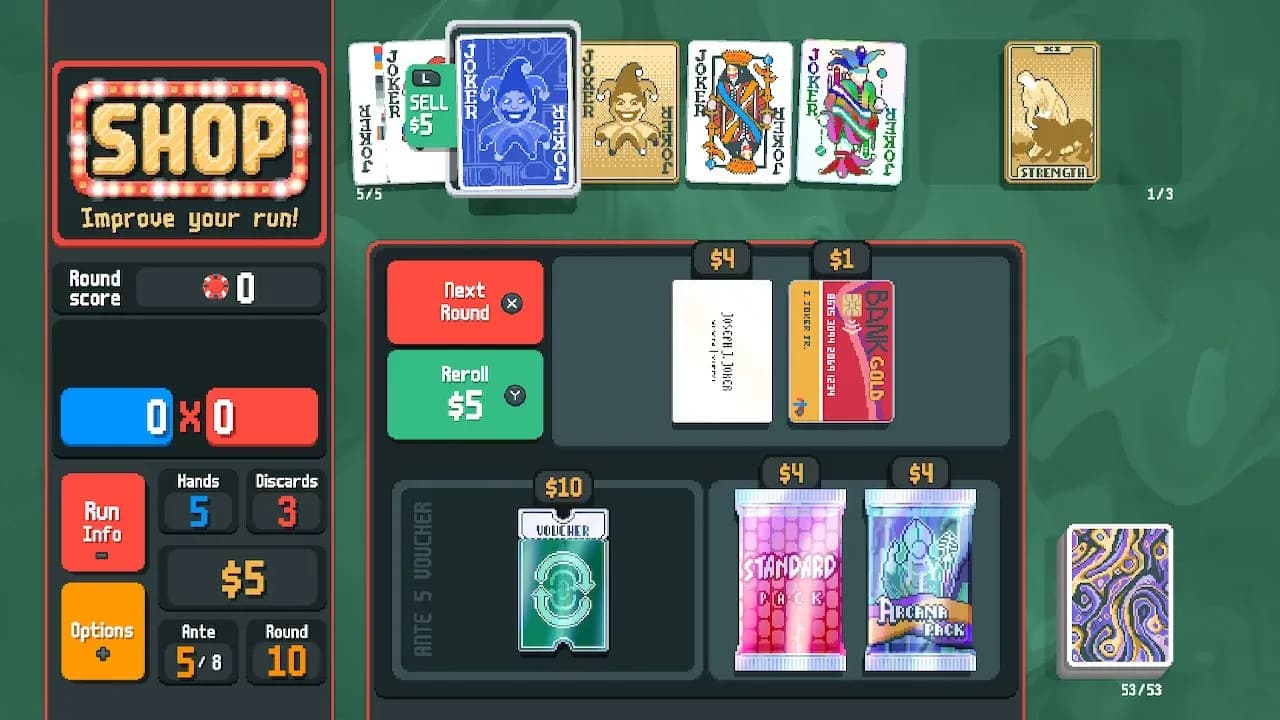
Economy Jokers in the shop
The Hermit Tarot card doubles your current money up to a cap of $20. If you are sitting on $10, The Hermit turns it into $20 instantly. The key rule that experienced players know: always use The Hermit before spending in the shop, not after. Spending first reduces the base you are doubling, cutting the card's value significantly.
Paired with Temperance, which grants cash equal to the total sell value of your current Jokers (capped at $50), these two Tarot cards can inject $50 to $70 of immediate income into a run at exactly the right moment. That kind of burst funding is often what separates a run that survives Ante 6 from one that comfortably reaches Ante 8.
Rental Jokers were introduced in Update 1.0.1f with a 30% spawn chance on Gold Stake. They cost only $1 upfront but charge $3 every round they remain in your slots.
At Gold Stake, there is roughly a 28% chance any given Joker in the shop carries no sticker at all, since Eternal, Perishable, and Rental stickers each have a 30% chance to appear and can stack. This dramatically changes how you evaluate every shop offer.
For economy planning specifically:
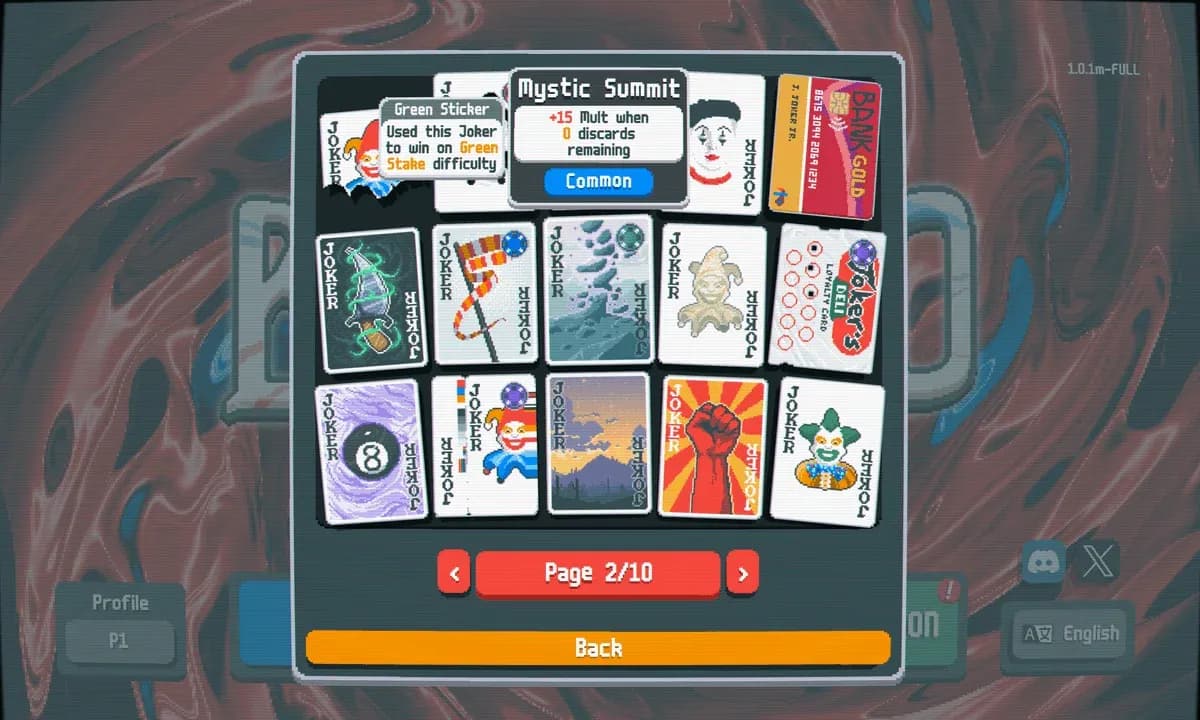
Rental sticker on a Joker card
Different decks interact with the economy system in distinct ways. Here is what to prioritize based on your starting deck:
Yellow Deck starts with an extra $10, giving you the fastest path to capping interest at $25. Buy your first Voucher or economy Joker a round earlier than other decks allow.
Green Deck earns no interest at all, instead paying $2 per remaining hand and $1 per remaining discard at round end. Jokers like Satellite and Rocket become your primary income sources. Vagabond, which creates a Tarot card when you play a hand with $4 or less, has natural synergy here since holding less money does not cost you interest.
Anaglyph Deck generates a Double Tag after every Boss Blind. Saving these for the Economy Tag (doubles your money, up to $40) or the Investment Tag ($25 after beating the Boss) can create dramatic cash spikes. One well-timed Economy Tag on $40 gives you $80, enough to cap interest and still have shop money left over.
Plasma Deck doubles the base Blind size, making it harder to survive early, but Bull scales exceptionally well here because the balanced Chips and Mult calculation turns cash directly into score.
Vouchers refresh every Ante, so knowing which ones to prioritize on a given run saves money and maximizes long-term income. The economy-focused Vouchers ranked by general usefulness:
One important note on Clearance Sale and Liquidation: they reduce the sell value of your Jokers, which makes Temperance less powerful and hurts Swashbuckler and Ceremonial Dagger builds. Factor this in before buying if your run relies on sell-value mechanics.
Skipping Small and Big Blinds is not always the right call, but certain Tags make it worthwhile from an economy perspective:
On Gold Stake, skipping Blinds is riskier because you need every dollar from unplayed hands and interest. The Investment Tag is the main exception since its $25 payout often outweighs what you would have earned from playing the Blind normally.
For more strategies across all aspects of the game, browse the latest guides on GAMES.GG to find builds, deck tips, and stake-specific advice.
The most reliable economy loop in Balatro looks like this: maintain $25 going into every Blind to cap interest, pick up Seed Money by Ante 3 or 4, grab To The Moon when it appears, and use The Hermit and Temperance as burst income whenever your cash reserve dips. Layer Golden Joker or Rocket as passive income sources in your Joker slots, and save at least one slot for a late-game xMult Joker once your economy is stable.
The players who struggle at higher stakes are almost always the ones who spend every dollar the moment they earn it. Building a cash buffer feels slow in the short term, but the compounding interest and expanded shop access it creates makes every subsequent Ante dramatically easier to navigate.