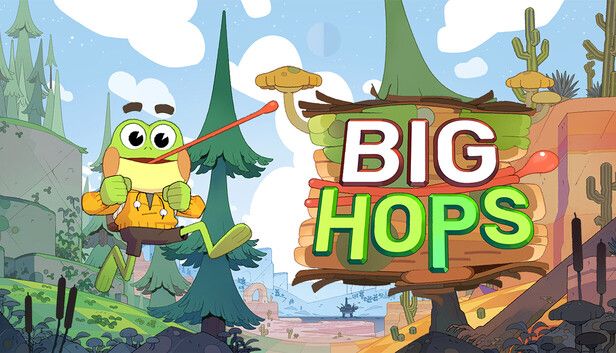

Big Hops is a single-player 3D platformer built entirely around one idea: momentum is everything. From your first bunny hop to your first grapple swing across a chasm, the game rewards players who understand its physics engine rather than fight against it. This guide breaks down every core movement mechanic, explains the design decisions behind them, and gives you the specific techniques top speedrunners use to shave milliseconds off their times.
What makes Big Hops different from other 3D platformers?
Most 3D platformers cap your movement speed. Big Hops does not. Hopper, the frog protagonist, can continuously build velocity by chaining specific moves together. Sliding down slopes, timing jumps precisely on landing, and reading the environment all feed into a traversal system that feels closer to a racing game than a traditional platformer. That mechanical depth is also why the game ships without any co-op or PvP mode: synchronizing frame-perfect physics across a network connection would destroy the responsiveness that makes it work.
How does bunny hopping work in Big Hops?
Bunny hopping (sometimes called b-hopping) is the foundation of fast movement. The mechanic works by timing your jump input to land exactly as Hopper touches the ground. A perfectly timed landing jump preserves your current velocity and adds to it, meaning every consecutive hop makes you faster. Miss the timing and you bleed speed, resetting your momentum chain.
The game includes input buffering to make this feel fair. Press the jump button a few frames before you actually land and the game queues the input, executing it the exact millisecond contact is made. This means you do not need superhuman reaction time to maintain a momentum chain. You just need to anticipate the landing rather than react to it.
Combining slopes with your hop chain
Flat surfaces are fine for building speed, but slopes are where momentum gets explosive. Diving onto a downward slope converts vertical momentum directly into horizontal speed, making slope-to-dive combinations the fastest ground traversal method in the game. Look for any downward incline after a dive and aim directly at it.
How does the grappling hook work?
The grappling hook in Big Hops is governed by pendulum physics, not a simple pull-to-point mechanic. When you attach to an anchor node, your body swings in a realistic arc. The height you gain and the speed you carry out of the swing depend entirely on when you release.
Two release points matter most:
- Apex release: Letting go at the highest point of your swing gives you maximum height. Use this to reach elevated platforms or set up a long glide.
- Pre-apex release: Releasing just before the apex sacrifices height but converts the swing energy into forward velocity. This is the faster option for covering horizontal distance quickly.
The grappling hook also interacts with the mid-air dive, a move that trades height for a burst of forward momentum. Chaining a pre-apex grapple release into an immediate dive is one of the core sequence-breaking techniques the speedrunning community uses to bypass intended routes.
What is coyote time and why does it matter?
Coyote time is a hidden mechanic that lets you jump for a brief window of frames after walking off a ledge, even though you are technically airborne. The name comes from classic cartoon physics where a character runs off a cliff but does not fall until they look down.
In Big Hops, coyote time makes precision platforming feel significantly more forgiving. If you slightly overshoot a platform edge and find yourself in the air, you still have a short window to jump as if you were standing on solid ground. Skilled players also use this deliberately: running off a ledge and jumping during the coyote window at a specific angle can produce movement trajectories that a standard standing jump cannot replicate.
How does ghost racing work, and is it worth using?
Big Hops records every level run as ghost data tied to the global leaderboard. You can download the ghost of any top-ranked player and race against a translucent replay of their exact inputs in real time. This is the closest the game gets to live multiplayer, and for movement learning purposes it is more useful than watching a video.
Watching a ghost shows you:
- Exact crosshair placement for each grapple anchor
- The specific angles used to cut corners during bunny hop chains
- Which dives and slope combinations the fastest players prioritize
The leaderboard also lets you filter to show only friends, so you can run a persistent competition against people you know without any live matchmaking.
Big Hops core mechanics at a glance
| Mechanic | How it works | Primary use |
|---|---|---|
| Bunny hopping | Jump on landing frame to preserve and stack velocity | Base speed building on any surface |
| Input buffering | Jump queued a few frames early executes on contact | Consistent momentum chains without frame-perfect timing |
| Grapple swing | Pendulum arc from anchor node, speed varies by release point | Verticality, shortcuts, sequence breaks |
| Mid-air dive | Forward momentum burst while airborne, trades height for distance | Gap bridging, slope combos, recovery |
| Coyote time | Jump window persists briefly after leaving a ledge | Precision recovery, angle manipulation |
| Ghost racing | Translucent replay of another player's recorded inputs | Route study, asynchronous competition |
Four movement tips that actually change your times
After testing all of these mechanics across multiple level types, the techniques below produce the most consistent time improvements for players moving from casual runs to leaderboard competition.
- Study ghosts before you copy them. Do not just try to match a ghost's pace. Pause and look at where the crosshair sits during each grapple setup. The angle of approach to an anchor node determines your swing arc before you even fire.
- Find every downward slope on a level before your first timed run. Slopes are multipliers. Knowing where they are lets you plan dive entries rather than stumbling onto them mid-run.
- Use coyote time for angle corrections, not just saves. Jumping slightly off a ledge edge at a specific angle during the coyote window lets you redirect momentum in ways a flat-surface jump cannot. Top players use this on corners to avoid losing speed mid-turn.
- Learn two grapple release points per anchor. Every anchor node in the game has an apex release and a pre-apex release that produce different trajectories. Knowing both gives you options when a route requires either height or speed.
Is Big Hops worth learning as a speedrunner?
The movement system in Big Hops is deep enough that the gap between a casual run and an optimized one is enormous. The combination of bunny hopping, grapple physics, dive cancels, and coyote time manipulation means route optimization is genuinely complex, and the ghost system gives you direct feedback on exactly where you are losing time. For players who enjoy mastering movement for its own sake, the mechanics here hold up well against much larger-budget platformers.
The single-player focus, far from being a limitation, is what makes the physics tight enough to reward this level of study. As of the latest developer updates, there are no official plans for native multiplayer, but the roadmap points toward new single-player levels and expanded speedrunning tools.
For more guides covering movement-focused games and competitive platformers, browse more guides on GAMES.GG.