
Black Jacket looks simple at first glance: get close to 21 without going over. The moment you hit your first boss fight or draw a card with Whisper, Drain, or Hollow on it, that simplicity evaporates fast. The game layers a full suite of card keywords, coin pressure systems, forced bets, and table-bending effects on top of the blackjack foundation. Most early losses come from misreading one of these systems, not from bad luck. This guide breaks down every major mechanic so you know exactly what just happened and what to do about it.
What does "Black" actually mean in Black Jacket?
The name is not decorative. The "Black" in Black Jacket signals that this is blackjack with the rules bent hard in your favor, if you know how to bend them. Normal blackjack gives you draw, stand, and compare. Black Jacket gives you cards that look ahead in the deck, force coins into the bet, stack other cards on top of themselves, demand specific card types, break values into negatives, and disrupt your opponent's future draws. The core loop is still blackjack math, but the tools you use to win that math are completely different.

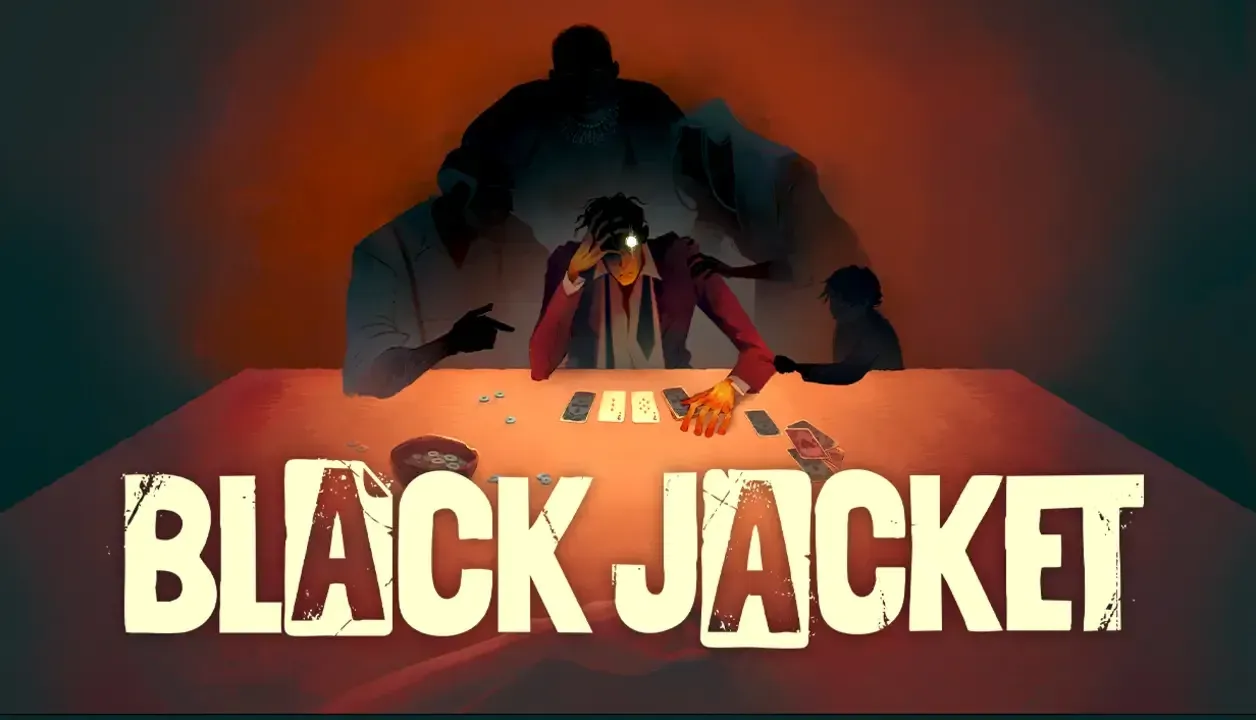
Blackjack vs normal 21: what is the difference?
This is the single most important rule in the game, and it catches beginners constantly.
Blackjack beats a normal 21. A true blackjack means an Ace plus any 10-value card. If you reach 21 through multiple cards, value changes, or stacked effects, that is still a strong hand, but it loses to a real blackjack every time.
| Your hand | Opponent hand | Result |
|---|---|---|
| Ace + 10 | 21 from multiple cards | You win |
| 21 from multiple cards | Ace + 10 | You lose |
| 20 | 19 | You win |
| 22 or higher | Any non-bust hand | You lose |
| Same total | Same total | Highest card decides |
The tie-breaker rule matters more than most players realize. If neither side has blackjack and both totals match, the game checks the highest single card in each hand. A hand sitting on 20 with a 10 as its top card beats a hand sitting on 20 with an 8 as its top card. A true blackjack overrides all of this, though. Tie-breaker logic only applies when blackjack is not involved.
How do coins, forced bets, and the winner's pot work?
Coins are not just currency. They are your survival resource, your betting pressure, and your economy all at once. You spend them through blinds, sleeve plays, slot costs, forced betting effects, and opponent pressure. Lose them all and the run ends regardless of how good your deck is.
The winner's pot collects coins lost during an encounter. It can swing a fight dramatically, but only if you are actually favored to win the round. The beginner trap is thinking a bigger pot is always good. A bigger pot just means more is at stake, and if your hand is weak or unstable, you are the one funding your opponent's win.
Every card play has two separate costs to evaluate:
- Card risk: will this card bust or improve your hand?
- Coin risk: can you afford to lose the round if this goes wrong?
Before activating any effect that raises the pot, ask whether you can survive losing that bet. If the answer is no, do not raise the stakes just because the effect looks powerful.
Soul Coins are separate from normal coins entirely. Normal coins keep your current run alive. Soul Coins are tied to boss progression and longer-term unlocks. Do not manage them the same way.
| Coin type | Primary use |
|---|---|
| Normal coins | Blinds, bets, sleeve costs, shops, survival |
| Winner's pot coins | Encounter swing reward |
| Soul Coins | Boss progression and long-term rewards |
How does the sleeve mechanic work?
The sleeve lets you hold a card back instead of playing it immediately. You can deploy it in a later round when conditions are better. This is one of the strongest tools in the game for timing control, but it is not free. Sleeving a card costs coins.
Treat the sleeve as a deliberate plan, not a way to avoid a difficult decision. Sleeving a card just because you are unsure what to play is how you bleed your economy dry.
| Situation | Sleeve it? | Reason |
|---|---|---|
| Drew an Ace but cannot safely use it now | Yes | Future blackjack potential |
| Drew a 10 while already sitting at 17 | Usually yes | Playing it busts you; saving it wins later |
| Holding a face card combo piece | Maybe | Can complete a Royal Set or Face Trio setup |
| Almost out of coins | Usually no | Sleeve cost may end the run |
| Boss curse exhausts sleeved cards | Be careful | The card may vanish before you use it |
| Just avoiding a hard decision | No | Sleeve should be a plan, not panic |
What do Hollow and Whisper actually do?
These two mechanics get confused constantly, and the confusion leads to some of the worst unforced errors in the game.
Hollow is the mechanic that lets another card be played on top of a card. When this happens, both card values stay active. That means stacking a high card onto a Hollow card adds both values to your total, which can push you toward 21 or toward busting faster than expected.
Whisper is the effect that triggers when a card is played into a Hollow slot. The source material is explicit on one point: Whisper effects are not optional. The moment you play a card into a Hollow slot, the Whisper fires whether you want it to or not.
The practical rule is simple: only play into a Hollow slot when you actually want the Whisper effect to happen.
Whisper is risky when you are already near 21, when the stacked card pushes toward bust, or when a boss curse punishes altered cards. Whisper is strong when the extra card helps your total and the triggered effect supports your current plan.
How does Drain work?
Drain reduces a target card's value to zero, then adds that value to the Drain card's highest value. The result is a two-sided swing: the target gets weaker and your Drain card gets stronger at the same time.
The detail that trips most players up: if the target card has multiple values, only the leftmost value is drained. You may expect Drain to take the value you care about, but the card text specifies leftmost only. Always check which value is leftmost before confirming the play.
Drain is best used to create a safe 20 or 21, to lower an opposing card enough to flip the round, or to prevent a bust. Avoid it when you are guessing how much value will move or when the round is already stable and the risk is not worth it.
What do Demand, Exploit, and Insight do?
These three mechanics each operate differently, but they all share one thing: they change what "playing a card" means beyond just adding a number to your total.
Demand asks for the type of card named in its text. A card might say "Demand an awakened card." The exact result depends entirely on the card, so reading the full card text before committing is non-negotiable. Demand is what makes Black Jacket feel different from normal blackjack at a mechanical level: cards can ask for specific card types or effects instead of relying on natural draws.
Exploit is a coin-pressure tool. Playing into an exploit slot forces the opponent to commit coins into the bet. It is strongest when the opponent is already low on coins and your total is already safe. The right question before using Exploit is not "Can I use this?" but "Do I want more coins at stake right now?"
Insight lets you look at upcoming cards and, depending on the effect, move cards to the top or bottom of the deck. This is one of the safest mechanics in the game for beginners because it replaces blind gambling with actual information. Insight is especially valuable when sitting on totals between 13 and 17, where one bad draw ends the round. If Insight shows only dangerous cards, passing is usually correct.
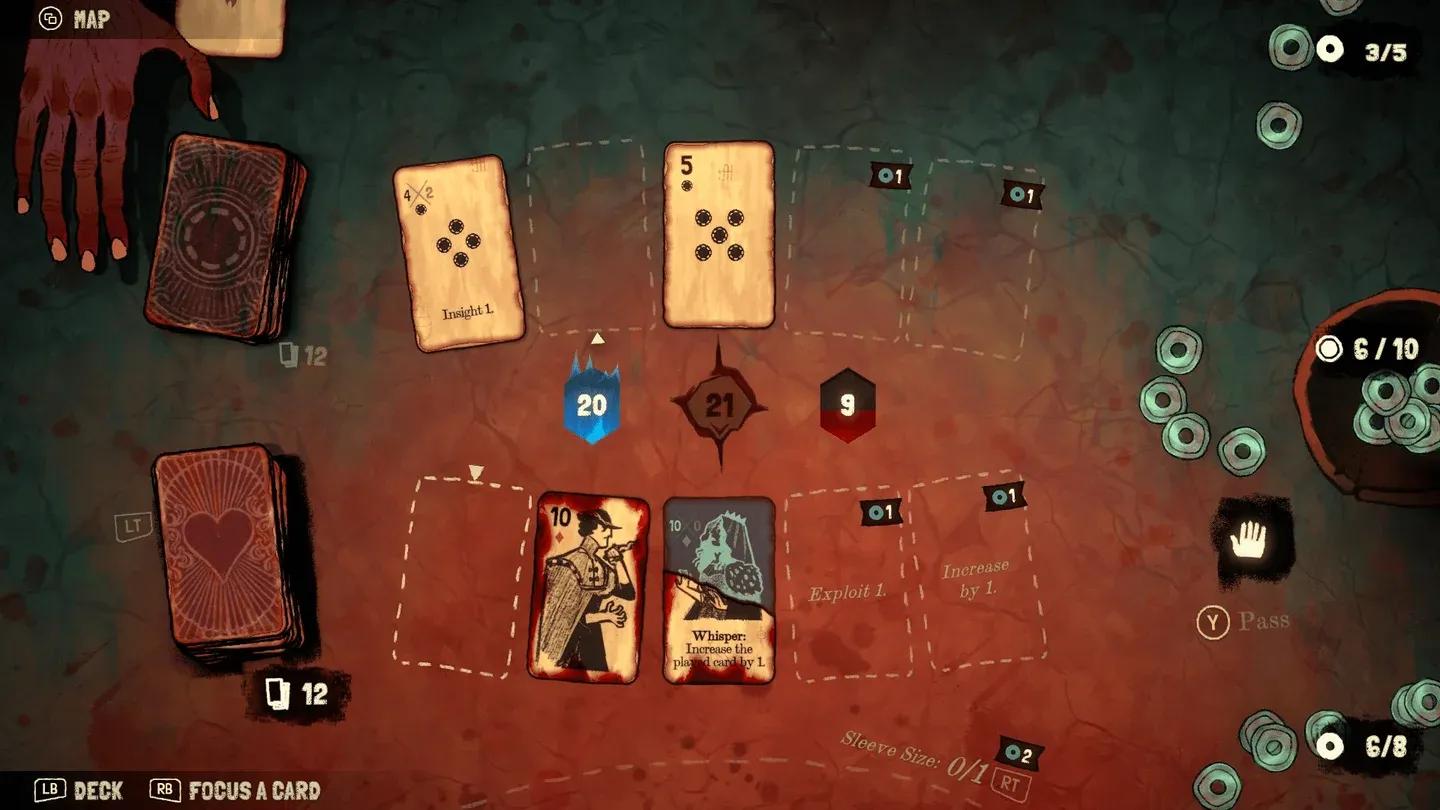
Insight upcoming card preview
What do Burn, Awaken, Break, and Put a Card do?
Burn removes a card from your deck permanently. Every weak card removed makes your strong cards appear more reliably. The goal is not the smallest deck possible, though. The goal is a deck where most draws are actually useful. Do not burn low-value cards just because the number is small. If a low card carries Insight, Exploit, Whisper, or another useful effect, it earns its spot.
Awaken upgrades a card with an additional effect. Awakened cards can look ahead in the deck, change values, demand specific card types, trigger Hollow or Whisper interactions, or force coin pressure. For beginners, the safest awakened cards are the ones that provide information or flexibility, specifically Insight effects and flexible value cards that make busting harder.
Break can flip card values into negatives. Negative values can help when you are about to bust and need to lower your total, or when the opponent gets stuck with a broken card. They hurt when you needed that value to reach 20 or 21 and the change happens after you already committed to a plan. Whenever broken or negative cards appear, slow down and recalculate before playing anything else.
Put a Card places a named card somewhere in the target deck until the end of the encounter. This is a disruption tool. Instead of only improving your own hand, you make the opponent's future draws worse. It works best when the encounter will last long enough for the disruption to matter and when you have Insight or another way to understand what the target deck looks like.
What are boss curses and why do they matter?
A curse is a special rule that changes a boss fight or encounter. Curses can exhaust sleeved cards, add negative cards to your side, change card values, increase slot costs, or punish specific card placements. They are not flavor text. They define the fight.
Before entering any boss encounter, read the curse and run through these checks:
- Does this punish sleeve?
- Does this punish high card values?
- Does this punish a large deck?
- Does this punish slow combo setups?
- Do you have enough coins to survive a bad opening round?
A habit that worked perfectly in normal rounds can become a liability the moment a curse targets it. The players who lose to bosses repeatedly are almost always ignoring the curse and playing their usual pattern.
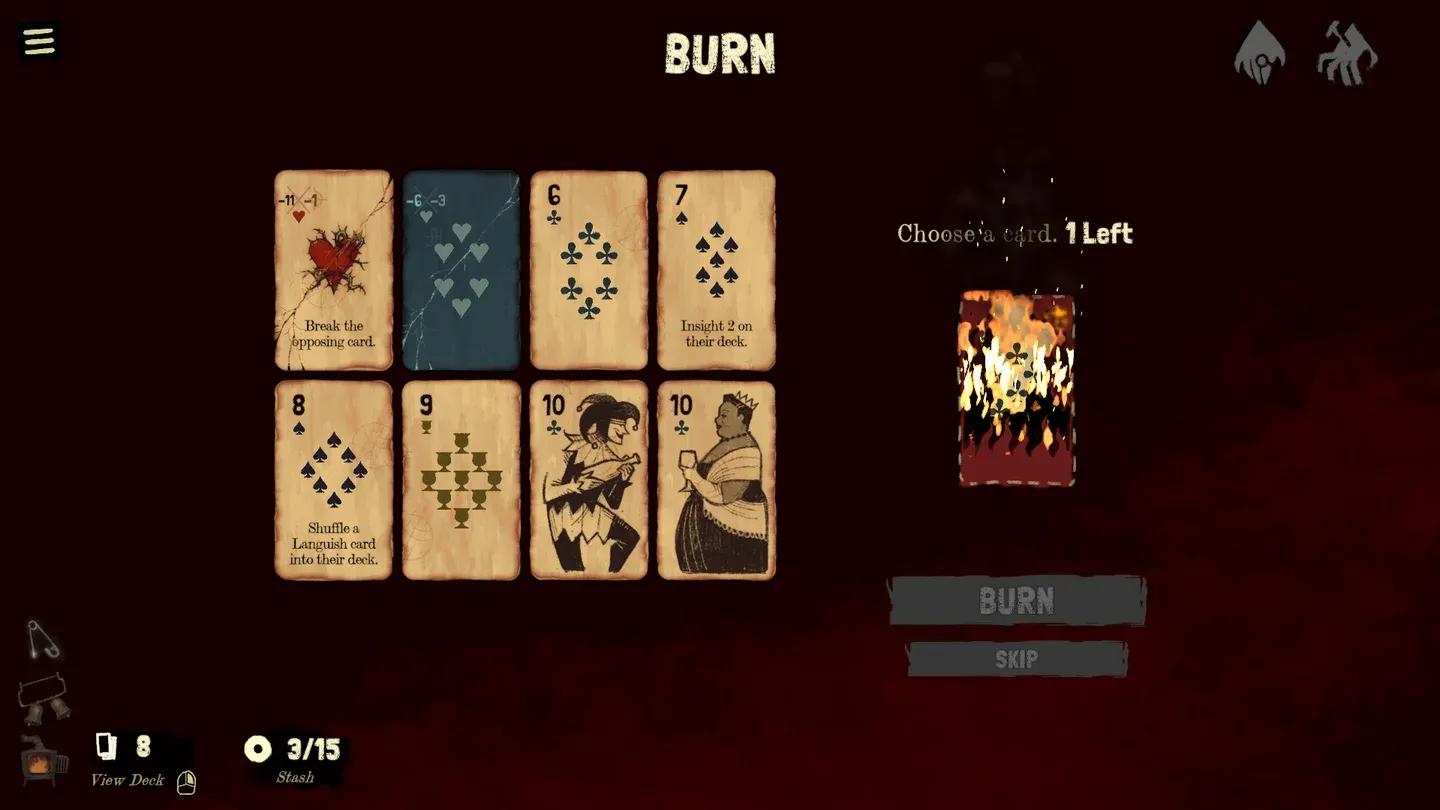
Boss curse pre-fight warning
What are Face Trios and Royal Sets?
Face cards are not just 10-value cards. The game signals early that face cards can create special interactions when placed next to each other. These interactions are discussed as Face Trios and Royal Sets, and the exact effect depends on which face cards are involved and how they are positioned.
The practical advice from the source material is straightforward: avoid burning face cards too early, test them next to other face cards, and use the sleeve to save one if you are waiting for a matching combo piece. They still function as strong high cards even without triggering a combo.
Which mechanics should beginners learn first?
Trying to master every keyword in a single run is a fast path to a confused loss. The source material lays out a clear priority order, and after testing it across multiple encounters, it holds up.
| Priority | Mechanic | Why it matters first |
|---|---|---|
| 1 | Coins, forced bets, winner's pot | Most early deaths are economy deaths |
| 2 | Blackjack vs normal 21, tie-breaker | Prevents basic rules mistakes |
| 3 | Sleeve | Saves key cards, but costs coins |
| 4 | Exploit | Teaches when to pressure the opponent |
| 5 | Insight | Makes risky draws safer |
| 6 | Demand | Introduces card-specific rule bending |
| 7 | Awaken | Starts real deckbuilding |
| 8 | Burn | Improves deck consistency |
| 9 | Whisper, Drain, Break | Stronger effects, easier to misread |
| 10 | Curses | Required for boss fights |
| 11 | Soul Coins, long-term progression | Matters after you start beating bosses |
If you are losing early, the answer is almost never "I need a more advanced combo." It is usually one of three things: too many coins spent, drawing when passing was correct, or using Sleeve and Exploit without checking whether you could afford the bet.
Common mistakes and how to fix them
| Mistake | Root cause | Fix |
|---|---|---|
| Sleeving every strong card | Wanting future options without a plan | Sleeve only when the future value justifies the coin cost |
| Using Exploit during a misunderstood curse | Assuming winning the round is always good | Read the curse before playing the first card |
| Ignoring Insight | Thinking drawing is faster | Use Insight to avoid busts and plan future turns |
| Using Demand without reading the card | Assuming all Demand effects work identically | Check the full card text before committing |
| Burning low cards blindly | Low numbers look weak | Keep low cards if their effects are useful |
| Misreading Drain | Value transfer is not obvious | Recalculate before confirming |
| Treating Soul Coins like normal coins | Both use coin language | Normal coins are survival; Soul Coins are progression |
For deeper strategy across all of these systems, the Black Jacket guides collection covers deck building, boss preparation, and advanced combo setups in full detail. Black Jacket sits firmly in the strategy games space where understanding systems beats raw luck every time, and the more mechanics you internalize, the more the game opens up.