

Winning in Blox Fruits PvP is not about who has the flashiest fruit or the longest combo video memorized. It comes down to five core pillars: picking a build that fits your brain, landing reliable combos consistently, surviving hits with can trick, choosing the right race, and moving in ways that make you genuinely hard to catch. Every player who gets deleted by a 2 million bounty stranger is missing at least one of these. This guide covers all of them, from the ground up.
What Actually Decides PvP Fights in Blox Fruits?
Most new players assume more damage equals more wins. That mindset leads to mashing abilities, eating full combos, and dying before understanding why. Real PvP in Blox Fruits is decided by three things happening at once: your ability to land an opener, your ability to survive your opponent's opener, and your positioning before either of those moments arrives.
Fruit choice matters, but it matters less than execution. A player who truly understands Ice will beat a sloppy Leopard main more often than not, because the Ice player knows exactly what their stun window looks like and punishes every whiff. Start from that principle and the rest of this guide makes sense immediately.
How to Choose the Right PvP Build
Should You Play Meta or Off-Meta?
Here is the thing about meta builds: Leopard, Dough V2, Venom, Dragon, and Blizzard are genuinely powerful, but maining them as a beginner teaches you almost nothing. Their hitboxes are so forgiving and their damage so inflated that you never develop real timing or game sense. You just get used to abilities comboing into themselves for free.
Switching to a lower-tier or less dominant fruit forces you to find real openings, read your opponent's patterns, and discover combinations through experimentation rather than copying. That process builds a skill ceiling that carries over to every fruit you pick up afterward.
The same logic applies to weapons. Maining Cursed Dual Katana (CDK), Hallow Scythe, Tushita, or Yama before you understand spacing and timing means you are winning on the weapon's stats, not your skill. Similarly, relying on Soul Guitar (SG), Godhuman, Electric Claw, or Dragon Talon too early creates habits that collapse the moment you face someone who has actually earned their wins.
What Are the Best Starter Fruits for PvP?
Two fruits consistently produce faster improvement for new PvP players: Ice and Portal.
If you are brand new, Ice gives you one clear rule to build around: land V, then combo. Everything flows from that single stun confirm. Portal rewards players who enjoy baiting and repositioning, but its combos require more deliberate practice before they feel natural.
How to Land Consistent Combos With Ice
The Flash Step Plus Ice V Pattern
Running in a straight line and pressing V is the most predictable thing you can do. Experienced players read that approach instantly and sidestep or can trick the entire thing. The fix is pairing Flash Step with your opener so the attack arrives before your opponent has time to react.
A reliable Ice combo sequence looks like this:
- Flash Step directly onto the opponent
- Immediately cast Ice V (Stomp) to land the stun
- Confirm with Ice C to extend the lockdown
- Land M1 x3 during the stun window
- Follow with Ice Z
- Finish with Ice X or swap to a weapon finisher
The reason this works is that V provides a wide, forgiving stun that gives you time to confirm C and the M1 chain without rushing. Z and X either close out the health bar or set up a weapon swap. If you are consistently missing V, the problem is almost always that you are running in rather than teleporting in and dropping it immediately upon arrival.
How to Practice Ice Without Wasting Time
Open a private server and stand at medium range from a dummy or a cooperative friend. Drill Flash Step into immediate V until the motion is muscle memory before adding anything else. Once V lands nine times out of ten, add C. Once C confirms reliably, add the M1 chain. Build the sequence one step at a time rather than attempting the full route from day one.
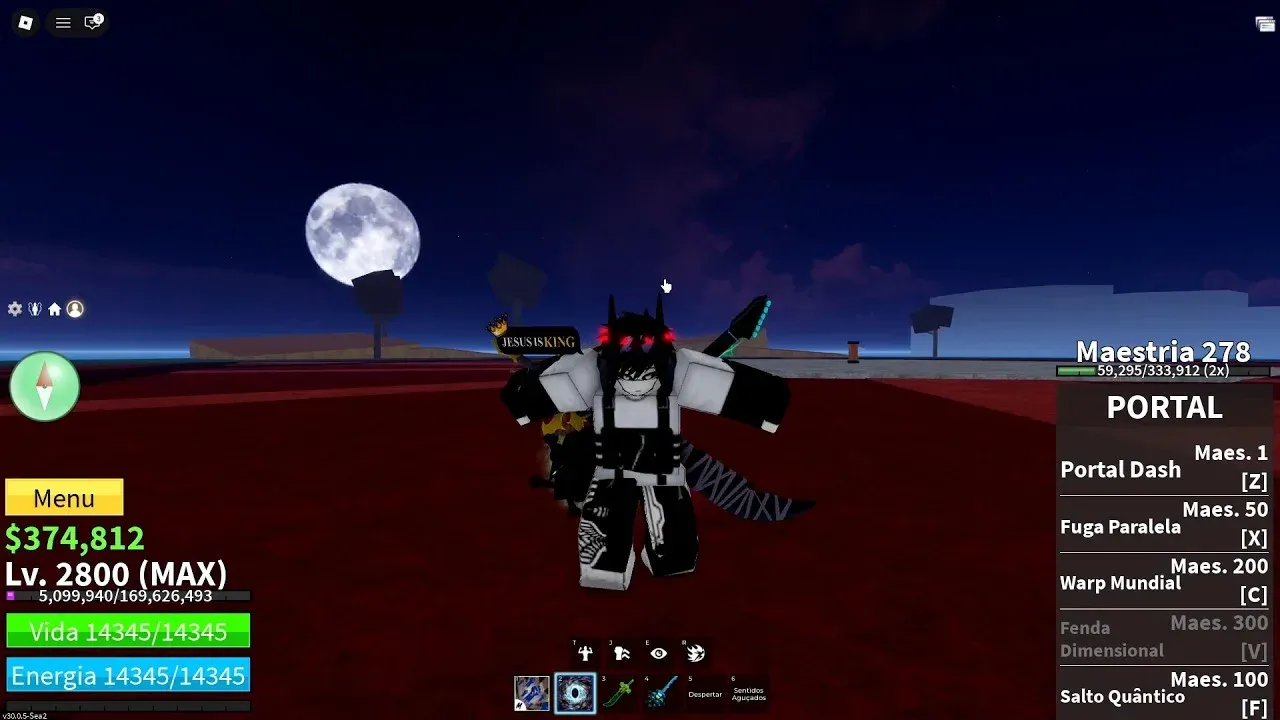
Portal X entry and stun setup
How to Use Portal for PvP Dominance
The Classic Portal Build Setup
Portal gets a reputation for being toxic, but that label comes from players who have never learned to fight it. In practice, Portal is one of the best fruits for developing spacing awareness and bait-and-punish instincts.
A beginner-friendly Portal build pairs the fruit with CDK for stun-into-damage and Soul Guitar for mobility extension and ranged pressure:
The Core Portal Combo Route
A structured Portal combo that beginners can build toward:
- Flash Step onto the target
- Portal X for the invisibility mini-stun entry
- Portal Z to maintain pressure and control
- CDK Z into CDK X for the primary damage window
- Sanguine Z into Sanguine X as finishers
If that full sequence feels overwhelming, cut it to Flash Step into Portal X into Portal Z into CDK Z and basic M1s. A shorter combo you execute cleanly under pressure is always worth more than a longer one you drop halfway through.
What Is Can Trick and How Do You Use It?
The Mechanic That Stops One-Shot Combos
Can trick is the technique of timing your Observation activation so that the heaviest part of an incoming combo deals little to no damage. Without it, high-bounty players will delete you in a single sequence before you even process what happened.
The process works like this:
- Start with Observation OFF so the enemy commits to their move
- Let the opponent fully release their big ability (CDK Z is a common example)
- Right as that move lands, activate Observation at the precise moment
- The dodge frame triggers and the damage gets negated or drastically reduced
The timing is tight and requires dedicated practice. Ask a friend to charge CDK Z repeatedly while you drill the Observation activation window. When you get it right, a move that should have taken 80% of your health bar deals almost nothing.
What Moves Cannot Be Can-Tricked?
Not every ability is can-trickable. Some moves have multi-hit patterns, unusual hitbox behavior, or ignore specific dodge frames entirely. When you find a move you consistently fail to can trick after real practice attempts, stop gambling on it. Use Flash Step, ragdoll tricks, or simple distance management to avoid that ability outright rather than eating it and hoping.
Which Race Should You Pick for PvP?
Beginner Race Recommendations
Your race functions as a long-term foundation that determines how many mistakes you can make and still survive a fight. For players who are still dying in one combo, Shark and Cyborg provide the most forgiving entry point.
The fandom wiki guide from BloxFruitTryhard makes an interesting counterpoint here: for players focused on genuine skill development rather than surviving fights, Rabbit and Human are recommended because they offer zero defensive cushion. Getting hit costs you the fight, which forces you to actually learn movement and prediction rather than tanking through mistakes. Both approaches are valid depending on your current goal.
Why Does V4 Matter So Much?
Every race has four versions (V1 through V4). Once you activate V4, you gain bonus HP, buffed stats, and race-specific effects that can turn fights around entirely. Players above roughly 2.5 million bounty who have not yet unlocked any V4 are leaving their single biggest power upgrade on the table, more impactful than any minor stat difference between weapons.
How to Use Flash Step Beyond Just Escaping
Most players treat Flash Step as a panic button. That is half its value at best. The other half is using it as a timed punishment tool.
When an opponent commits to a slow, high-commitment move like CDK Z, they cannot cancel or reposition during the animation. That is your window. Flash Step directly onto them while they are locked in and drop your opener before they recover. You get a free punish on their biggest move simply by reading the animation.
Flash Step also works best when used at unexpected angles. If every Flash Step you throw is in a straight line toward the opponent, experienced players will position to punish your arrival. Flash Step sideways or behind the target, especially when baiting predictable openers, to make your entry angles genuinely unpredictable.
What Is Baiting and Why Does It Win Fights?
Baiting means intentionally faking commitment so your opponent wastes their key move, then punishing the recovery animation. The simplest example involves Ice: walk toward an Ice user as if you are about to engage, then step back or Flash Step away just before you enter Ice V range. They panic and press V into empty space. While they are stuck in the recovery frames, you Flash Step in and take your free punish.
The general principle applies to every build:
- Identify the opponent's primary catch move (Ice V, Portal Z, CDK Z, etc.)
- Dance at the edge of that move's range without committing
- Step in and out quickly until they commit first
- Once they whiff, you take your turn
Players who always rush in are essentially skipping the bait step entirely and volunteering to eat the opponent's best move. Slowing down and forcing the whiff first is often the difference between winning and losing the entire exchange.
Advanced Movement: Ragdoll Tricks and Soul Guitar Dash Extension
Soul Guitar Dash Extension
Using Soul Guitar immediately before a dodge noticeably increases your dash distance. This gives you longer escapes, unexpected entry angles, and an extra burst of repositioning speed in tight situations. That extra distance is frequently the margin between getting caught mid-combo and landing completely outside the opponent's reach.
Ragdolling for Speed
Ragdolling uses self-knockback moves to generate absurd repositioning speed. Weapons like Yama Z and Sanguine Z knock your character around when used with your crosshair angled upward. Immediately following the ragdoll with a Soul Guitar dash flings your character forward at a speed that looks broken to players who have never seen it before. Once this is consistent, you control the engagement range of every fight because you decide when to be in and when to be completely out.
How Long Does It Take to Get Good at PvP?
Expect at minimum three months of consistent, deliberate practice before the fundamentals feel natural. That is not a discouraging number, it is a realistic one. The improvement process involves losing frequently, analyzing what went wrong rather than blaming the opponent's fruit, and making small corrections fight by fight.
Sparring with a friend at a similar skill level accelerates this faster than anything else. You both push each other's weak points in a low-stakes environment, highlight specific mistakes immediately, and improve together rather than grinding against strangers who may not be teaching you anything useful.
Fighting players with higher bounty than you is also valuable. Losing to a skilled player with a non-broken build tells you exactly what you are doing wrong. Reflect on your own decisions first, not what the opponent did, and carry those corrections into the next fight.
Key Takeaways for Climbing the Bounty Ranks
Stripping away everything else, Blox Fruits PvP improvement comes down to a short list of priorities. Pick a build that matches how you naturally think, whether that is Ice for clear timing rules or Portal for mobility and mindgames. Practice one reliable combo until it executes under pressure before touching anything more complex. Learn can trick timing on the moves that show up most in your matchups. Get a forgiving race and work toward V4 as a long-term goal. Use Flash Step as a punishment tool, not just an escape. Bait the opponent's best move before committing. And give yourself the time the process actually requires.
When even half of those pieces click together, you stop being the player everyone farms and start being the player people notice on the server.