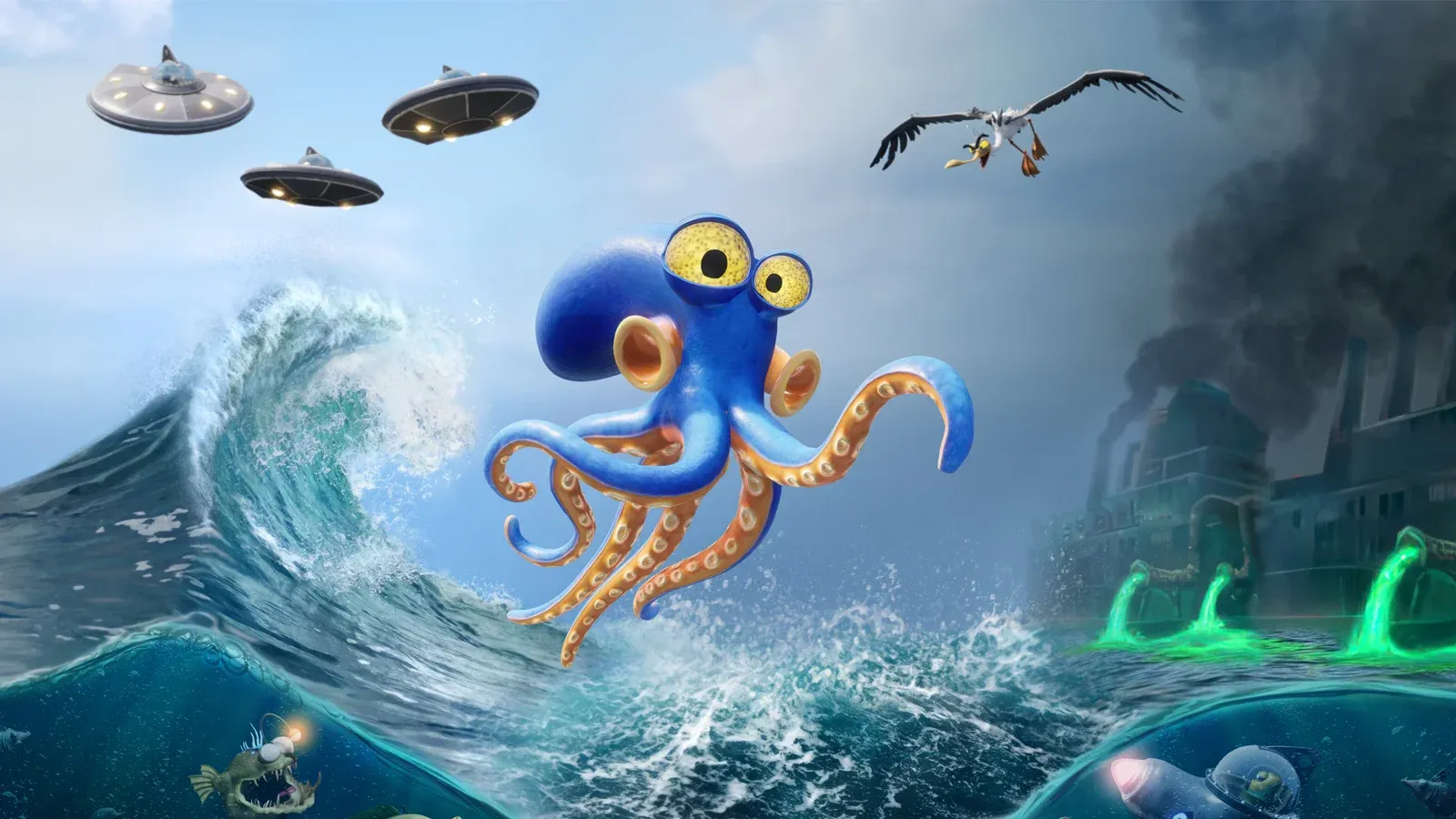


Darwin's Paradox! drops you into an industrial nightmare as Darwin, a cartoon octopus whose real-world biology doubles as a full toolkit of platforming and stealth mechanics. Paris-based developer ZDT Studio built every core system around what octopuses actually do: squeeze into tight spaces, fire ink, climb any surface, and vanish on command. The result is a 5-7 hour adventure platformer that plays nothing like anything else on PS5, PC, Xbox Series X/S, or Nintendo Switch.
What makes Darwin's abilities different from a standard platformer?
Most platformers hand you a jump and a dash and call it a day. Darwin's Paradox! does something more specific: it roots every ability in real octopus behavior, then amplifies those behaviors into cartoony, readable mechanics. The game's design philosophy centers on making Darwin's toolkit feel like natural extensions of how an actual octopus survives in the wild.
That approach matters in practice. You are not pressing a button to activate an arbitrary power — you are using the same logic an actual octopus would use to navigate threats and obstacles. That consistency means the game rarely needs to explain itself twice.
The four core abilities
Darwin's moveset centers on four behaviors drawn directly from octopus biology:
- 360-degree climbing — Darwin can scale walls and ceilings in any direction, not just vertical surfaces. This opens traversal routes most players miss on a first run.
- Ink — Used defensively rather than offensively. Spraying ink creates cover, disrupts enemy sight lines, and buys time to reposition.
- Camouflage — Darwin blends into surfaces to avoid detection. The stealth sections in the early industrial chapters rely heavily on timing this correctly.
- Suction cup grip — Arms with suction cups allow Darwin to cling to surfaces and manipulate objects in the environment.
How do the early chapters use these abilities?
The Darwin's Paradox Walkthrough for the Industrial Complex chapters documents how the first three chapters introduce platforming, stealth, and puzzle mechanics in sequence. The industrial setting is cold and mechanical, which creates deliberate contrast with Darwin's soft, expressive design.
Chapters 1 through 3 function as an extended tutorial, but the game does not announce that. Each ability gets introduced through a situation that demands it rather than through a pop-up prompt. That means players who skip environmental details tend to get stuck not because the puzzles are hard, but because they forgot an ability exists.
Ability introduction order
What is Darwin's Paradox! actually about?
The concept originated from a dream art director Mikael "Mika" Tanguy had over a decade ago: an octopus lost in an industrial world, using its natural abilities to survive. The goal is to guide Darwin back to the ocean. That premise keeps the moment-to-moment motivation clear — every level is a step closer to escape.
ZDT Studio describes the tone as a mix of Looney Tunes, Inside, and Ori. That is a useful reference point. Expect cartoon slapstick in the visual design, a darker undercurrent in the environmental storytelling, and precise, demanding platforming in the mechanical layer. The three do not cancel each other out — they coexist in a way that keeps the experience from feeling one-note.
For more context on the real-world biology behind Darwin's abilities, the Darwin's Paradox Wikipedia entry covers how the developers grounded the game's mechanics in actual octopus behavior, including arm suction cups and ink ejection.
How long does Darwin's Paradox! take to beat?
The main run clocks in at 5-7 hours. That is short by modern standards, but the game is designed for replayability. Secrets and unlockables are scattered throughout each level, and the ability-based traversal means returning to earlier areas with a fuller moveset reveals routes that were not accessible on a first pass.
Tips for getting the most out of Darwin's abilities
After working through the industrial chapters, a few patterns become clear:
- Think vertically first. The 360-degree climbing means the intended path is rarely the obvious one. Before assuming you are stuck, look up and behind you.
- Save ink for emergencies. Ink is a recovery tool. Using it proactively tends to leave you exposed at worse moments later in the same encounter.
- Camouflage has a movement threshold. Moving too fast breaks the effect. Slow, deliberate movement keeps it active longer.
- Suction cup grip solves most environmental puzzles. If an object looks interactive and nothing else is working, try grabbing it with Darwin's arms.
Is Darwin's Paradox! worth playing?
For platformer fans who want something that does not play like a reskin of existing templates, yes. The ability set is genuinely built around a single coherent idea — real octopus biology — rather than assembled from genre conventions. The March 30, 2026 critical reception praised it as a short, focused experience that does not overstay its welcome, and the mechanics hold up across the full runtime.
For more platformer recommendations and gaming guides, browse the latest guides on GAMES.GG to find similar titles worth your time.