


Dead as Disco is not a game you can button-mash your way through. Every attack, dodge, and ability is tied to the game's Rhythm-Sync engine, which rewards on-beat inputs and punishes sloppy timing with a 40% damage penalty. Getting your build right before you hit the mid-game is the difference between breezing through the hardest content and watching your run collapse in the final sector. This guide breaks down every viable loadout, stat priority, and advanced technique drawn from deep testing across all three major archetypes.

What are the best builds in Dead as Disco?
Based on the current 2026 patch cycle, three archetypes stand above everything else. The Synth-Lord sits at S-Tier, the Bass-Cannon Tank at A-Tier, and the Rhythm Rogue at B-Tier. Here is the full breakdown:
The gap between S and A is real but not insurmountable. The Synth-Lord is the fastest clear option, but the Bass-Cannon Tank is arguably the most forgiving for players still learning the Rhythm-Sync timing windows.
Understanding the four core stats
Dead as Disco runs on four primary stats: Tempo, Gain, Distortion, and Sustain. Spreading points evenly across all four is the most common mistake new players make, and it produces mediocre results at every stage of the game.
Tempo
Tempo controls attack speed and the size of your Rhythm-Sync window. The stat feels minor at low investment, but crossing the 50-point threshold changes how the game plays entirely. At that level, you can animation-cancel recovery frames, which effectively doubles your DPS output. For any endgame build, Tempo is non-negotiable. The soft cap sits at 85 points — beyond that, the returns on attack speed diminish sharply, and those extra points are better spent elsewhere.
Gain vs. Distortion
Gain adds flat damage to every hit. Distortion applies elemental debuffs that bypass the armor-plating mechanics on late-game enemies. In the current patch, Distortion outperforms Gain in boss encounters because armor plating reduces the value of flat damage significantly. If elite mobs are stopping your progress, prioritize Distortion items over raw Gain.
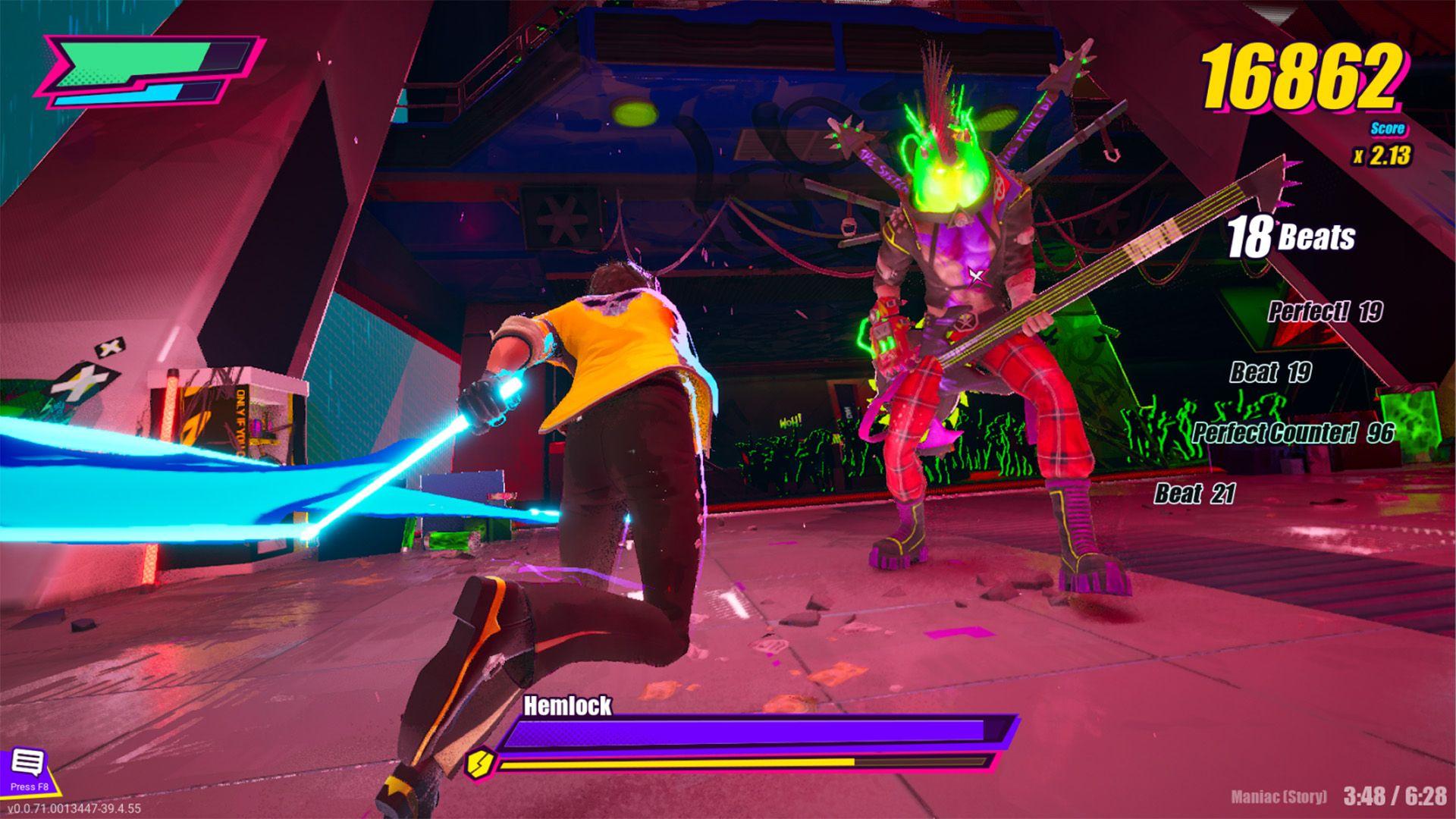
Sustain
Sustain determines your survivability during phase transitions and sustained damage windows. Solo players need enough Sustain to survive the Neon Overlord's phase-2 projectile spam without a teammate to draw aggro. In co-op, you can deprioritize it and dump those points into Gain or Distortion instead.
S-Tier: The Synth-Lord build
The Synth-Lord is built around the Resonance Blade, which carries a passive that triggers a massive AOE shockwave on every 4th on-beat hit. Pair that passive with gear that stacks Tempo, and entire rooms clear in seconds. This is the gold standard for speedrunning and high-level leaderboard play.
The build's weakness is Sustain. Going into the Neon Overlord fight without enough survivability will end runs during the phase-2 shockwave, so keep at least a baseline investment there even when pushing Tempo hard.
A-Tier: The Bass-Cannon Tank build
The Bass-Cannon Tank trades clear speed for reliability. You stack Gain and Sustain, equip the Heavy Sub-Woofer, and absorb damage while landing massive single-target hits. This is not a build that dodges everything — it is a build that does not need to.
For solo players tackling the hardest bosses, the Bass-Cannon is arguably safer than the Synth-Lord. The high Sustain stat keeps you alive through phase transitions that would delete a glass-cannon build, and the Gain investment means your damage output is still competitive in boss-farming scenarios.
B-Tier: The Rhythm Rogue build
The Rhythm Rogue uses Dual Treble Daggers and prioritizes Tempo alongside Crit Chance. It excels at mob clearing but loses ground on single-target boss damage compared to the top two archetypes. The playstyle rewards precise timing more than the other builds, making it a solid choice for players who have the Rhythm-Sync system fully internalized.
How do you optimize mid-game progression?
The mid-game is where most players stall. Starting gear is obsolete, but legendary drops are locked behind heavy RNG. The fix is the Cycle of Three strategy: identify three zones with high enemy density and low environmental hazards, then run them in a loop. Focusing your farming route this way improves your Materials Per Hour (MPH) ratio by roughly 35%
Inventory discipline matters just as much as route selection. Any item without a Legendary or Set tag should be broken down immediately for Synth-Shards. Hoarding low-tier loot wastes inventory space, which is a resource in Dead as Disco, and you will need those Synth-Shards for late-game crafting.
Advanced combat: frame data and glitch tech
For players chasing leaderboard times, Dead as Disco has a layer of frame-data tech that most players never touch.
The Dash ability has 4 invincibility frames at the start but 8 recovery frames at the end. Dashing too close to an enemy leaves you exposed. The Dash-Cancel technique fixes this: input a light attack immediately after the dash to cut recovery animation by 50%.
The Ghost Hit is a known engine interaction where triggering a knockback ability while an enemy is mid-jump registers two hits instead of one. This is the key technique for defeating the Neon Overlord in under two minutes.
The Rhythm-Parry requires blocking on-beat, which stuns the target for 3 seconds. In Phase 3 of the Neon Overlord fight, chaining Rhythm-Parries into the Synth-Lord's shockwave passive is the fastest way to end the encounter.
How to beat the Neon Overlord
The Neon Overlord has three phases, and players who treat it as a single encounter will fail at phase 2 or 3. Each phase requires a different defensive approach.
Phase 1 (Pulse) throws AOE ground shockwaves. Jump-dodge these — rolling into them is a common mistake that gets players killed.
Phase 2 (Distortion) shifts to ranged projectile spam. This is where Sustain and shielding gear earn their keep. If you are running the Synth-Lord build with low Sustain, this phase will punish you hard.
Phase 3 (Overdrive) is an enraged melee rush. Rhythm-Parry is your primary tool here. Land the stun, follow up with your highest-damage combo, and repeat.
The Ghost Hit technique is most reliable in Phase 3 when the Overlord frequently jumps during the melee rush. Practice the timing in the training room first.
Solo vs. co-op stat allocation
Your build needs to shift depending on whether you are playing alone or with a squad. The stat priorities are different enough that running the same allocation in both modes is a significant handicap.
Solo: Prioritize Sustain and Tempo. You are the only damage source and the only aggro target, so your ability to stay alive and maintain attack flow determines everything.
Co-op: Drop Sustain investment and push Gain and Distortion. Tankier teammates handle aggro, so you can focus purely on maximizing DPS output.
The hybrid trap is real in co-op specifically. Splitting points to cover both defense and offense in a group setting produces a character who is ineffective at both roles.
Frequently asked questions
Is the Bass-Cannon build viable for solo play? Yes. Despite being designed around group content's defensive buffs, the high Sustain stat makes it one of the safest options for solo players tackling the hardest bosses.
What counters the Static Shock debuff in Act 3? Equip gear with Grounding resistances. On the Synth-Lord build, the high movement speed from stacked Tempo partially mitigates the debuff's slow effect as an alternative.
Does Dead as Disco have cross-platform progression? No. As of the current patch, save files are locked to their platform.
For more on getting the most out of Dead as Disco's systems, check out the guide on how to import songs and sync BPM perfectly — custom tracks can change how the Rhythm-Sync engine feels at different BPM ranges, which matters for build timing. Dead as Disco sits within the broader fighting games genre space, but the rhythm-action layer makes its build theory closer to an action RPG than a traditional fighter.
For everything else, the full Dead as Disco strategy guides collection covers boss strats, progression tips, and more to keep your runs on track.