

Souls are everything in Deadlock. They buy your items, upgrade your abilities, and determine whether you walk into a fight as a threat or a liability. Yet most players lose the economy battle not because they play badly, but because they misunderstand where souls actually come from and when to go get them. This guide breaks down every income stream in the game, from lane Troopers to neutral camps to breakables, and shows you exactly how to prioritize them so you never fall behind again.
What Are the Main Soul Income Sources in Deadlock?
Before touching a single strategy, you need to understand the economic hierarchy. Not all souls are created equal, and treating every source as equally valuable is the first mistake new players make.
Here is how the income streams rank from most to least reliable:
The single most important takeaway from this table: lane Troopers are your paycheck. Everything else is a bonus.
How Do Creep Spawn Timings Work?
Knowing the spawn schedule lets you plan routes instead of wandering. Here are the exact timings you need to memorize:
Lane Troopers spawn every 25 seconds, with four creeps per wave.
Neutral Camps follow a tiered schedule:
- Tier 1 (Small Camps): Spawn at 2 minutes, approximately 40 souls per creep, respawn every 4 minutes.
- Tier 2 (Medium Camps): Spawn at 7 minutes, approximately 90 souls per creep, respawn every 6 minutes.
- Tier 3 (Hard Camps): Spawn at 7 minutes, up to 240 souls per creep, respawn every 8 minutes. These are best handled with a teammate.
Soul Slot Machines appear at 10 minutes and respawn every 5 minutes. Melee them to receive souls at the cost of some health.
Spirit Urn begins descending at 10 minutes and lands after 30 seconds. Carrying it prevents you from attacking or using abilities, so timing your pickup around wave control is critical.
The #1 Rule: Why Missing a Wave Is So Expensive
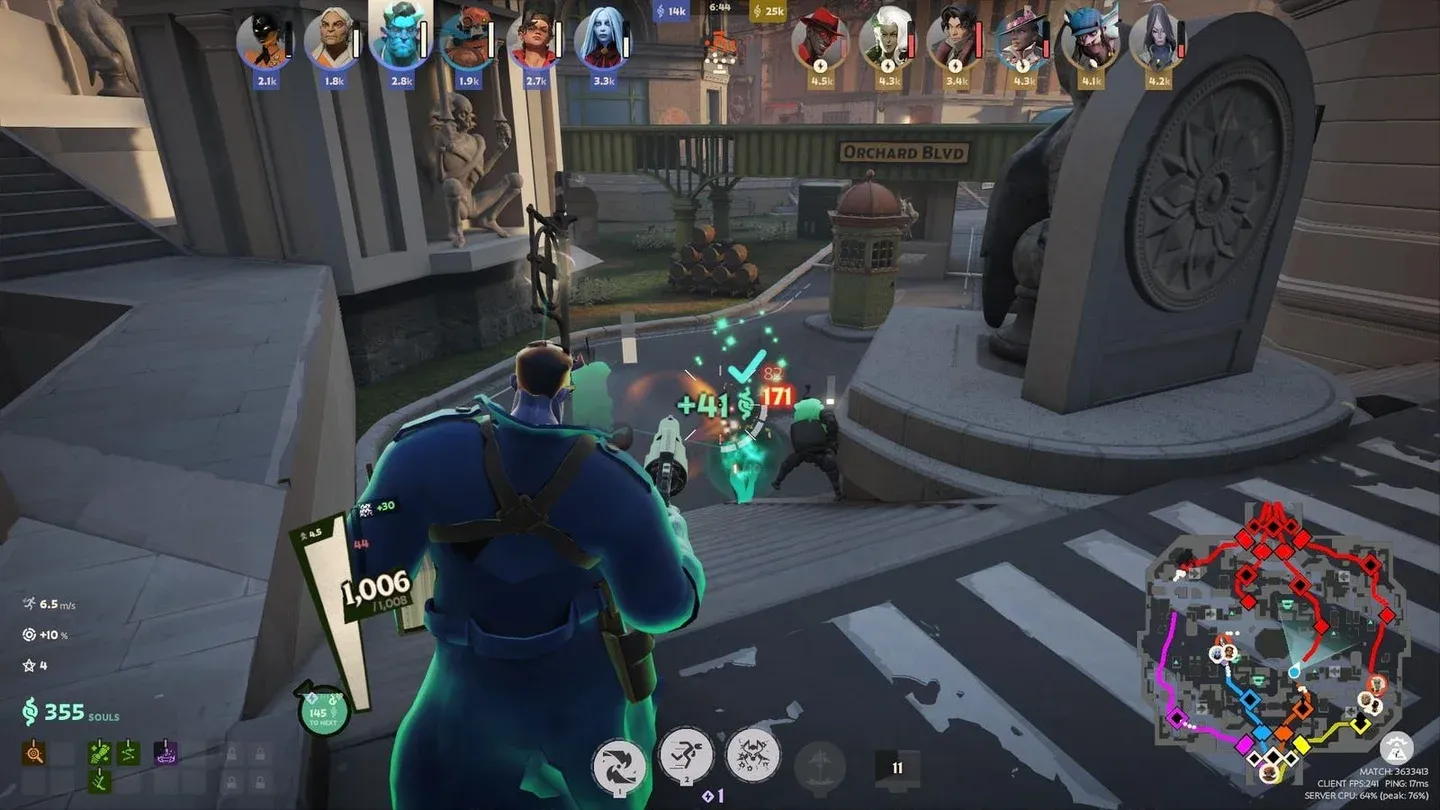
Here is the thing most players never internalize: a full Trooper wave is almost always worth more than any side activity. When you leave lane at the wrong moment, you lose two things simultaneously: the souls from the wave itself and the lane control that protects your structure.
What wave discipline actually looks like in practice:
- Be in position when the wave arrives.
- Clear it efficiently from cover.
- Collect drops safely, stepping in briefly and resetting behind cover.
- Use the short downtime for one quick extra action (a nearby camp, a breakable on your route, a shop visit).
- Return to lane before the next wave.
That loop, lane → quick extra → lane, is the foundation of every strong farming game. Players who fall behind are almost always doing the opposite: roaming first, then arriving late to a wave that already died or crashed into their structure.
Push before rotating lanes
How to Last-Hit and Deny Creeps Effectively
The soul collection mechanic has a few layers worth understanding:
Securing souls:
- Finishing a creep with a melee attack instantly grants souls without spawning an orb. Nobody can steal what was never created.
- Finishing with ranged attacks or abilities spawns a green soul orb. You must destroy it to collect the souls.
- Failing to destroy your own green orb lets the enemy claim it.
Denying enemy souls:
- Enemy creep deaths create green orbs as well. Destroying these denies your opponent their income.
- Allied creep deaths create orange soul orbs. Destroying these prevents the enemy from claiming them.
- In simultaneous contests, the player who initiates the attack on a soul orb first secures it.
The deny priority system:
- Priority A: Secure your own wave income first. A deny that costs you your own drops or heavy damage is never worth it.
- Priority B: Deny when you are already safely in position. Free value is great. Sprinting into danger for a deny is not.
- Priority C: Deny during high-value moments: when the enemy is low and one deny forces a recall, or when the wave is near your own structure so the risk is minimal.
When Should You Jungle in Deadlock?
Jungle camps are filler income, not the foundation of your economy. That distinction matters enormously.
Jungle is the right call when:
- Your lane is pushed far enough that stepping up to farm is dangerous.
- The wave is handled and you have time before the next one arrives.
- You are rotating between lanes and need income while traveling.
- Your team is grouping for an objective and a nearby camp fits the timing.
Jungle is the wrong call when:
- Taking the camp means missing a full wave.
- The camp is slow to clear and drains your health, forcing a reset.
- You are jungling on the wrong side of the map and cannot join an incoming objective.
- Your structure is being pressured and nobody is clearing the lane.
The priority order that experienced players follow: Wave → Sinner's Sacrifice → Mid room objectives → Enemy camps → Your own camps → Breakables.
Steal enemy jungle whenever you safely can. Your own camps are a last resort, not a default activity.
Are Breakables Worth Hunting?
Breakables feel rewarding because smashing a crate and watching a number go up is satisfying. The reality is more nuanced.
Breakables are worth it when:
- They sit directly on your rotation route between lane and shop.
- Collecting them adds 5 to 10 seconds to your path at most.
- The map is quiet and no wave is about to arrive.
Breakables are not worth it when:
- You detour significantly off your lane path.
- A Trooper wave is about to arrive and you are not in position.
- You are holding a large stack of Unsecured Souls and enemies are missing from the map.
For Calico players specifically: her cat form is excellent for box hunting, but it is easy to waste the form clearing breakables while neglecting lane waves. Her slash and coldfront abilities handle Tier 1 camps well, and Tier 2 camps become more accessible as the game progresses. The cat form shines most when you clear boxes on the way back to lane, not as a dedicated roaming mission.
What Are Unsecured Souls and Why Do They Matter?
Certain income sources, particularly jungle camps and breakables, generate Unsecured Souls. These souls can be dropped on death and take time to fully convert into safe currency. This changes how you should play when you have a large stack.
When holding significant Unsecured Souls:
- Avoid coin-flip fights where the outcome is uncertain.
- Do not face-check fog or be the first into an objective area.
- Play one level more defensively than you otherwise would.
- Farm near lanes and teammates rather than deep in isolated jungle.
The safest way to handle Unsecured Souls is to tie your jungle and breakable farming to safe wave cycles. Clear the wave, grab the nearby camp, return to lane. Your Unsecured stack converts safely while you keep earning reliable lane income.
How to Farm Souls When You Are Behind
Falling behind in souls does not mean you should start taking desperate fights. That approach almost always makes the gap worse.
The catch-up sequence that actually works:
- Stabilize lanes first. Clear waves safely near your own structures. Do not chase into enemy territory.
- Collect the safest waves available. Behind teams win by guaranteeing income while the ahead team wastes time hunting kills.
- Trade objectives instead of fighting for pride. If the enemy groups on one side of the map, take something safe on the other: clear two waves, damage a structure, secure a nearby camp.
- Only take fights with a clear payoff. Fight when you have numbers, an objective to take afterward, or a pick opportunity with a guaranteed escape.
The mindset shift: stop trying to out-aim the enemy economy. Protect your income stream and punish their over-commitments.
Role-Based Farming Priorities
Fast farming also means not competing with teammates for the same income. Here is how farming priorities shift by role:
Gun carry / primary DPS: Your job is the highest consistent souls per minute on the team. Take safe lane waves, avoid sharing lane income with multiple allies (splitting reduces per-person payout), and join objective fights that matter.
Spirit carry: Farm to hit ability breakpoints, then pressure objectives. Waves still pay better than deep jungling. Rotate when your wave is pushed and your cooldowns are ready.
Initiator / frontliner: You do not need to top the souls chart, but you cannot afford to be broke. Farm waves when nothing is happening. Your best farming often comes from: win a fight, take an objective, then collect safe lane waves during enemy respawn timers.
Assassin / roamer: The biggest mistake is permanent roaming poverty. You need a loop: clear wave, look for a pick, return to wave. Picks are great but missed waves will make your burst irrelevant later.
Support: Take unclaimed farm (waves nobody can reach, safe camps while rotating). Help your carry farm safely. Steady income beats random spikes.
Teamwide rule: if three or more allies are standing in one lane for an extended period, everyone is getting poorer. Spread out, cover waves, and regroup only for genuine objectives.
Practical Farming Checklist
Use this mental checklist during every game:
- Always path so you end up catching a lane wave.
- Push or stabilize the wave before rotating.
- Steal enemy jungle before farming your own.
- Take breakables only when they are on your direct route.
- When holding large Unsecured Soul stacks, play more defensively.
- Win a fight, then convert it into a structure or objective.
- Late game: farm toward your team, not away from it.
- When genuinely unsure what to do, clear the nearest safe wave. It is almost never the wrong answer.