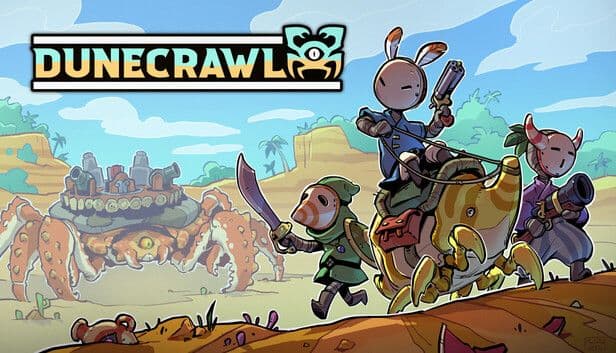


DuneCrawl drops you and up to three friends onto the back of a colossal walking crustacean and points you at a desert ocean full of enemies, ruins, and rival crawlers. Developed and published by Alientrap, the game launched on January 5, 2026 on PC via Steam, and it hit a concurrent player peak of 1,037 on its very first day. The core loop is deceptively simple: steer your Dune Crawler across the dunes, fight Vassals and bug swarms, drop into hand-placed dungeons for loot, and upgrade your mobile fortress to survive the next encounter.
What exactly is DuneCrawl?
At its heart, DuneCrawl is a co-op action-adventure for one to four players, playable both online and in local co-op on the same couch. You take on the role of a Crab Keeper, a desert-faring privateer who lives and fights aboard a giant crustacean fitted with black-powder cannons. The Dune Crawler is not just your vehicle. It is your base, your battle platform, and your home between excursions into the world.
The game blends three distinct activity types: open-world traversal across the dust seas, ship-to-ship skirmishes between rival crab walkers, and instanced dungeon runs that lean on traps and close-quarters brawls. Each feeds into the others. Loot from dungeons funds upgrades, upgrades improve your crawler's combat performance, and better combat performance opens up riskier trade routes and tougher encounters.
How does co-op work in DuneCrawl?
The game supports one to four players in both online and local co-op formats. Every player operates as a crew member aboard the same Dune Crawler, which means coordination matters from the moment you set sail. One player might be managing cannon fire during a broadside while another is handling a boarding action on deck.
Because the crawler itself is the shared base, upgrades apply to the whole crew. This creates natural role division: some players focus on combat during skirmishes while others handle navigation or manage the dungeon runs. The progression is persistent across sessions, so a squad that commits to regular play will notice their crawler becoming meaningfully more capable over time.
Understanding the Dune Crawler: your most important asset
The Dune Crawler is the game's central mechanic and the thing that makes DuneCrawl feel distinct from conventional open-world games. Rather than a ship sailing water or a caravan crossing land, you are piloting a living fortress with legs. That changes how you think about positioning, retreating, and engaging enemies.
During skirmishes with other crab walkers, cannon broadsides, boarding actions, and quick repositioning are the three tools that determine who controls a trade route. Staying broadside to an enemy crawler maximizes your cannon coverage. Boarding actions shift the fight to close-quarters brawl territory, which favors crews that have invested in melee upgrades. Repositioning quickly can break an enemy's firing angle and buy time to reload.
Between fights, the crawler carries you to oasis islands scattered across the map and to the entrances of hand-placed dungeons. These dungeons house the story beats and the best treasure the game offers.
What enemies will you face?
DuneCrawl throws two primary threat types at you on the surface: jar-headed Vassals and bug swarms. Vassals are organized humanoid enemies rather than random spawns, and they show up with enough tactical awareness to make surface encounters dangerous. Bug swarms function as environmental hazards that can pressure your crew during traversal.
Dungeons introduce a third category: trap-heavy instanced areas designed for close-quarters brawls. The combination means DuneCrawl asks you to switch between ranged cannon combat, swarming survival scenarios, and tight corridor fights across a single session.
The Sandstorm Update: what changed?
About three months after launch, Alientrap released the Sandstorm Update, which added a new battle royale mode called Sandstorm. This mode supports up to 16 players with bots and takes advantage of the game's large open-world combat systems.
In Sandstorm mode, players ride steeds and pilot beetles alongside the larger crawlers. The goal is to collect loot and make it back safely before the titular sandstorm closes in. The mode reuses the existing open-world combat framework but scales it up to a competitive 16-player format, which is a significant expansion from the base game's four-player co-op ceiling.
How long does DuneCrawl take to beat?
The main story runs approximately 7 hours. Side content and full completion data are not yet available, which is common for games this close to launch. For a co-op session with a full crew of four, expect individual runs to feel shorter since combat encounters scale with player count and coordination tends to accelerate progress.
The 7-hour main story figure positions DuneCrawl as a strong weekend game. A squad can realistically complete the core content across two or three sessions without the commitment that longer open-world games demand.
Getting started: practical tips for new crews
Alientrap pushed launch fixes within the first week of release, which signals an active development team that responds to player feedback quickly. That is worth knowing because it means the game is likely to improve and expand from its already positive foundation.
Here are the core priorities for any new crew:
- Upgrade your crawler early. Upgrades apply to the whole crew, so every coin spent on the crawler benefits everyone aboard.
- Learn the broadside angle. Keeping your cannons facing the enemy during skirmishes is the single most important positioning habit to build.
- Do not skip oasis islands. They provide resources and story context that feed into dungeon readiness.
- Coordinate roles during dungeons. Traps punish players who rush ahead without communicating. Assign a lead and follow their pace.
- Try Sandstorm mode after the campaign. The battle royale format rewards the same positioning instincts you build in co-op, but the 16-player scale changes the stakes entirely.
For more guides on co-op adventures and new releases, browse more guides at GAMES.GG to find coverage across every genre.