Search games, articles, guides...CtrlK
Sign InGet Started

Master Dynasty Mode in CFB 27 with tips on Athletic Director goals, NIL strategy, facilities, recruiting, and the new Stadium Builder.

Written by Larc
Content Writer
See more GAMES.GG guides on Google
Add us as a preferred source and our guides show up first in your results.
College Football 27 Dynasty Point Hoarding Guide
Master skill point hoarding in CFB 27 Dynasty to cut NIL costs, stop unwanted transfers, and control exactly when players hit their peak.

CFB 27 Best Offensive Playbooks and Settings Guide
Master the post-update meta in CFB 27 with the best offensive playbooks and settings for Oregon State and Colorado.

College Football 27 Best Playbooks and Defensive Settings Guide
Best offensive and defensive playbooks in CFB 27, plus settings adjustments after the running game and blocking updates.
EA Sports College Football 27 arrives with the most ambitious version of Dynasty Mode the series has seen. Year 3 of EA's original vision brings Athletic Director Expectations, a fully revamped Dynasty Blueprint system, NIL resource management, a new coaching carousel, and Stadium Builder — all working together to make every program feel genuinely different from the last. This guide breaks down every major system so you know exactly where to spend your resources and how to keep your job while doing it.
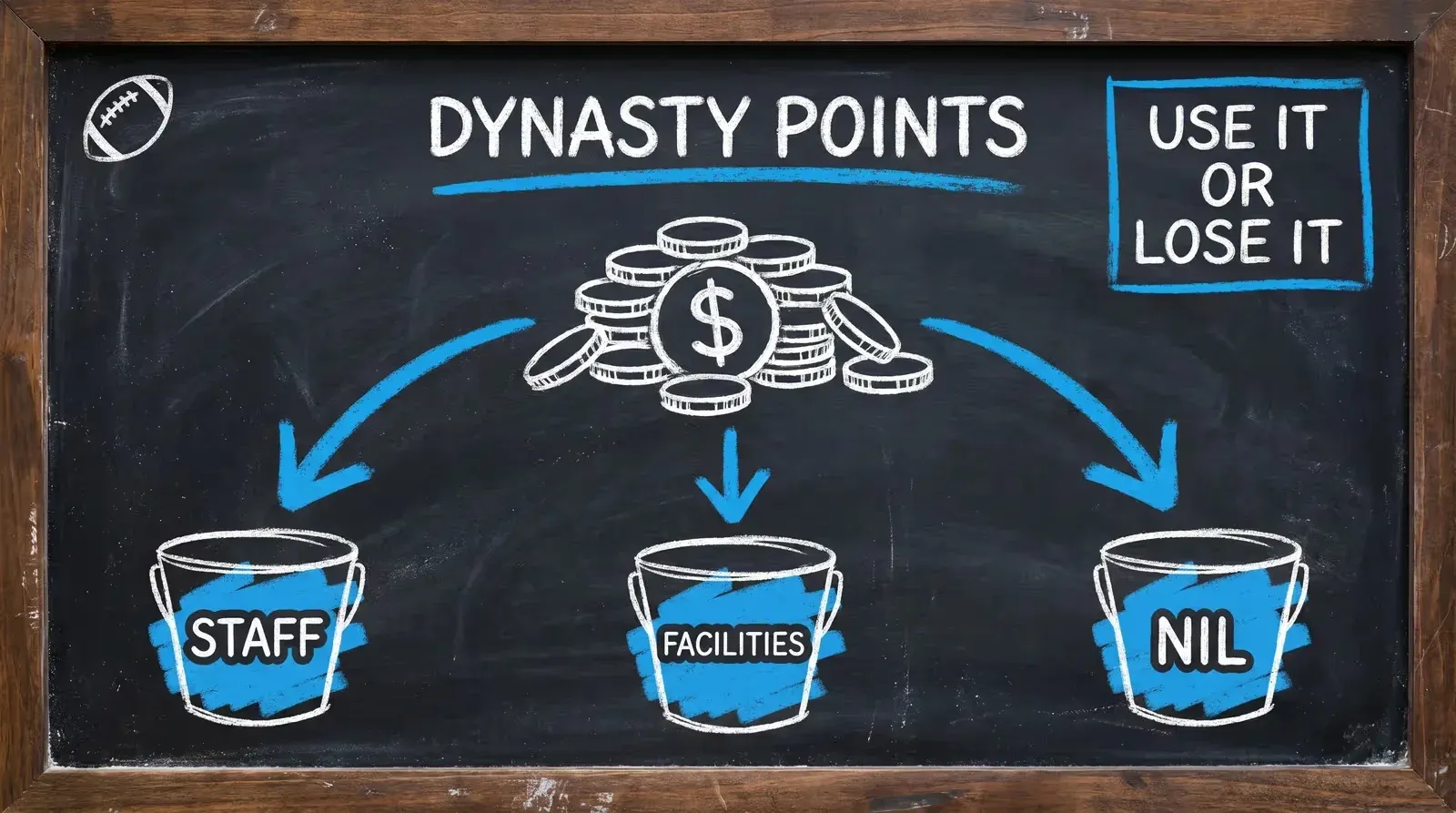
Dynasty Blueprint is your annual budget system. Each year, your program earns Dynasty Points, which function as a use-it-or-lose-it resource pool that resets during End of Season Recap. Points do not roll over, so spending strategically across the full calendar matters more than hoarding.
Your baseline Dynasty Points come from four My School grades: Conference Prestige, Brand Exposure, Stadium Atmosphere, and Program Tradition. Schools with stronger brands and richer histories naturally start with more to work with. You can grow that baseline by winning — conference championships, College Football Playoff appearances, bowl wins, and National Championships all trigger season payouts that add to your refresh total.
Completed Athletic Director Expectation goals also pay out Dynasty Points, essentially rewarding you for hitting the objectives your school already demands. If you build around the Rainmaker archetype, the Contract Incentives ability increases what you receive from those completed goals.
Dynasty Blueprint budget overview
The three areas where you spend Blueprint points are:
Every school in CFB 27 has a unique set of AD Expectations built around two factors: school demeanor and program priorities.
School demeanor runs from patient to reactionary. Patient programs give you room to develop a roster over multiple seasons. Reactionary programs expect results immediately, and failing a priority goal can drop your job security fast. At a program like that, a 9-win season can feel like a disappointment if it misses the wrong benchmark.
Program priorities define what the school actually cares about. Some programs want conference titles. Others demand control of in-state recruiting pipelines or specific statistical identities — a points-per-game floor, defensive dominance, or a Top 25 recruiting class. These priorities shape the three active goals you are responsible for at all times.
Goals fall into two categories. Firm expectations carry real downside if missed. Stretch objectives offer bigger upside for achieving them but less penalty for falling short. Understanding which is which matters enormously at impatient schools.
Expectations also evolve. Build Oregon from a bowl hopeful into a perennial playoff contender and the standard rises with you. What earned praise in year two becomes the baseline in year six.
Facilities are the long-term investment that shapes your roster's developmental ceiling. Your Athletic Facilities grade is built from two components: your facility tier and your equipment.
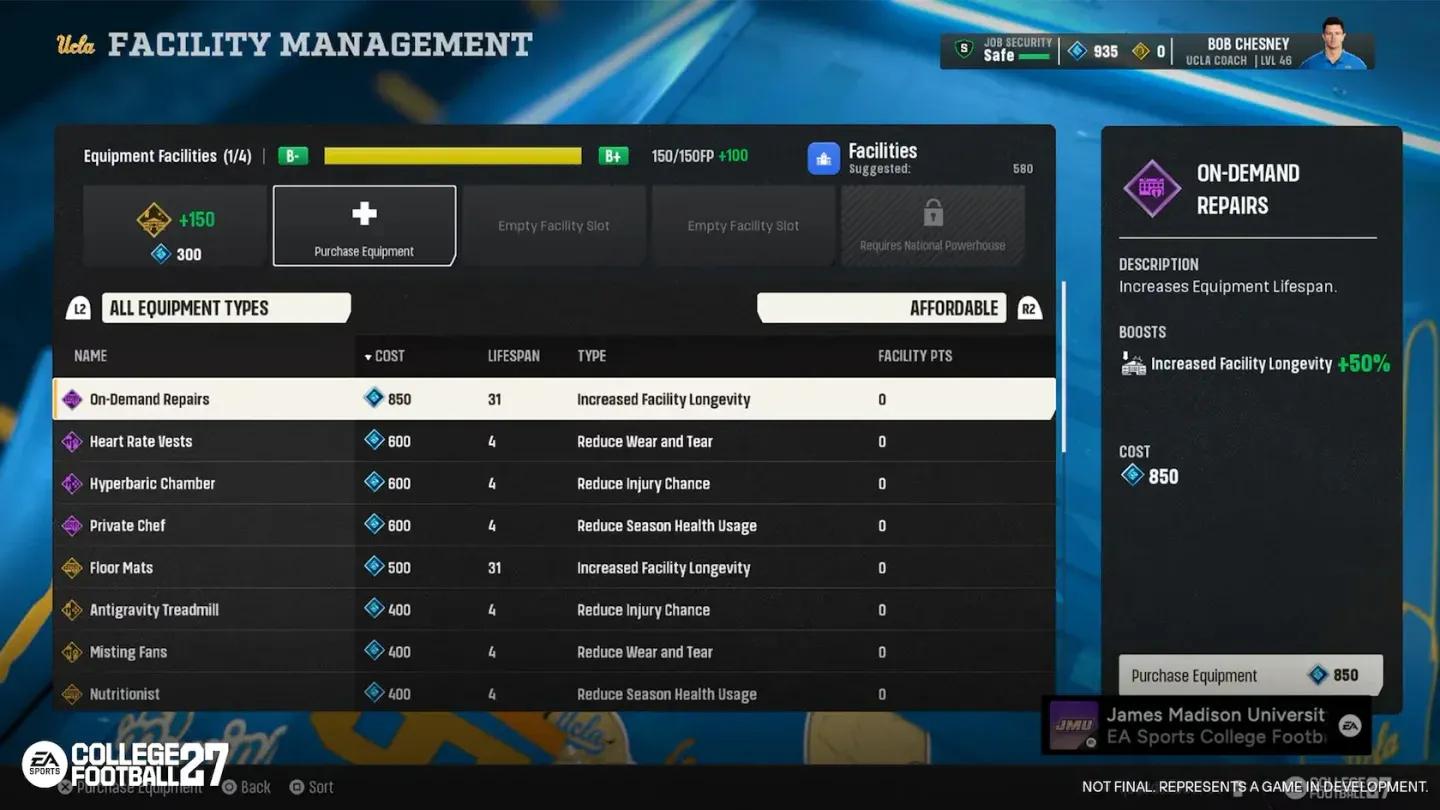
Facility tier upgrade options
There are five facility tiers, each setting a grade range your program can reach:
| Facility Tier | Grade Range | Equipment Slots |
|---|---|---|
| Basic | F | 1 |
| Competitive | D- to D+ | 2 |
| Premier | C- to C+ | 3 |
| Elite | B- to B+ | 4 |
| National Powerhouse | A- to A+ | 5 |
Upgrades happen once per year during End of Season Recap. Your new facility goes under construction during the offseason and becomes active in the following preseason. Higher tiers carry higher annual maintenance costs — miss that payment and your facility drops one tier automatically.
Downgrading can be a deliberate choice. Dropping from National Powerhouse to Elite frees up Dynasty Points for NIL or staff without gutting your developmental setup entirely. If you later want to climb back, the re-upgrade cost is reduced because your program already operated at that level.
Equipment is the flexible layer inside your facility tier. It can raise your Athletic Facilities grade within your current band (moving from B- to B+, for example), reduce practice Wear and Tear, lower season health usage, and cut practice injury risk. Short-term equipment boosts are especially useful during brutal stretches of the schedule when your roster is already beat up.
NIL is split into two separate pools: Recruiting NIL and Roster NIL. They pull from the same Dynasty Points budget, so every dollar you promise to a recruit is a dollar that cannot go toward keeping your current roster together.
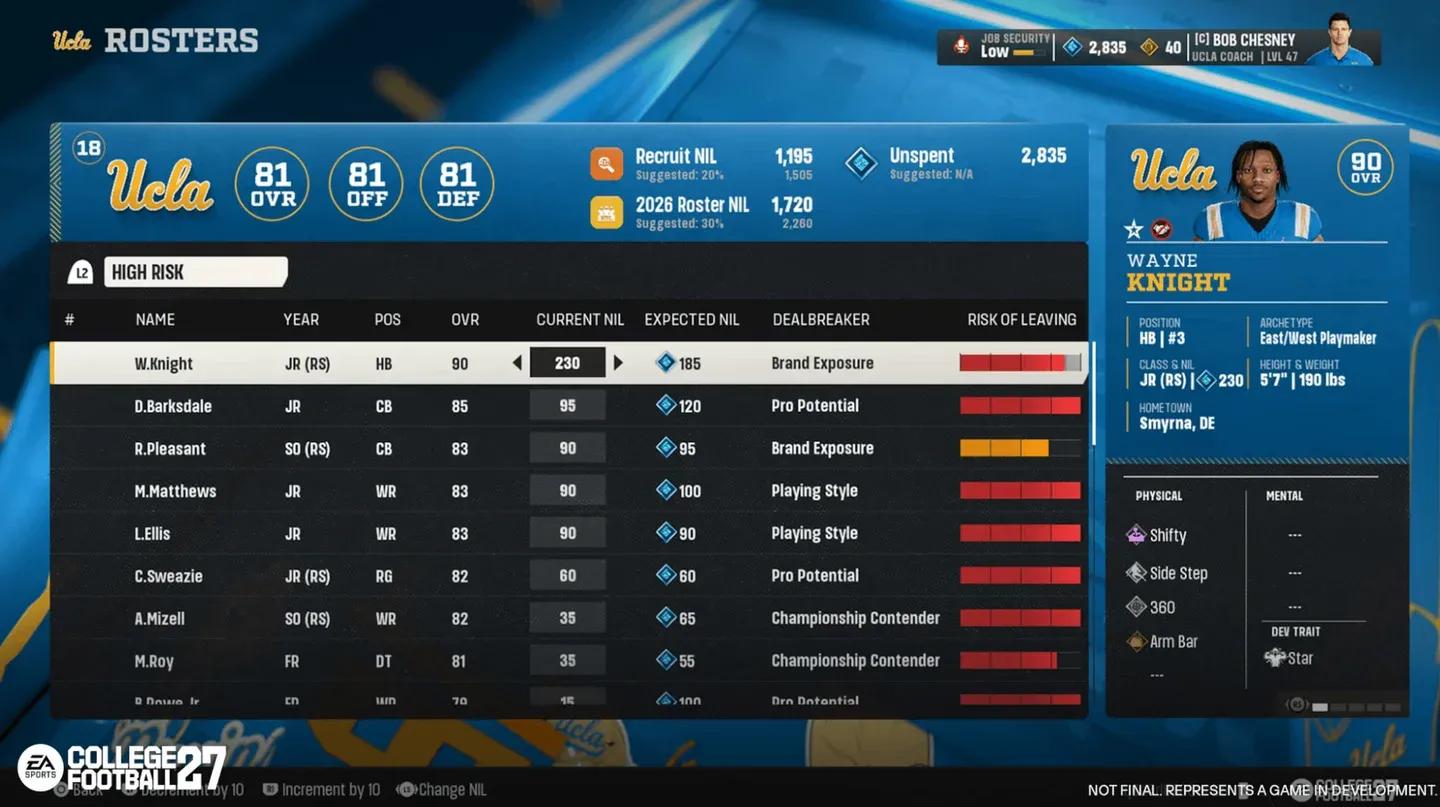
Roster NIL risk management view
Starting with CFB 27, scholarship offers can no longer be made during the preseason. The preseason is now a scouting-only window. Offers begin in Week 0, and every offer you make includes an NIL component that immediately deducts from your available Dynasty Points.
Each prospect has an expected NIL amount relative to your school. Offer above that amount and you gain a weekly influence bonus — but you also permanently raise that player's floor. If you offer 150 points to a prospect who expected 100, their expectation from your program becomes 150 going forward. Lower your offer later and you take a negative influence hit.
You can offer up to two times a prospect's expected NIL for the maximum influence bonus. Transfers operate similarly but move faster — their motivations are already clear, so the window is condensed and NIL carries even more weight in those battles.
Every player on your roster has a current NIL amount and an expected NIL amount. The Roster NIL screen during End of Season Recap defaults players to their expected amount, and you can raise or lower individual commitments from there.
The screen includes a risk of leaving column showing which players are most likely to enter the transfer portal or declare for the NFL Draft. Increasing a player's NIL reduces that risk. The Stay Power ability from the Rainmaker archetype amplifies how much your NIL offer moves the needle on retention.
The hardest decisions in Dynasty Blueprint happen here. A breakout wide receiver, a veteran offensive tackle, a star pass rusher, and your starting quarterback may all expect more at the same time. You cannot satisfy everyone. Deciding who gets protected shapes the next two or three seasons of your roster.
The carousel has been completely rebuilt. Schools now evaluate coaches primarily on Coach Prestige rather than coach level alone. National Championships, conference titles, awards, and recent results carry the most weight. A younger coach who just won big can generate real interest. A coach with a high level but poor recent results may find fewer schools calling.
When you enter the carousel, jobs are split into two sections: Schools Interested in You and All Openings. You can express interest in up to six jobs. Expressing interest is a real commitment — if the school selects you when the week advances, you automatically accept. There is no second decision point.
Every time you express interest, you take a small hit to Coach Stability, which can ripple onto the recruiting trail. Chasing the wrong job at the wrong time has consequences beyond just missing out.
Every job now shows its annual Coach Point award (ranging from 0 to 25 per season), available Dynasty Points, AD Expectations, Blueprint allocation, and My School grades before you commit. Your current school can also extend you with an enhanced payout of up to 30% above what other programs can offer — sometimes staying put and continuing to build is the better move.
CFB 27 adds two new exclusive archetypes on top of the existing coaching trees.
Visionary (available to players who pre-order Madden NFL 27 or the MVP Bundle) focuses on player development and weekly preparation:
Rainmaker (available to MVP+ Members) is built around Dynasty Blueprint resource management:
Ability costs now scale by tier. Within elite archetypes like Elite Recruiter, Scheme Guru, and Master Motivator, Tier 1 abilities cost 25 Coach Points while Tier 4 abilities cost 40. Kicker and punter abilities cost half as much as other abilities, giving you more flexibility to invest in special teams without a major commitment.
All pre-orders receive 100 bonus Coach Points at the start of every Dynasty. MVP+ Members receive 150.
Stadium Builder is part of Team Builder and is accessible to Dynasty players who use it. When setting up your Team Builder team's stadium, you choose between Existing or Custom.
Existing gives you access to real stadiums from in-game teams, generic stadiums from previous titles, and newly added high school stadiums for smaller program builds.
Custom lets you build from one of four base stadiums, ranging from high school style to mid-sized college venues. The base you choose determines which structural elements you can edit, including:
All changes update live in the 3D viewer on the right side of the screen. You can also set historical team records for your created school — career rushing yards leaders, single-season passing touchdown records, and more — so your program arrives with a history already in place.
Your Team Builder school's selected city now drives Proximity to Home calculations using latitude and longitude, and weather and Dynamic Time of Day reflect that actual region. A program placed in the Pacific Northwest will see different conditions than one built in Florida.
At the end of each season, an action item lets you reimport the latest version of your Team Builder team from the website. That means you can update uniforms, adjust your stadium, and tweak your crowd stripe-out logic as your program grows — just make sure the website version is finalized before importing.
Beyond the headline systems, a number of smaller updates add up across a full Dynasty run.
Weekly Practice Plans give you direct control over each player's weekly workload. Four options are available per player: Full Practice, Limited Practice, No Practice, and Week Off. Full Practice provides the most XP and the best chance of starting hot but carries the highest injury risk and zero Wear and Tear recovery. Week Off provides maximum recovery but removes the player from that week's game entirely. You can apply plans by position group using Square/X on the practice screen.
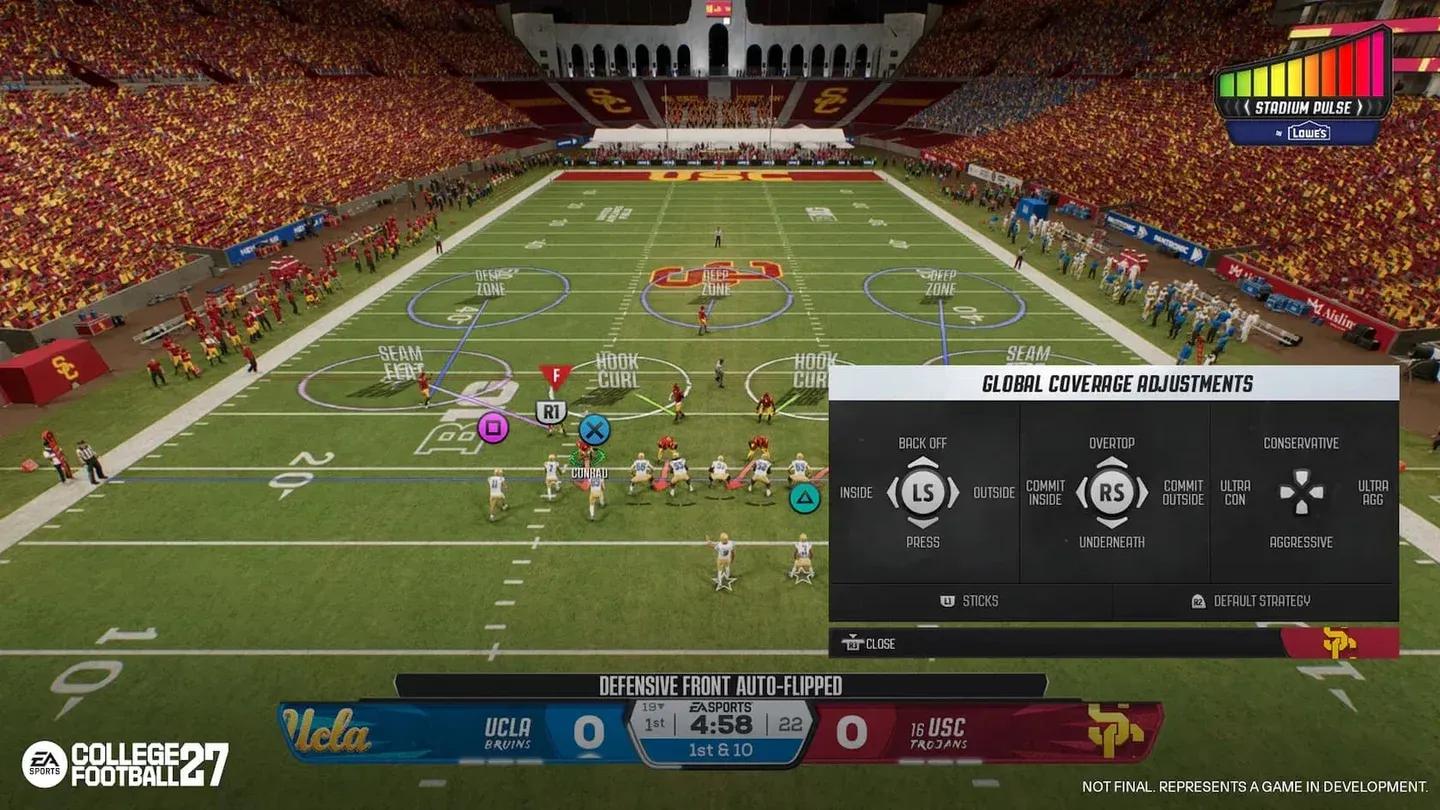
Dynamic Weather now shifts during games rather than staying static. Rain can move in and out across a game, snow accumulates on the field, and conditions vary by region and time of year. A weather report is available from the Play Game button in the Dynasty Hub before kickoff.
Season History tracks every team's final ranking, record, conference standing, and bowl results going back to 1869 and across all 30 years of your Dynasty. A new Team Historical Stats spreadsheet adds all-time wins, playoff appearances, national championship wins, total draft picks, and recruiting class rankings for every program.
The College Football Playoff structure has been updated to reflect the current 12-team format. ACC, Big Ten, Big 12, and SEC champions receive automatic bids regardless of ranking. The highest-ranked team from the American, Conference USA, MAC, Mountain West, Pac-12, or Sun Belt also earns an automatic bid. Notre Dame qualifies automatically if it finishes in the Top 12.
Two new programs join Dynasty this year: North Dakota State and Sacramento State, bringing the total to 138 available schools.
The Heisman ceremony now plays out automatically during Bowl Week 1, with all four finalists introduced on stage before the winner is announced.
New player awards include the Paul Hornung Award (most versatile player) and the William V. Campbell Trophy (top scholar-athlete).
For a full look at everything available before launch, including early access options and how to jump in before standard release, check out the early access dates, times, and prices guide and the exact release date and start times breakdown. If you want to try the game before committing to a purchase, there is also a guide on how to play for free with the EA Play trial.
For everything else — trophy hunting, mode breakdowns, and strategy deep dives — the full EA Sports College Football 27 guide collection has you covered.