Search games, articles, guides...CtrlK
Sign InGet Started
Master Everwind's combat with weapon tier breakdowns, skill tree paths, parry mechanics, and the rune enchanting system explained.

Written by Nuwel
Content Writer
See more GAMES.GG guides on Google
Add us as a preferred source and our guides show up first in your results.
How to Get the Hang Glider in Everwind: Blueprint & Fabricator Guide
Find the Steamer Vault Key, locate the crashed Steamer Shuttle, and craft the hang glider at a Fabricator with this step-by-step guide.
Everwind Skills Guide: Warrior, Arcanist & Engineer Trees
Master all three Everwind skill trees with this complete breakdown of every Warrior, Arcanist, and Engineer upgrade.

Everwind Guide: How to Fly Airship
Learn how to build and fly your first airship in Everwind, from placing the Flying Ship Core to mastering lift and steering.
Everwind drops you into a sky full of floating islands and enemies that will absolutely fold you if you treat the combat like a casual sandbox romp. The stamina bar is not decorative. Weapons break. Enemies hit hard from the first island. Getting a grip on the skill trees, weapon tiers, parry timing, and rune system early is the difference between surviving long enough to build a proper ship and respawning next to a pile of your own crafting materials.
The current maximum level in Everwind Early Access is 40. Every level grants a single skill point, and with three separate trees to spend across, you cannot unlock everything in one playthrough. That is intentional. You have to commit to a direction.
The safety valve is the respec potion, which you can purchase in-game to wipe your entire build and start fresh. This makes early experimentation far less painful. Dump points into physical damage to survive the opening islands, then buy a potion and pivot to a full magic build once you have better materials. Playing with friends? Respec freely to test complementary role combinations without permanently locking yourself into a bad fit.
There are three paths: Warrior, Arcanist, and Engineer. Each tree has six tiers, and you must spend five points in a tier before the next one unlocks. The trees do not share progress, so five points in Warrior tier 1 does nothing for your Arcanist tier 2 access.
The Warrior tree covers physical damage, survivability, and melee utility. Early tiers give passive health buffs and unlock the ability to parry. Upper tiers are where the build gets genuinely interesting: a stealth mechanic that makes you completely silent while crouching, and the Throatslice ability, which gives you a percentage chance to instantly kill an enemy based on the damage dealt. Throatslice does not work on bosses or elite enemies, but it makes clearing bandit camps significantly faster.
Investing in this tree is also a hard requirement for equipping Advanced and Master tier armor. You cannot simply craft the gear at a Smithing Station without first unlocking the relevant recipe through Warrior skill progression.
The Arcanist tree scales through sequential elemental masteries: Fire, then Ice, then Lightning, then Poison. Tier 4 contains the Wild Magic node, which gives every spell you cast a chance to deal 50 percent more damage or 25 percent less. It is a high-variance gamble that can carry a fight or end it badly.
Magic weapons like staffs have a strict durability cap of 50 uses, so treat them as situational heavy artillery rather than your primary weapon. You will always find melee weapons more easily than alchemy materials, so maintaining solid melee fundamentals matters even on a full Arcanist build.
The Engineer tree does not boost raw damage, but it makes everything else easier. The standout node is a compass scan that highlights living creatures through walls up to 650 meters away, which is genuinely useful for scouting dangerous islands before committing to a landing. Passive reductions to sprint stamina consumption round out the utility, giving you a reliable exit option when a fight goes sideways.
Parrying is one of the most effective tools in the game when timed correctly. The mechanic works differently depending on whether you have a shield equipped or have invested in the Parry Master skill.
Equip a shield in the Shield Slot through the Inventory Screen. In a fight, hold Right Mouse Button (or LT on controller) to raise the shield into an active block, then press Left Mouse Button (or RT on controller) precisely as the enemy's attack is about to connect. A successful parry stuns the enemy for roughly 2 seconds, giving you a free window to attack. A mistimed attempt lets the hit bypass the shield entirely for full damage.
Shields are not craftable by default. You will find the recipe naturally as you loot new islands, and dungeons frequently have shields in chests if you need one quickly.
The Parry Master skill in the Warrior tree unlocks weapon parrying. It sits at Tier 1 with no prerequisites, so you can grab it the moment you hit level 2. Both one-handed and two-handed weapons work with Parry Master. The execution is identical to shield parrying: block stance, then attack input at the last moment.
One important caveat: if you have a one-handed weapon and a shield equipped simultaneously, the shield takes priority for parrying. You cannot weapon-parry while a shield is in your off-hand.
Three distinct enemy factions populate the sky islands, each with different behavior and loot profiles.
Human settlements appear on settled islands in the first atmospheric layer, complete with merchants, guards, and villagers. Humans are reactive rather than aggressive by default. They will not attack unless provoked, but the entire settlement will defend itself once a fight starts. City Guards have high HP pools, so picking a fight unprepared is a bad idea.
The upside is that human settlements are your primary source for armor and outfits. Merchants cover a wide range of specializations:
| Merchant Type | Sells |
|---|---|
| Alchemist | Potions, Elixirs, Materials |
| Armorer | Armor and Shields |
| Blacksmith | Tools, Refined Ingots, Materials |
| Bowyer | Bows and Arrows |
| Weaponsmith | Swords and Melee Weapons |
| Innkeeper | Food and Drinks |
| Herbalist | Herbs and Rare Materials |
| Jeweler | Rings, Necklaces, Materials |
Not every settlement has every merchant type, so marking useful ones with waypoints saves time later. Avoid drawing your weapon around merchants; an accidental swing can trigger the whole town.
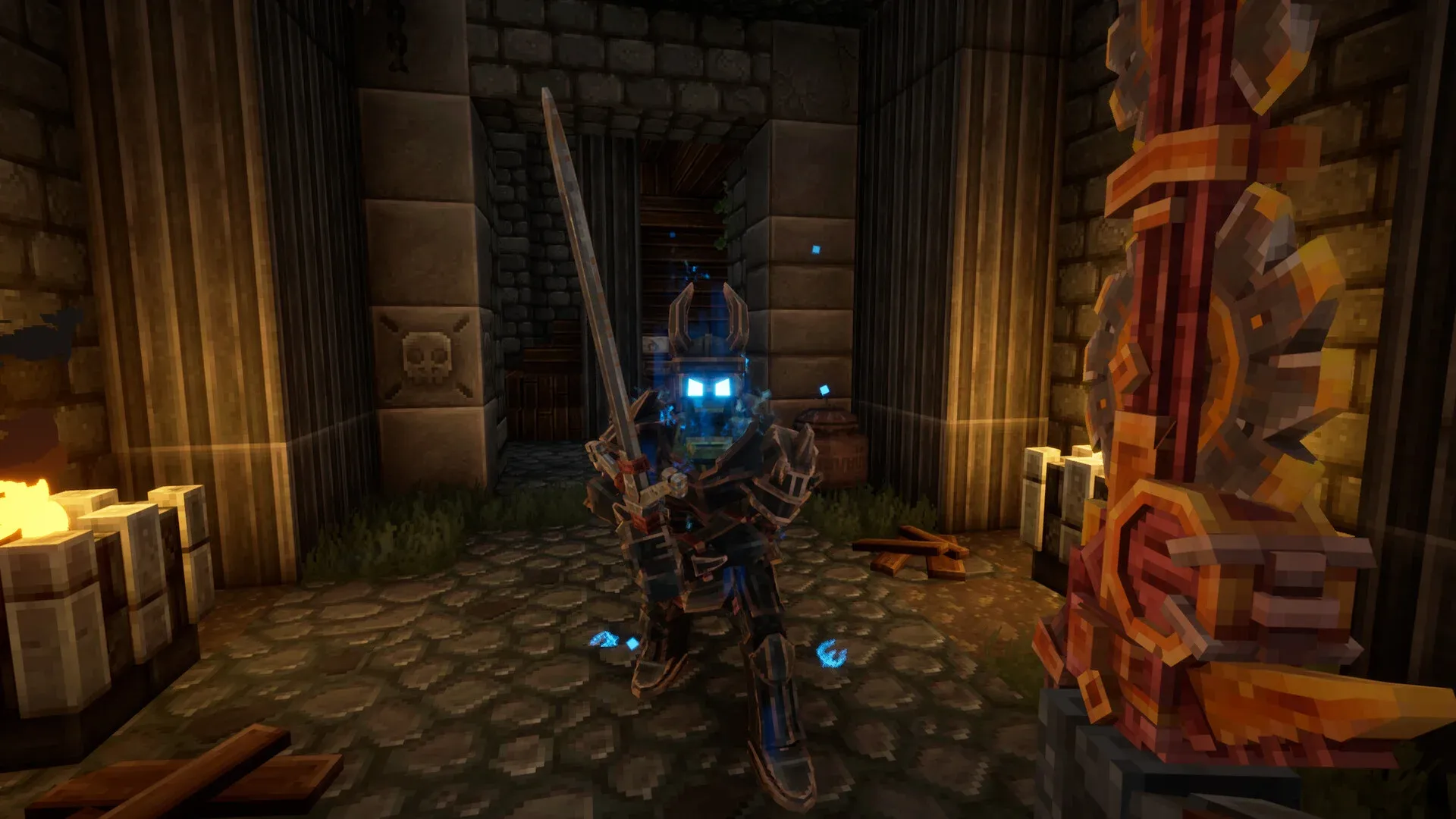
The Mortivar are the skeletal enemies you will encounter most frequently across the islands. They are always aggressive on sight. Each Mortivar type has multiple models with unique stats and defenses, so the same enemy variant can present very differently depending on the encounter. Notable drops include various Mortivar Skulls, armor, coins, and weapons. Bosses like the Mortivar General drop rare items including Crystals of Force, while the Forest Ent mini-boss drops a unique sword called Grove Murmur.
Steamers are broken metal humanoid constructs found at higher atmospheric layers. Like the Mortivar, they are immediately hostile. A key hazard: many Steamers explode on death, so stepping back after landing the killing blow is not optional. Defeating Steamers is one of the most efficient ways to collect metal machinery components without needing a Fabricator or Drill.
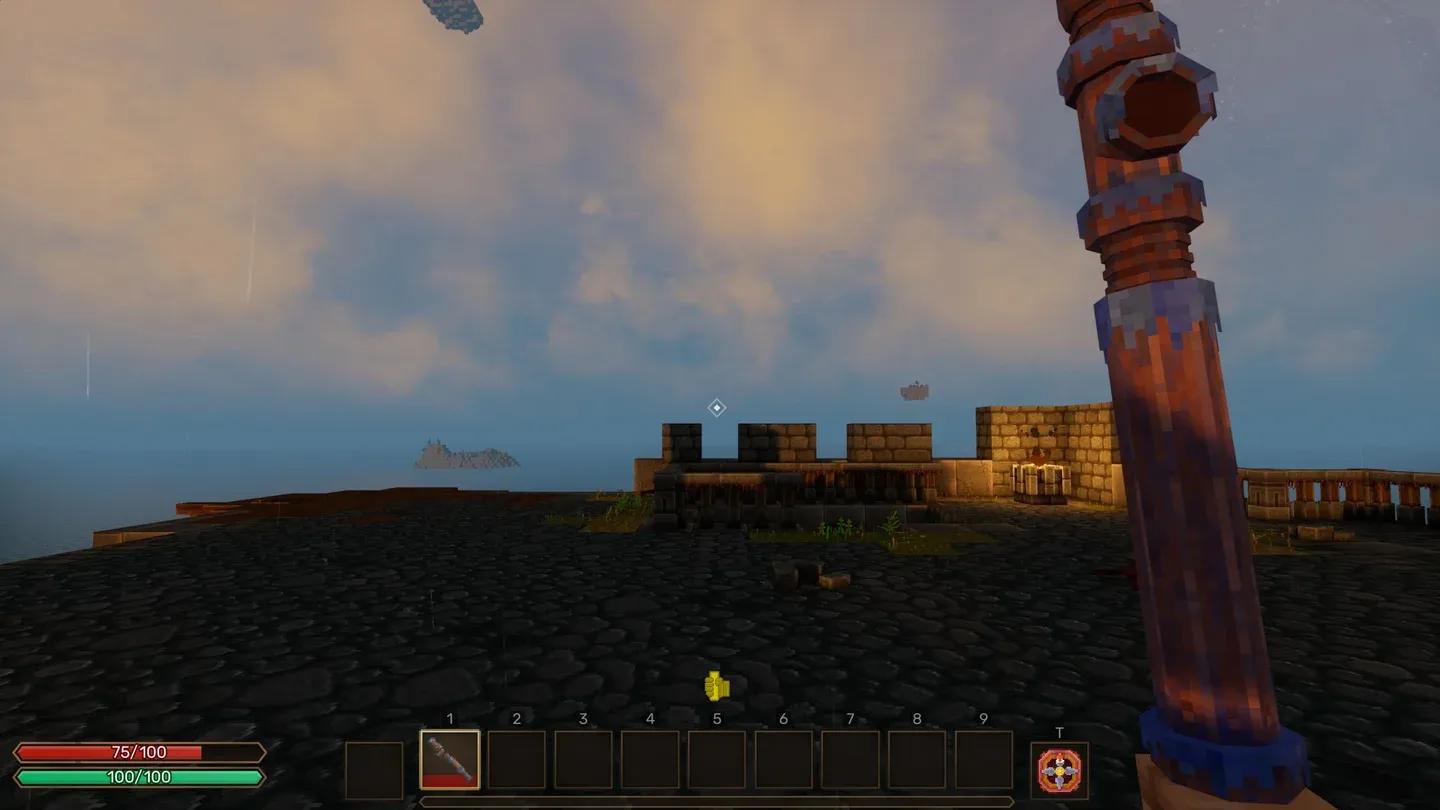
Mortivar enemy encounter
The starting wooden sword is not a weapon. It is a placeholder. Here are the weapons that matter, based on their damage output and endurance values:
| Weapon | Damage | Endurance | Notes |
|---|---|---|---|
| Stone Hatchet | 7-8 | 120 | Best early-game option. Fast and consistent. |
| Bronze Sword | 16-18 | 250 | First major power spike. Requires a functioning Furnace. |
| Iron Spiked Wooden Bludgeon | 25-28 | 145 | High damage, breaks fast. Pure glass cannon. |
| Mechanical Long Sword | 35-40 | 750 | Endgame weapon. Slow swings, devastating output. |
The jump from stone to bronze is the most impactful upgrade you can make early. It requires building a Furnace and a Smithing Station on your ship and smelting raw copper ore into ingots first. Raw ore does nothing at the smithing table.
Runes apply permanent stat buffs to weapons and chest plates. The crafting chain is steep: you need 5 Rune Fragments to make one Small Rune, then 5 Small Runes for a Medium Rune, scaling up through Big, Huge, and finally Perfect Runes. Fragments drop from low-level enemies and appear in special chests across the map.
To apply a rune, hold it in your hand, press the use key, and select the target weapon. The rune and a specific crafting component are consumed permanently.
If you find an enchanted weapon with a rune you do not want, do not scrap it. Build a Processing Station on your ship and run the item through it to extract the rune fragments for later use.
Picking up gear from defeated enemies is one of the fastest ways to upgrade outside of crafting. Bosses and mini-bosses from all three factions occasionally carry exclusive rare gear that cannot be obtained through normal crafting recipes. Checking enemy drops before moving on is worth the few seconds it takes.
For players wanting to track known item locations and community-sourced data, the Everwild Wiki on Fandom maintains a growing database of enemy loot tables and item locations as the community maps them out.
Everwind rewards players who treat combat as a system rather than a button-mashing exercise. Block timing, stamina management, build direction, and knowing which faction you are walking into before you land all matter. The respec potion removes the penalty for experimenting, so there is no reason to lock into a build early without testing it.
For additional context on known bugs, fixes, and community-sourced technical information, the PCGamingWiki page for Everwind is worth bookmarking as the game continues through Early Access development. For more guides covering every system in the game, browse the full guide library at GAMES.GG.