


GOALS hands you a squad of mostly low-rated cards at the start, and that's by design. The game's entire team-building loop revolves around developing those cards over time rather than chasing a perfect starting roster. Every card you own is unique to your account, nobody else in the world has that exact player, and the growth ceiling on even a Basic-rarity card can surprise you if you understand how the system actually works.
How does XP work for player cards?
Every player card carries an XP meter, visible when you inspect the card. Play a complete match with that card in your squad and it earns XP. The rate varies between cards, but every player in an active squad picks up something after a full game, no exceptions.
Once a card accumulates enough XP to hit its threshold, an upgrade becomes available. Upgrades raise the card's overall rating and boost specific stats. Those stat boosts are assigned randomly, so two copies of the same base card can develop differently depending on which upgrades they roll. Keep playing with the same card consistently and those upgrades stack into something genuinely useful.

Training value lightning icon
What is the training value and why does it matter?
The training value is the single most important number on a card, and it's easy to miss. Look at the bottom-left corner of any player card and you'll see a small lightning bolt icon with a number next to it. That number runs from 1 to 8, with 8 being the highest possible value.
Training value determines how far a card can be developed. A low-rarity card sitting at training value 7 or 8 has more long-term potential than a higher-rarity card stuck at 2 or 3. The rarity you see when you first receive a card is just the starting point. A card with high training value can climb through rarity tiers as it levels up, which means you should never discard a low-rarity card without checking that lightning bolt number first.
How does player age affect development?
Every card displays an age value beneath the player's position. Players age as you use them and eventually retire after accumulating enough playtime. Younger cards give you a longer development window, which means more matches to earn XP, more upgrade opportunities, and more time to get value from a high training value before the card ages out.
When you're deciding which cards to build around for the long term, prioritize younger players with high training values. A card that starts young and rates a 7 or 8 on the training scale can become a cornerstone of your squad across many seasons.
What's the best strategy for building your squad?
The most efficient approach is to identify your highest training-value cards immediately and build your starting lineup around them, regardless of their current rarity. Run those cards in every complete match to maximize XP gain. Don't spread your playtime evenly across your whole roster early on. Concentrate games on the cards with the best long-term potential.
For players that start at Uncommon rarity or higher with solid training values, expect a slower upgrade pace but a stronger stat floor. These cards reward patience. Basic cards with high training values are your quick-development projects and can fill gaps in your lineup while your higher-rarity cards grind through their longer XP thresholds.
The random nature of stat boosts on upgrade means some cards will develop into specialists and others into more balanced players. You can't control which stats get boosted, but you can control how consistently you play with a card and how early you start developing it.
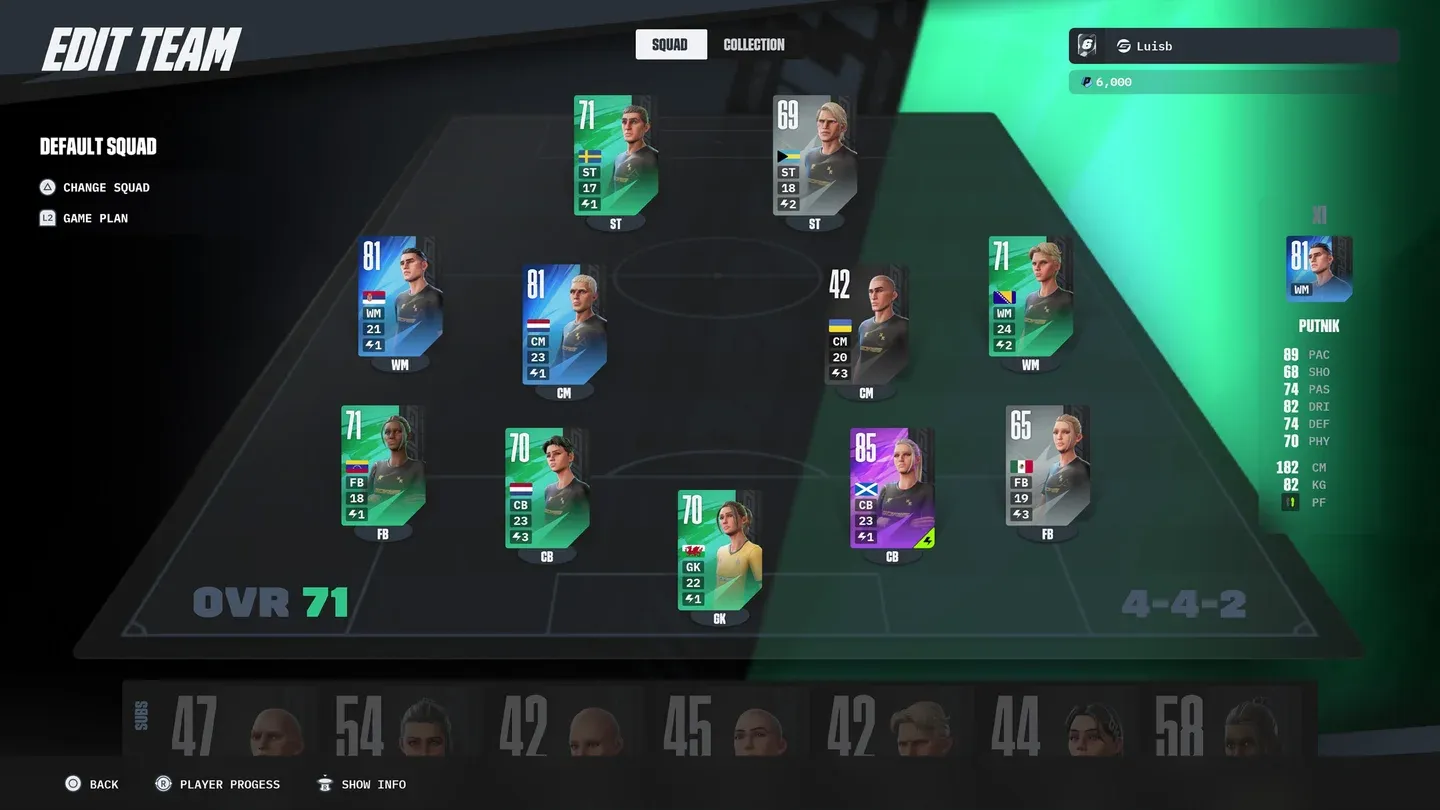
GOALS squad selection screen
Building a long-term squad in GOALS
The player training system rewards consistent play over chasing the highest-rated cards available. A Basic card with maximum training potential, developed from a young age, can outperform a higher-rarity card that was neglected or picked up late in its career window. That's the core philosophy the system is built around.
For more strategies on building your squad and mastering the game's systems, the GOALS guides collection covers everything from formation choices to match tactics. GOALS sits firmly in the sports games genre but brings a card-based progression layer that sets it apart from most football titles on the market right now.