
Biggest discounts, free games, and limited-time offers across every major gaming store.
Never pay full price again.
Overview
Goat Simulator 3 is a sandbox chaos game that commits fully to its own joke without ever getting tired of it. Developed by Coffee Stain Studios and released on November 16, 2022, it drops players into a wide open farmyard world with one instruction: cause problems. There's no real objective, no morality system, and no one telling you to stop headbutting NPCs into the stratosphere. That's the entire point.
The game is a direct sequel to the original Goat Simulator, which launched in 2014 as a deliberate parody of simulation games. Goat Simulator 3 (yes, they skipped 2 on purpose) takes that same energy and builds a proper open-world game around it, with more content, better co-op, and a map large enough to get genuinely lost in.
Gameplay and mechanics: what does Goat Simulator 3 actually play like?
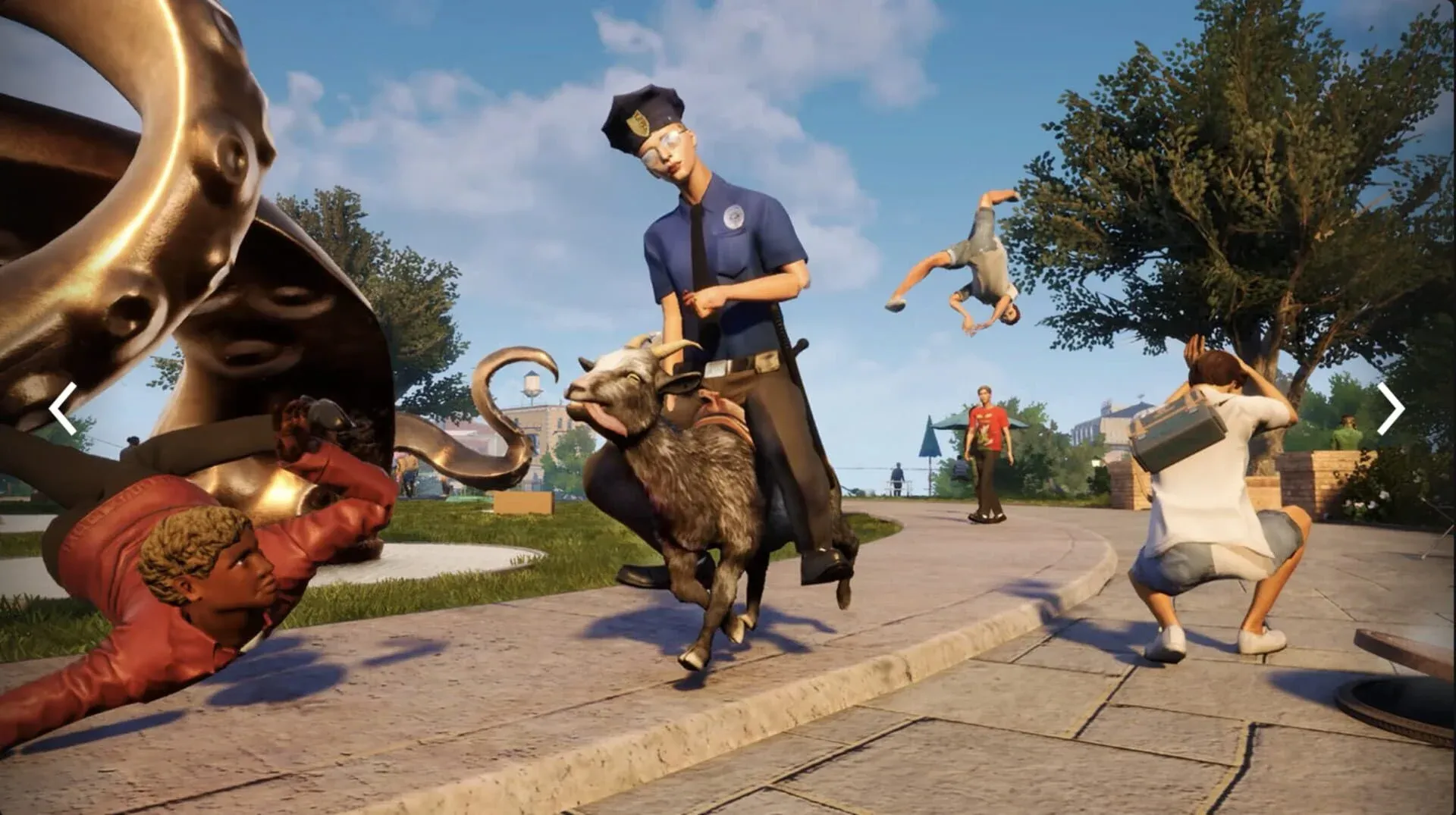
At its core, Goat Simulator 3 is a physics sandbox. You play as Pilgor, a goat with a licker tongue, a taste for destruction, and access to a steadily expanding wardrobe of ridiculous outfits and abilities. The world is full of objects to interact with, NPCs to terrorize, and structures to knock down in increasingly creative ways.

Key mechanics include:
- Ragdoll physics that make every collision unpredictable
- Lick-and-drag to carry objects (or people) across the map
- Headbutt attacks for launching anything that isn't bolted down
- Outfit-based abilities that change how Pilgor moves and interacts
- Collectibles and quests scattered across the open world
The game doesn't hold your hand. Quests appear on the map, but completing them is optional, and the real draw is stumbling onto something chaotic by accident.

Multiplayer and social: is Goat Simulator 3 better with friends?
Yes, unambiguously. The game supports up to four players in both local and online co-op, and adding more goats to the mix scales the chaos in ways that are hard to predict and easy to enjoy. Players can team up to complete objectives together or ignore all of that and compete in mini-games instead.

The mini-games are worth mentioning specifically because they shift the dynamic from cooperative mayhem to competitive, which changes the tone entirely. One round you're working together to fling a car into a swimming pool; the next you're racing to see who can knock the most NPCs off a cliff. The game doesn't force either mode, it just makes both available and lets the group decide.

Content and replayability
The open world is packed with Easter eggs, hidden quests, and references to other games, films, and internet culture. Coffee Stain clearly had fun hiding things across the map, and players who explore thoroughly will find content that has nothing to do with the main quest structure.
Outfits and abilities add a light progression layer. Unlocking new gear changes what Pilgor can do, which opens up different ways to interact with the world. It's not a deep system, but it gives completionists a reason to keep pushing through the map.
Conclusion
Goat Simulator 3 is a sandbox game that knows exactly what it is and executes that vision with real craft. The open-world design gives the chaos room to breathe, the four-player co-op turns a solo joke into a shared experience, and the sheer density of hidden content rewards players who stick around. It's not a game for everyone, but for players who want a physics sandbox with no stakes and unlimited stupidity, Coffee Stain Studios has built something that genuinely delivers.