

Gene splicing in Jurassic World Evolution 3 has taken a significant step forward with the addition of Experimental Traits. These are special characteristics you can apply to individual dinosaurs after researching them, and they change how those animals behave, age, fight, and interact with the rest of your park. The catch is that several of them come with real drawbacks that can cause serious problems if you apply them carelessly. Getting 100% familiarity with a species and its genes gives you the best selection of available traits to choose from.
All Experimental Traits in JWE3
The trait system works the same way regardless of which species you apply it to. The number of traits available per species depends on how thoroughly you have researched that animal. Here is every Experimental Trait currently in the game and exactly what each one does.
| Trait | Effect | Drawback |
|---|---|---|
| Amicable | Removes all cohabitation penalties with other species | Does not override predator instincts, so placement still matters |
| Bio Resistance | Full immunity to diseases and poisoning | Animal also becomes immune to tranquilization |
| Biological Immortality | Animal ages extremely slowly | Cannot breed |
| Domesticated | Animal poses no threat to guests if it escapes, ignores vehicles, and can be recovered by Ranger teams | Not available for all carnivores |
| Hardy | Animal cannot lose more than 50% health in fights against similarly sized creatures | Health recovery rate is slower than normal |
| Prolific | Boosts fertility rates and increases female clutch size | None listed |
| Poisonous | Applies poison to attackers or predators that eat the animal | Passive only, does not change combat aggression |
| Venomous | Inflicts poisoning when the animal attacks | Offensive version of the poison mechanic |
What's the difference between Poisonous and Venomous?
These two traits are easy to confuse, but they work in opposite directions. Poisonous is a defensive trait: the animal poisons whatever attacks or eats it. Venomous is offensive: the animal poisons targets when it attacks them. For predators you want to make more dangerous in fights, Venomous is the relevant pick. For prey species you want to make harder to hunt, Poisonous adds a layer of deterrence.

Experimental traits research screen
Best Experimental Traits in Jurassic World Evolution 3
After testing how these traits play out across different park configurations, three stand out as consistently worth the research investment.
Domesticated
Domesticated is the most practical trait for carnivores, particularly if storms are a regular headache in your park. When a domesticated animal breaks out, it does not attack guests, ignores vehicles, and can be retrieved by your Ranger teams without incident. The downside is that not every ferocious carnivore has this trait available, so check your research options before planning around it. For the carnivores that do have access to it, the reduction in escape-related chaos is substantial.
Biological Immortality
This one solves a specific problem that catches a lot of players off guard. In Jurassic World Evolution 3, you cannot sell dinosaurs. When an animal reaches the end of its lifespan, your options for managing population are limited. Biological Immortality slows aging to a crawl, which gives you direct control over how quickly a population in a given enclosure grows. The trade-off is that the animal loses the ability to breed entirely, so you need to decide whether population control or natural reproduction matters more for that particular species.
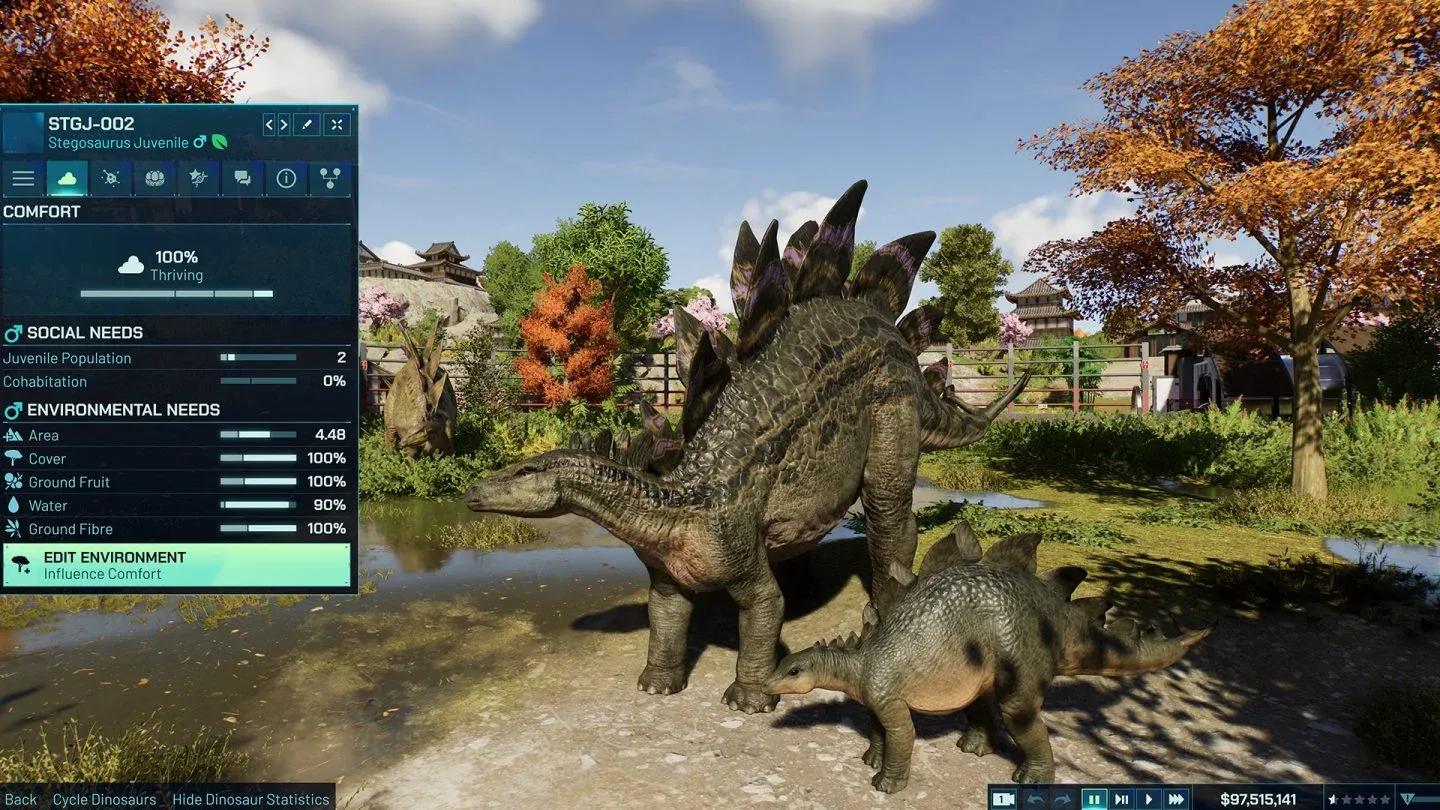
Dinosaur lifespan stats panel
Hardy
Dinosaur fights are one of the more expensive things that can happen in your park, especially when a rare or exotic species is involved. Hardy caps the health loss any animal can suffer in a fight against a similarly sized creature at 50%, which effectively prevents fatalities from same-size combat. The slower health recovery is a real cost, but preventing the death of an expensive exhibit animal more than compensates for it in most situations.
Which traits should you avoid or use carefully?
Bio Resistance and Prolific are the two that require the most thought before applying. Bio Resistance removes disease vulnerability entirely, which sounds great until you need to sedate the animal and cannot. Prolific is straightforward in what it does, but boosting fertility rates and clutch sizes in an enclosure where you already cannot sell animals can create overpopulation problems faster than you expect.
Amicable is situationally useful but not a substitute for proper enclosure design. Removing cohabitation penalties does not change the fact that a carnivore will still act like a carnivore.
For more strategies on managing your park and getting the most out of your dinosaurs, the Jurassic World Evolution 3 guides collection covers everything from enclosure design to research priorities. If you enjoy this kind of deep management gameplay, it sits firmly in the strategy games genre where every decision compounds over time.
