


Season 4 of Last Epoch, titled Shattered Omens, introduces one of the most thrilling and nerve-wracking additions to the game's already deep crafting system: the Rune of Corruption. This high-stakes mechanic lets you push your best gear into uncharted territory, potentially unlocking exclusive affixes and entirely new attribute types that no other crafting method can produce. The catch? One bad roll and your carefully crafted item could be rendered useless.
What Is the Rune of Corruption in Last Epoch?
The Rune of Corruption is a new crafting material introduced in Last Epoch Season 4 that permanently alters an item's properties in unpredictable ways. Using this rune on any equippable item will either make it significantly stronger or noticeably weaker, with no middle ground.
What makes this system distinct from every other rune in the game is the finality of the outcome. Once you corrupt an item, it loses all remaining Forging Potential and Legendary Potential, locking you out of any further modifications. You cannot fix a bad result, unseal affixes, or apply additional runes afterward. The item you get is the item you keep.
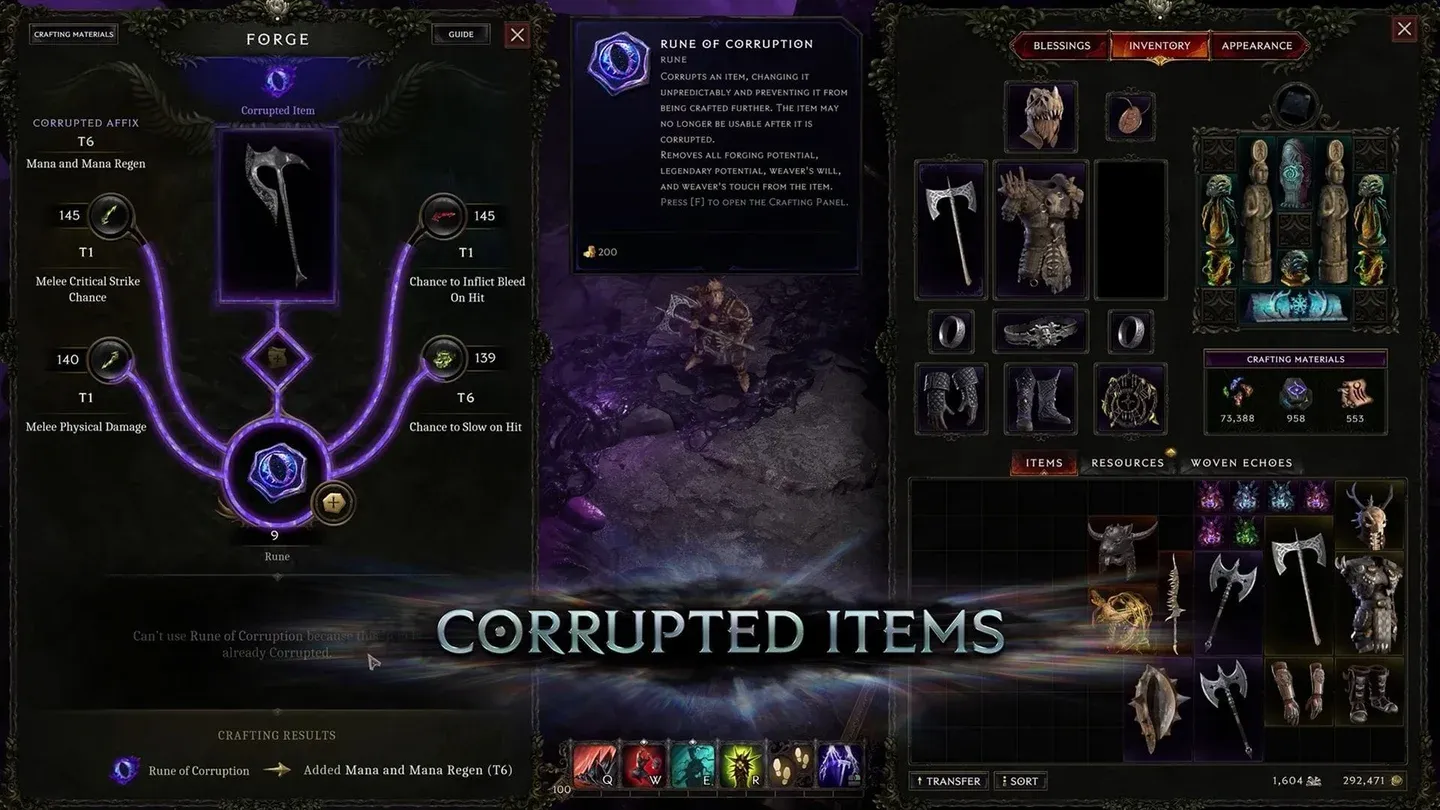
Forge corruption placement UI
How Do You Get the Rune of Corruption?
There are two primary ways to obtain Runes of Corruption in Season 4.
The first and most direct method is defeating an Omen during an Omen Window encounter. These two-phase fights appear throughout both the Campaign and the Monolith of Fate. During phase one, you fight within a circular arena while the Omen empowers nearby enemies. Once you fill the progress bar by defeating those enemies, the Omen itself becomes vulnerable in phase two. Killing it drops the rune directly into your loot.
The second method involves Timeglass Fragments, a new seasonal currency also earned from Omen encounters. You can spend these fragments with Apophis in the End of Time to purchase Runes of Corruption directly, or acquire Crates of Corrupted Items if you want pre-corrupted gear without the personal risk.
Step-by-Step: How to Corrupt an Item
The actual corruption process is straightforward once you have the rune in hand:
- Open the Forge and place the item you want to corrupt in the crafting slot.
- Select the Rune of Corruption from your available crafting materials.
- Confirm the action when the prompt appears.
- Review the results displayed at the bottom of the Forge window.
Note that class-specific items remain class-specific after corruption, but their level requirements or subtype may change, so double-check equip conditions after the process.
What Are the Possible Outcomes?
The results of corruption fall into two broad categories, and the system is entirely RNG-based. The following outcomes are possible:
Positive Results
- Adding a brand-new Corrupted affix unavailable through any other crafting method
- Adding a normal, Champion, or experimental affix to the item
- Maximizing the values of some or all existing affix rolls
- Boosting stat rolls to their highest possible tier
Negative Results
- Making the item completely unusable (unequippable)
- Lowering the item's rarity
- Removing existing affixes entirely
- Reducing affix tiers below their current values
- Minimizing roll values
- Changing the item's subtype to something unexpected
Corrupted affix result screen
What Are Corrupted Affixes?
Corrupted affixes are the main prize of the system. These are modifiers that cannot appear on any item through standard crafting, legendary potential, or normal drops. They occupy their own unique sealed slot on the item, meaning they do not compete with regular affix slots.
Some examples of exclusive corrupted affixes include:
- Increased Melee Attack Speed
- Seconds of Frenzy gained after using Evade
- Bonus Endurance percentage
These affixes have their own sealed slot, so you cannot double-corrupt or stack multiple corruption results on the same item.
How Does Attribute Conversion Work on Corrupted Amulets?
One of the most fascinating aspects of the corruption system is what happens specifically to Amulets. When you corrupt an amulet, you have a chance to trigger an Attribute Conversion, replacing one of your character's core attributes with an entirely new stat type.
Here is the critical rule: these converted attributes still count toward existing attribute-based scaling. So if a skill or passive scales from Strength, Brutality (the corrupted Strength equivalent) will still satisfy that requirement. You will not break your build's scaling foundation by rolling a conversion.
The five attribute conversions are:
Note that the base effect of the original attribute no longer applies once converted. For example, Intelligence normally provides 2% Ward Retention per point, but after converting to Madness, that baseline Ward Retention disappears entirely and is replaced by the Spell Crit Multiplier and the critical hit vulnerability.
Amulet attribute conversion result
What Are Corrupted Subtypes?
Beyond individual affixes and attribute conversions, corruption can also generate entirely new item subtypes that cannot be acquired through any other means. These subtypes always come paired with both a powerful bonus and a meaningful drawback.
Here are the confirmed corrupted subtypes for Season 4:
Bottled Time (Rogue Relic subtype)
- Bonus: Increased Movement Speed and Increased Cooldown Recovery Speed
- Drawback: Increased damage over time taken
Aberrant Eye (Mage Relic subtype)
- Bonus: Ward per second and percentage of Max Health gained as Ward Decay threshold
- Drawback: Reduced maximum Health
Corrupted Insignia (Ring subtype)
- Bonus: Increased Cooldown Recovery Speed for Evade and Frenzy granted after using Evade
- Drawback: Increased damage taken while Frenzy is active
Deadstar (Amulet subtype)
- Bonus: Reduced damage over time taken and increased damage over time dealt
- Drawback: Reduced Armor
These subtypes are not guaranteed outcomes. Corruption may or may not produce one, adding another layer of uncertainty to the process.
Idol Altars and Omen Idols: The Other Half of the Omen Reward Loop
Omen encounters do not only drop Runes of Corruption. They can also yield Idol Altars, a companion system that reshapes how you approach the Idol grid.
What Are Idol Altars?
Idol Altars are equippable items placed in a new dedicated slot above your Idol inventory. Once equipped, they immediately change the layout of the Idol grid within its fixed 5x5 space. There are 13 altar subtypes, each offering a different arrangement of open, blocked, and special slots.
Some altars introduce Refracted Slots, which appear as glowing purple squares in the grid. Idols that occupy one or more Refracted Slots gain amplified affix values or additional bonuses based on the affixes of the equipped Altar itself. This turns Idol placement into a meaningful spatial puzzle rather than a simple slot-filling exercise.
Idol Altar refracted slot layout
What Are Omen Idols?
Omen Idols are a new Idol type that drops from Omen Window encounters and from the new pinnacle boss Vision of the Observer. They come in 1x3 or 3x1 shapes but carry the prefix and suffix power of larger 1x4 and 4x1 Idols, making them considerably stronger than standard options of the same size.
By default, you can only equip one Omen Idol at a time. Certain Idol Altars can increase this limit, creating an additional reason to seek out the best altar for your build.
Omen Idols are always corrupted when they drop, which means they arrive unmodifiable but already carrying their elevated stat rolls.
Should You Corrupt Your Best Items?
The honest answer depends on where you are in your progression. Here is a practical framework for deciding:
- Do not corrupt items you are still actively using and cannot replace. The risk of bricking is real.
- Do corrupt items you have fully developed through standard crafting and have a backup available.
- Prioritize amulets if you are chasing an attribute conversion that fits your build identity, since that is where the most build-defining outcomes live.
- Target Rogue Relics and Rings if you want specific corrupted subtypes like Bottled Time or Corrupted Insignia.
- Farm Timeglass Fragments from Omen encounters as a secondary path to Runes if direct drops feel too slow.
For players coming from Path of Exile, the irreversible nature of corruption will feel familiar, though Last Epoch's version introduces more elaborate outcomes through attribute conversions and exclusive subtypes that go beyond a simple binary result.
For more guides covering Last Epoch and other ARPGs, browse more guides on GAMES.GG to stay ahead of the meta as Season 4 unfolds.