Search games, articles, guides...CtrlK
Sign InGet Started
Master Marathon's faction system, unlock all six factions through Liaison Contracts, and rank up fast to access the best gear and upgrades.

Written by Larc
Content Writer
See more GAMES.GG guides on Google
Add us as a preferred source and our guides show up first in your results.
Marathon Guide: How to Duo Queue
Learn how Duo Queue works in Marathon Season 2, how to access the rotating playlist, and tips for dominating as a two-player team.
Marathon Guide: How to Complete Research and Development Contract
Complete the Research and Development contract in Marathon Season 2. Down the Hazardous Transport Drone, grab the Anomaly Specimen, and deliver it to DCON.
Marathon Cradle System Explained
Master Marathon's Season 2 Cradle system, spend energy wisely, and max out your Runner Shell stats without wasting a single node.
Factions are the beating heart of progression in Marathon. From the moment you drop into Tau Ceti IV, these six corporate entities shape what gear you can access, what contracts you run, and ultimately how powerful your Runner becomes. You start with access to just one faction, but unlocking the rest (and ranking them all up) is how you build a genuinely dominant playstyle. Here's everything you need to know.
Think of factions less like story factions and more like corporate employers. Each one offers you a slate of Contracts to complete out in the field, and every contract you finish pushes that faction's progression forward. The higher a faction's Rank, the better the gear it sells you, the more Upgrades you can invest in, and the more reward packages you unlock along the way.
What makes this system genuinely interesting is that upgrades apply permanently across all your runs for the rest of the season. Early faction progress compounds fast. A cooldown reduction earned in week one pays dividends across every single run you take afterward.
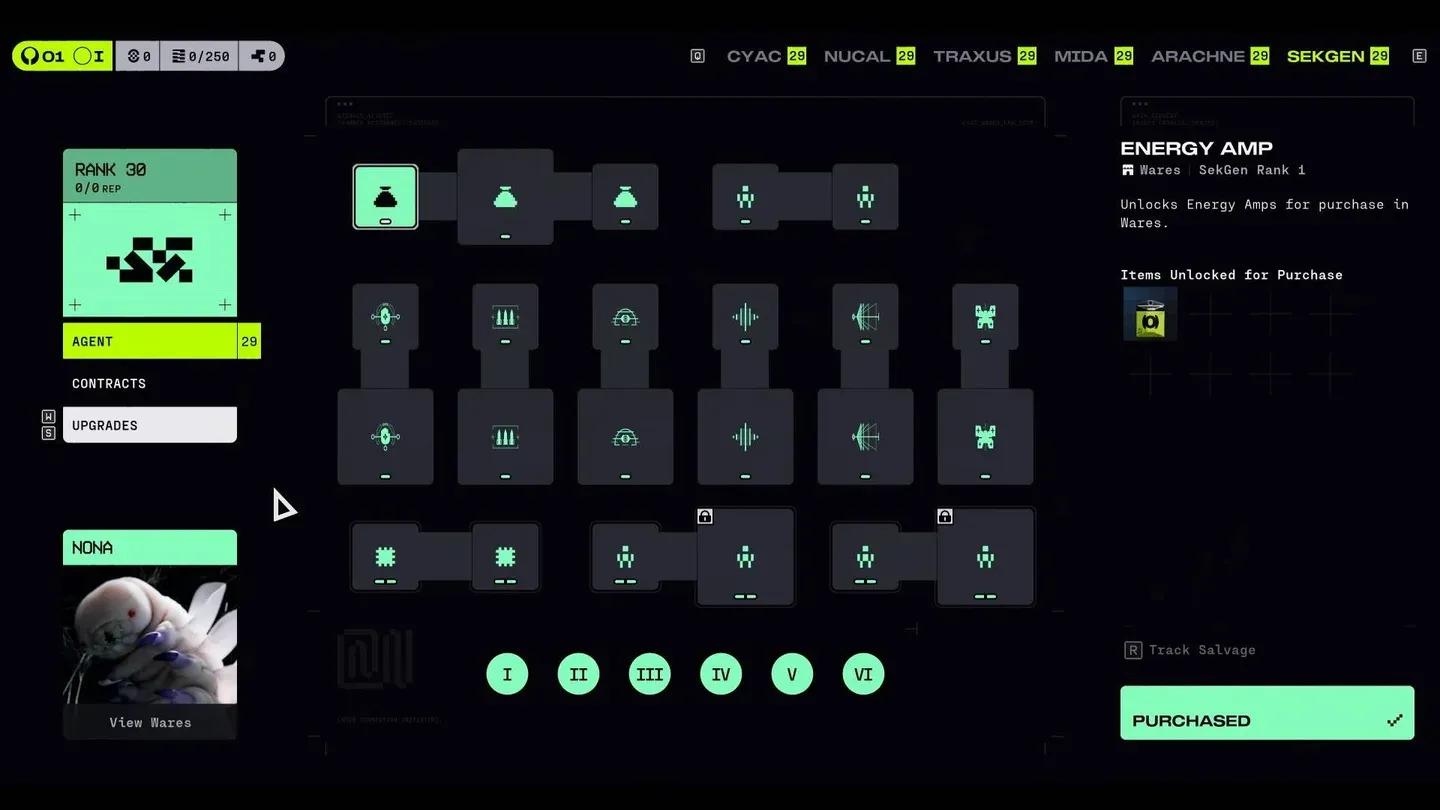
Faction upgrade tree screen
Factions don't lock you into a playstyle permanently either. Marathon treats you like a mercenary. You work for whoever benefits you most right now, and there's no penalty for spreading your attention across multiple factions.
Contracts come in three distinct varieties, each carrying different risk levels and rewards:
| Contract Type | Primary Goal | Risk Level | Failure Consequence |
|---|---|---|---|
| Standard | Repeatable objectives (loot, scans, extracts) | Low | Time loss only; no lasting penalty |
| Boost | Accelerated faction progression | Medium | Missed bonus progress if incomplete |
| Priority | High-value, story-relevant objectives | High | Lost objective item or run progress |
Priority Contracts deserve special attention. These are one-time missions tied directly to faction storylines and your Rank progression. Completing them pushes your standing forward significantly and unlocks meaningful story content through the Codex. Standard Contracts are repeatable and great for steady Rep accumulation, but Priority Contracts are the milestones you genuinely want to chase.
You begin Marathon with access to a single faction. To bring the other five into play, you need to complete the tutorial and finish the Welcome To Tau Ceti Contract first. Once those are done, a special category called Liaison Contracts becomes available.
Each Liaison Contract connects you with a specific new faction. Complete it once and that faction is unlocked permanently. There's no grinding required for the unlock itself, just a single successful run per faction contact.
Once a faction is unlocked, focus shifts to ranking it up, which is where the real long-term work begins.
Ranking up requires earning Rep, the progression currency tied to each faction. Rep accumulates automatically as you complete that faction's Contracts, with different contract types awarding varying amounts. You don't spend Rep manually; it feeds directly into the faction's Rank meter.
Higher Ranks unlock:
The Upgrade Tree is where things get genuinely build-defining. Some factions offer expanded Vault Space, while others grant permanent stat boosts to your Runner's combat performance, mobility, or survivability. Knowing which resources to gather on your runs to fuel these upgrades is a skill in itself.
Each faction supports a distinct playstyle. Here's a practical breakdown of what each one actually does for your Runner:
| Faction | Best For | Core Upgrades | When to Prioritize |
|---|---|---|---|
| CyberAcme | All-round efficiency | Faster cooldowns, larger inventory | Early season, learning phase |
| Arachne | PvP-heavy play | Combat stats, weapon access, faster TTK | High-confidence PvP routes |
| Sekiguchi | Recovery and resilience | Survivability, reduced death punishment | Solo play, risky experimentation |
| MIDA | Disruption and area control | Explosives, claymores, denial tools | Dense zones, objective-heavy areas |
| Traxus | Late-game power scaling | High-tier weapons, mods, shields | Disciplined extractions |
| NuCaloric | Mobility and traversal | Sprint speed, verticality, fall damage reduction | Stealth routes, map control |
CyberAcme is where most players should spend their first season energy. Its contracts are broad and forgiving, encouraging normal play rather than high-risk specialization. The upgrades (faster ability cooldowns, bigger inventory, general stat reliability) don't win individual fights on their own, but they make every single fight slightly easier. That friction reduction compounds across dozens of runs.
If you're actively hunting other Runners rather than avoiding them, Arachne is your faction. Contracts push you into high-traffic zones and reward eliminations. The upgrades tighten your time-to-kill and sharpen your combat toolkit. Arachne doesn't make you safer; it makes you deadlier.
Sekiguchi Genetics focuses on what happens after things go sideways. Recovery speed, baseline survivability, and reduced punishment for early deaths make this faction invaluable for solo Runners and anyone still learning the maps. Failure becomes less terminal, which is a massive advantage in a seasonal system where consistency beats peak performance.
MIDA contracts revolve around sabotage and disruption rather than clean eliminations. Grenades, claymores, and area denial tools let you force movement and mistakes from entrenched squads instead of trading bullets with them directly. This is one of the most tactically interesting factions for players who enjoy indirect pressure.
Traxus asks the most of you and pays the most in return. Contracts pull you into dangerous routes chasing rare extractions. The payoff is access to high-tier weapons, mods, and advanced shields. Players who master Traxus contracts tend to snowball hardest late in the season, but only if they survive long enough to cash in.
NuCaloric upgrades improve sprint duration, climbing speed, vertical movement, and fall damage reduction. None of that looks flashy on a stat sheet, but repositioning faster or escaping vertically often matters more than raw damage output. NuCaloric pairs exceptionally well with stealth-focused play.
Absolutely. Marathon's system is built for stacking complementary advantages. There's no allegiance penalty for working multiple factions, only opportunity cost in terms of where your contract focus goes each run.
Some combinations that work particularly well together:
The key is adapting your faction focus to what the current meta and your own strengths actually demand, rather than picking one and ignoring the rest.
Yes. All faction progression resets at the start of each new season (roughly every three months). This is intentional design, not a punishment. It prevents permanent power gaps between veteran players and newcomers, keeps the meta from going stale, and gives Bungie room to adjust balance without invalidating entire playstyles forever.
Each season reset is genuinely a fresh opportunity to rebuild your Runner differently based on what worked and what didn't the previous cycle. Players who treat resets as a chance to experiment tend to develop stronger overall game sense than those who just repeat the same faction path every time.