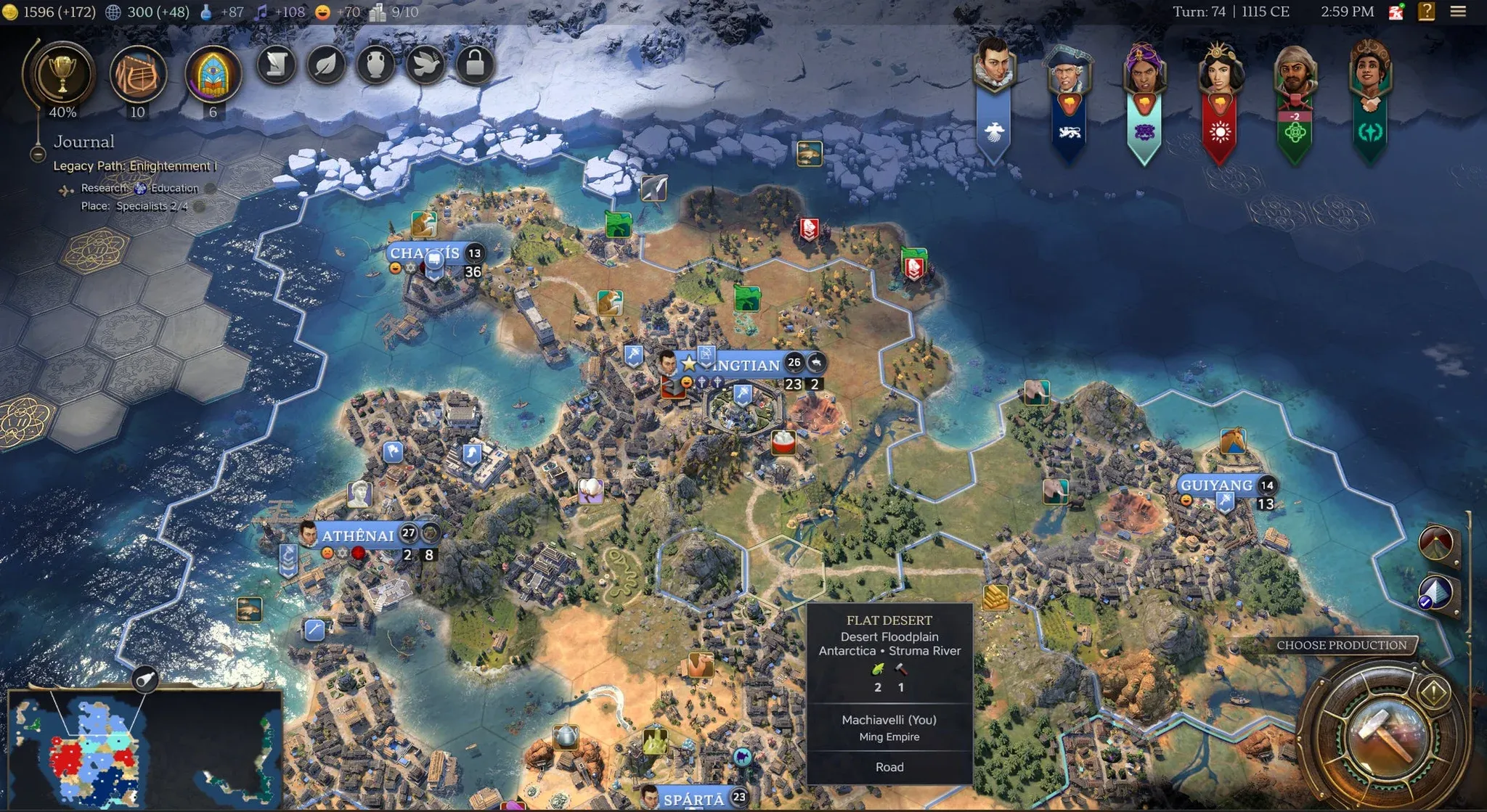


Two major updates dropped for Sid Meier's Civilization VII this year, and for the first time since launch, the game actually feels like it has a direction. The hefty Test of Time update arrived in late May with sweeping changes to how ages, victories, and civilizations work. A smaller follow-up at the end of June tightened up the happiness system and reworked governments. Neither update solves everything, but together they paint a clear picture of what Firaxis is building toward.
Age transitions finally respect your choices
The most contentious design decision at launch was the forced civilization swap between ages. Players who had spent years building a specific civ identity resented being pushed into a new one based on historical logic. Firaxis heard that loud and clear.
Now you can keep your original leader for the full game and continue with your starting civ if you want. The system works around an Apex Age concept: each civ has a historical peak era where it unlocks special units, buildings, and bonuses. Greece, for example, shines brightest in antiquity. Outside that Apex Age, your civ enters a "time-tested" phase where it keeps functioning, but the interesting wrinkle is syncretism: you can pick a special feature from another civ currently in its Apex Age, provided there's some historical overlap. Alternatively, you can "affirm" your traditions, which locks in a different set of bonuses and an extra tradition slot.
Here's the thing: these choices actually matter in practice. Playing as Alexander the Great on a cultural path during the Age of Exploration, one available syncretism option was a Norman motte and bailey fortification, which had zero value for a peace-focused cultural strategy. The other unlocked a new unique quarter. The decision was straightforward, but the fact that there was a meaningful strategic choice at all made the age transition feel like a moment of agency rather than an interruption.
Victory conditions that build, not race
The original victory conditions were arguably the game's worst feature. Economic victories turned into a treasure fleet stockpiling contest. Cultural victories devolved into artifact-hunting. Both felt like side quests bolted onto a strategy game.
Test of Time scraps both approaches. Economic victory is now cumulative, tied to your civ's GDP, which grows through slotted resources, gold-generating buildings, treasure convoys, and factory resources. Cultural victory pivots to tourism, built through wonders, celebrations, natural wonders, and unique quarters. These are wins you construct over an entire match rather than objectives you suddenly sprint toward in the final age.
Military and science victories are largely unchanged, which is fine since they worked reasonably well before. Science does add some incentive to specialize throughout the ages by accumulating science points over time.
Slotted between the major victories are smaller goals called triumphs, essentially customizable achievements tied to your strategy. Completing them earns dedications, which function like the old legacy rewards but pulled from a broader pool and generally more applicable to varied playstyles. The pacing benefit here is real, especially during the Age of Exploration, which still drags compared to the other ages.
Governments get depth, happiness gets complicated
The late June update reworked governments and the happiness system, and the results are mixed in interesting ways.
Government changes add genuine specialization. Playing a democracy-focused Alexander run with influence-oriented policies meant regularly sitting on surplus influence of several hundred, sometimes over 1,000. The options feel meaningful and distinct from each other.
Happiness is trickier to evaluate. The update introduced graded happiness levels, celebration incentives, and level-specific bonuses. These are welcome additions on paper. In practice, even after exceeding the settlement cap and absorbing angry cities taken during wartime, it's possible to keep every city producing 20 or more happiness units without much difficulty. The system works more like a checklist than a dynamic challenge: slot the right building, assign the right resource, repeat. For players on higher difficulty settings, this matters more. For everyone else, happiness rarely creates genuine pressure.
For a deeper breakdown of exactly what changed mechanically, the Civ 7 Update 1.4.1 governments explained guide covers the specifics in detail.
Where the game still falls short
Religion and diplomacy remain the two areas where Civ 7 feels most unfinished, and the contrast with the improved systems makes them stand out more, not less.
Religion offers some useful buffs for specific playstyles, but it's easy to forget it exists entirely. Miss a few turns of conversion activity, and the game barely registers it, until an age crisis with a religious theme arrives and the consequences feel disconnected from anything you actually experienced. Crisis events in general need more work to feel like genuine threats rather than flavor text.
Diplomacy is the bigger disappointment. With a surplus of influence and policies built around leader interactions, the actual diplomatic options remain: trade, declare friendship, declare hostility, or threaten. Pouring excess influence into war support to force a quick peace deal and extract free cities is satisfying in a narrow way, but it's closer to bullying than statecraft.
City planning has also changed very little across both updates, which is notable given how much the surrounding systems have evolved.
The trajectory matters more than the current state
What these updates demonstrate, more than any individual fix, is that Firaxis has a coherent vision for what Civ 7 should be and a working method for getting there. The age system now rewards strategic thinking. The victory paths reward long-term planning. The government options reward specialization. That's a meaningful improvement from a launch version where each playthrough felt like a variation on the same script.
The game isn't where it needs to be yet. Diplomacy, religion, and crisis events are still waiting for the same level of attention that ages and victories just received. But the foundation is noticeably stronger than it was six months ago.
If you want to get the most out of the current build, the Civ 7 strategy guides collection has everything from government optimization to civ-specific builds to help you take advantage of what these updates changed.