

The EPOMAKER Wisteria is a custom mechanical switch designed for users looking to upgrade the feel and sound of a mechanical keyboard without replacing the entire board. Available in both linear and tactile versions, the Wisteria offers a choice between a smoother keypress and a more tactile typing experience.
This review focuses on the linear EPOMAKER Wisteria, which combines a 45gf actuation force with a 2.2mm pre-travel and 3.6mm total travel. The switch also uses a POM and PTFE stem, a polycarbonate top housing and a PA66 bottom housing, giving it a combination of smooth travel, controlled acoustics and broad compatibility.
For gamers and mechanical keyboard enthusiasts, the Wisteria provides a well-balanced experience that works particularly well for fast inputs while remaining comfortable for longer typing sessions.

Use code TRYHARD33 at checkout to redeem this offer before code expires again.
Get 33% Off GAMES+ Subscription
EPOMAKER Wisteria Specifications
- Switch type: Linear
- Actuation force: 45gf
- Pre-travel: 2.2mm
- Total travel: 3.6mm
- Stem material: POM + PTFE
- Top housing: Polycarbonate
- Bottom housing: PA66
- Spring: 20.4mm extra-long spring
- Pins: 5-pin
- Mount: MX-compatible
- LED orientation: South-facing
- Tactile variant: 46gf, 2mm pre-travel, 3.1mm total travel
Design
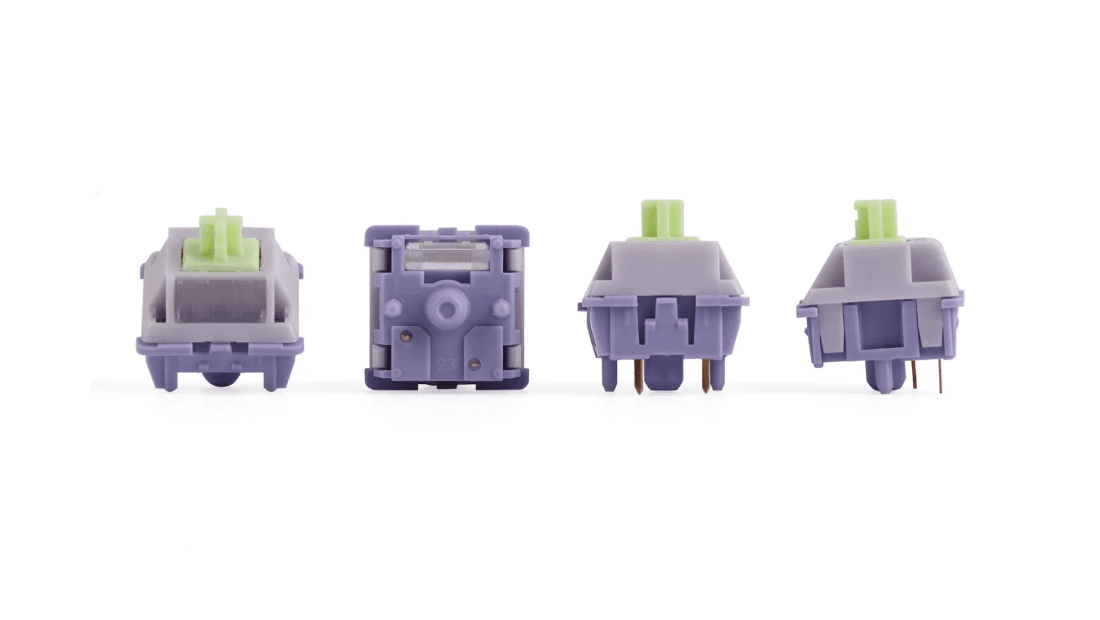
The EPOMAKER Wisteria immediately stands out thanks to its three-colour design. The linear version features a purple bottom housing, a lighter purple top housing and a pastel green stem. The colour combination gives the switches a distinctive appearance without relying on transparent or translucent plastics.
The tactile version uses an orange stem, allowing the two variants to be distinguished relatively easily.
Although the housings themselves are not translucent, EPOMAKER has incorporated an LED slot into the switch design. This allows RGB lighting from a compatible keyboard PCB to shine through the switch.
The Wisteria also uses a 5-pin mechanical switch design. This is important for custom keyboard builders because the switches are compatible with 5-pin hot-swappable PCBs and standard MX-style keycaps.
One consideration is the LED orientation. The Wisteria features a south-facing LED slot, so users should check their keyboard's PCB before purchasing. Boards designed around a different LED orientation may not provide the expected lighting compatibility.
Packaging
The switches arrive in a relatively straightforward cardboard box, with two layers of plastic covers protecting the switches from above and below.
There is not much unnecessary packaging, which makes sense for a product primarily concerned with the switches themselves. The packaging keeps the components protected during shipping while remaining relatively simple.
For a set of custom mechanical switches, the important factor is that the switches arrive securely and without damage, and the Wisteria's packaging provides that basic protection.
Compatibility
Compatibility is one of the Wisteria's strongest features.
The switches use a 5-pin MX-compatible structure, allowing them to be installed in compatible 5-pin hot-swappable mechanical keyboards. They can also be paired with standard MX-compatible keycaps.
The 5-pin design provides additional PCB stability compared with a two-pin switch, although users should still verify that their keyboard supports this type of switch before purchasing.
The south-facing LED design is another consideration. Anyone planning to use the Wisteria in an RGB mechanical keyboard should check the PCB's LED orientation beforehand.
Provided those requirements are met, the Wisteria is a flexible option for custom keyboard builds and switch replacements.
Gaming Performance
The EPOMAKER Wisteria performs particularly well for gaming.
The linear switch requires 45gf of actuation force, while the 2.2mm pre-travel and 3.6mm total travel provide a good balance between responsiveness and controlled key movement.
For gaming, linear switches are often preferred because they provide a consistent keypress without the tactile bump found on tactile switches. The Wisteria follows that approach, delivering a smooth press from the top of the stroke through to the bottom.
The relatively moderate actuation force also helps prevent the switch from feeling tiring during extended sessions. At 45gf, it is light enough for repeated inputs while still providing enough resistance to avoid feeling excessively loose.
This makes the Wisteria suitable for games that require frequent movement and repeated key presses. Competitive players looking for extremely short-travel switches may still prefer switches specifically designed around faster actuation, but the Wisteria offers a sensible balance between gaming responsiveness and everyday usability.
Gaming score: 4.25/5
Typing Experience
Typing is where the Wisteria makes an especially strong impression.
The switch provides a smooth keypress while maintaining a controlled mechanical sound. Rather than producing an excessively loud or sharp acoustic profile, the Wisteria delivers a more restrained sound that remains recognisably mechanical.
The combination of POM and PTFE in the stem contributes to the smooth movement. These materials are designed to reduce friction, and that is noticeable when moving the switch through its travel.
There is also a controlled amount of bounce-back at the end of each press. The return feels mechanically responsive without making the switch feel overly aggressive.
For users who spend as much time typing as gaming, this balance makes the Wisteria an appealing choice. It retains the character expected from a custom mechanical switch without becoming unnecessarily loud or fatiguing.
Typing score: 5/5
Sound and Switch Performance
The Wisteria has a comparatively dry sound profile.
Compared with EPOMAKER's Jade Blossom switches, the Wisteria produces a drier acoustic character while maintaining the same attention to reducing scratchiness and unwanted pinging.
That distinction is important because sound is a major part of the mechanical keyboard experience. The Wisteria does not attempt to create an especially deep or bass-heavy sound. Instead, it focuses on a controlled mechanical presentation.
The result is a switch that sounds clean and consistent. The return stroke also produces a subtle mechanical pop with a slightly higher pitch than the Jade Blossom.
The switch's performance is supported by its material selection. The POM and PTFE stem, polycarbonate top housing and PA66 bottom housing provide a solid foundation for smooth operation.
There is still some personal preference involved with mechanical switch acoustics. Users looking for a particularly deep or muted sound may prefer a different switch design, while those who enjoy a cleaner and slightly drier mechanical sound should find the Wisteria appealing.
Build Quality
EPOMAKER has paid considerable attention to the construction of the Wisteria.
The POM and PTFE stem is designed to provide smooth movement, while the polycarbonate top housing and PA66 bottom housing provide a combination of durability and structural stability.
The 20.4mm extra-long spring is another notable component. Combined with the 45gf actuation force, it contributes to the switch's consistent feel throughout its travel.
The most important aspect of the Wisteria's construction is how these components work together. The switch does not simply offer attractive colours; its material choices are focused on reducing friction and maintaining a controlled typing experience.
EPOMAKER Wisteria vs Other Custom Switches
The Wisteria sits in an interesting position within EPOMAKER's range.
Its sound is drier than the Jade Blossom, while the overall operation retains the smoothness expected from a higher-quality custom mechanical switch. The controlled scratchiness and reduced pinging also help distinguish it from cheaper mechanical switches.
For users moving up from basic stock switches, the difference should be noticeable. The Wisteria provides a more refined keypress and a more controlled acoustic profile without requiring an especially heavy actuation force.
It is also versatile enough to work across gaming and productivity setups rather than being designed exclusively for one use case.
Verdict
The EPOMAKER Wisteria is a strong option for anyone looking for a smooth linear mechanical switch with a balanced gaming and typing experience.
Its 45gf actuation force, 2.2mm pre-travel and 3.6mm total travel make it responsive enough for gaming while remaining comfortable during longer typing sessions. The POM and PTFE stem helps deliver smooth movement, while the polycarbonate and PA66 housings contribute to the switch's overall build quality.
The sound profile is another strength. The Wisteria produces a controlled, relatively dry mechanical sound, with limited scratchiness and pinging. It is not necessarily the right choice for someone specifically looking for a deep, muted or highly bass-heavy switch, but its cleaner acoustic character works well for a broad range of mechanical keyboard builds.
Compatibility is also strong thanks to the 5-pin MX-compatible design, although users should check their PCB and south-facing LED requirements before purchasing.
Overall, the EPOMAKER Wisteria linear switch offers a refined combination of smoothness, sound control, compatibility and gaming performance. It is an easy recommendation for mechanical keyboard enthusiasts looking to upgrade from basic switches without moving to an excessively heavy or specialised design. You can learn more here.