

Forty years in the hardware business and Gigabyte still has something to prove. The company's freshly unveiled AORUS INFINITY Series is the centrepiece of its anniversary product push, and while the RTX 5090 graphics cards and DDR5 motherboards are grabbing most of the headlines, the peripherals are quietly doing something more interesting.
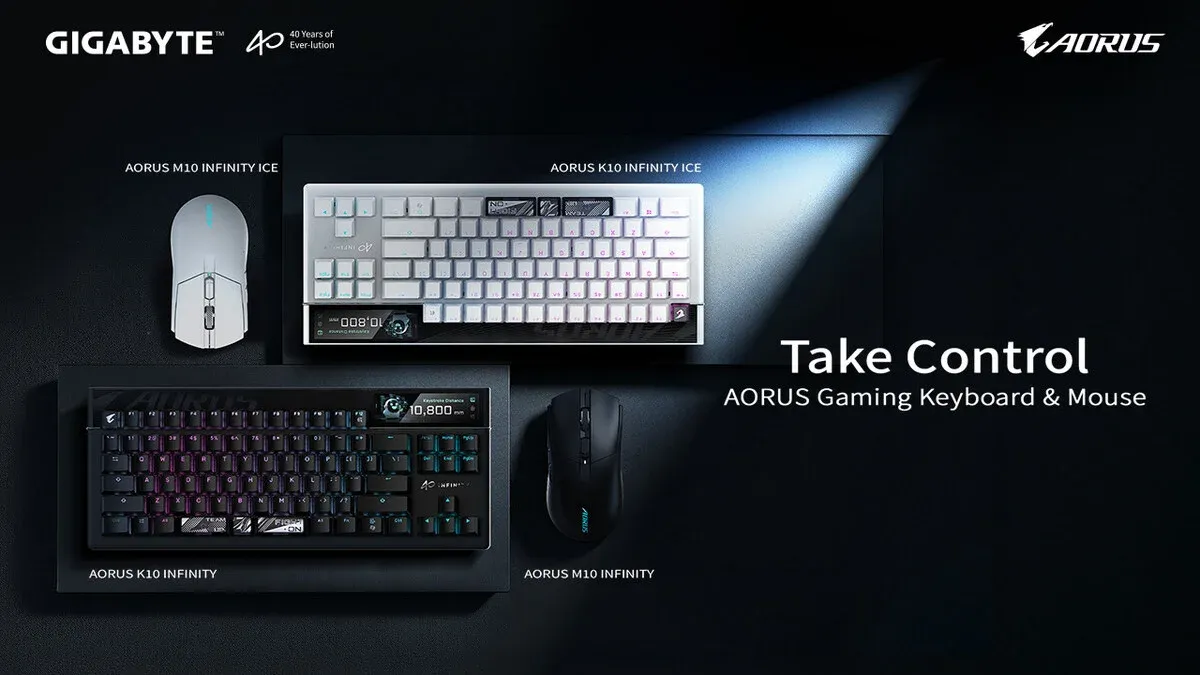
The AORUS K10 INFINITY keyboard and AORUS M10 INFINITY mouse landed alongside the rest of the INFINITY range this week, and on paper they read like a spec sheet designed to win arguments. The keyboard runs magnetic switches with 0.1mm actuation, an 8000 Hz polling rate, and a built-in 3.1-inch OLED touch screen. The mouse pairs optical switches with an aluminium-magnesium alloy frame. Both look sharp. Neither is the most interesting part of the story.

Use code TRYHARD33 at checkout to redeem this offer before code expires again.
Get 33% Off GAMES+ Subscription
The software angle nobody is talking about
Here's the thing: premium gaming peripherals live and die by their companion software. A keyboard with a 3.1-inch OLED display is genuinely useless without software that gives that screen something worth showing. The same goes for 8000 Hz polling, which requires driver-level support to actually translate into a smoother feel rather than just a bigger number on a spec sheet.
Gigabyte has been building toward this with GiMATE, its AI agent for system optimisation and RGB Fusion 3.0 customisation across the AORUS ecosystem. The INFINITY peripherals slot directly into that framework. What most players miss is that GiMATE isn't just a lighting app with a chatbot bolted on. Gigabyte has been developing it as a system-wide control layer, and the INFINITY keyboard's OLED panel becomes a live readout for whatever GiMATE is tracking, whether that's thermals, frame rates, or RGB profiles synced across your build.
That kind of integration is rare in peripheral software. Most manufacturers ship a standalone app that handles macros and lighting, then leave the keyboard and the rest of your system to figure things out independently. Gigabyte is betting that tying peripherals into the same software layer as your motherboard, GPU, and cooler creates something more useful. For anyone already running an AORUS build, the pitch is strong.
What the hardware actually delivers
Stripping back the ecosystem angle, the specs on both peripherals hold up on their own. Magnetic switches at 0.1mm actuation sit well below the typical 1.2mm to 2.0mm range you get from mechanical switches, which means the K10 INFINITY responds closer to the moment your finger moves than any conventional keyboard. Whether that translates to measurable competitive advantage depends entirely on the player, but the polling rate of 8000 Hz at least ensures the signal gets to your PC fast enough not to be the bottleneck.
The M10 INFINITY's aluminium-magnesium alloy construction is worth noting too. Most gaming mice at this tier still use polycarbonate shells. Metal frames add weight, but they also add rigidity, and optical switches eliminate the contact bounce that plagues some mechanical designs. The key here is that Gigabyte isn't just chasing specs; the material choices suggest actual engineering decisions rather than marketing copy.
The full INFINITY launch also includes the AORUS C510 GLASS INFINITY chassis, which features a 16-inch side display built into the case itself. Pair that with the keyboard's OLED screen and GiMATE's monitoring layer, and Gigabyte is clearly building toward a setup where multiple surfaces in your battlestation are live displays. It's an ambitious vision, and the software is the only thing that can make it coherent.
Where this fits in the broader AORUS push
The INFINITY Series is Gigabyte's biggest product cycle in years, spanning motherboards like the X870 AORUS INFINITY (supporting DDR5 at up to 11,400 MT/s), RTX 5090 and 5080 graphics cards, OLED and Mini LED monitors hitting up to 540Hz, and now peripherals with their own display surfaces. The peripherals aren't the headliner, but they're the part most gamers will actually touch every day.
For a closer look at how AORUS hardware performs across different game types, the game reviews section covers a range of setups and peripherals in real-world conditions. You'll want to check there once units start shipping and independent testing catches up with the launch claims.
Pricing and availability for the AORUS INFINITY peripherals haven't been confirmed yet, but Gigabyte's INFINITY range is positioned firmly at the premium end of the market. If you're building out or upgrading a full AORUS system, the gaming guides hub is a solid starting point for figuring out what components actually pair well together before committing to a build at this price tier.