

"The tools we have today are not the tools we need for the next decade of games." That sentiment is driving one of the more intriguing engine announcements to surface in the European games industry recently. The Immense Engine is a new game engine built from the ground up with AI at its core, and the person behind it spent years as a technical director at Epic Games.

Use code TRYHARD33 at checkout to redeem this offer before code expires again.
Get 33% Off GAMES+ Subscription
Who is behind this and why it matters
The project comes from a former Epic Games technical director who worked directly on Unreal Engine infrastructure. That background is not a minor detail. Unreal Engine is the backbone of a significant portion of the games industry, from triple-A blockbusters to indie breakouts, and someone who spent years inside that system understands both its strengths and the places where it creaks under modern demands.
The announcement positions The Immense Engine as a European alternative, which is a deliberate framing. The engine space has long been dominated by American companies. Epic Games is based in North Carolina. Unity is headquartered in San Francisco. A serious European contender, built by someone with direct Unreal lineage, is a different kind of proposition.
What makes it AI-heavy, specifically
Here's the thing: most engine announcements in 2026 slap "AI-powered" on the press release and call it a day. The Immense Engine appears to be taking a more structural approach, with AI integrated into core workflows rather than bolted on as a feature layer.
The engine is described as AI-heavy in its design philosophy, meaning the tooling, asset pipelines, and development processes are built around AI assistance from the start. The key here is that this is not a plugin or an optional module. The architecture itself is shaped around what AI can do for developers at every stage of production.
This matters because the alternative, retrofitting AI into an existing engine, produces the kind of awkward hybrid that neither traditional developers nor AI-forward studios find particularly satisfying. Building from scratch means no legacy constraints.
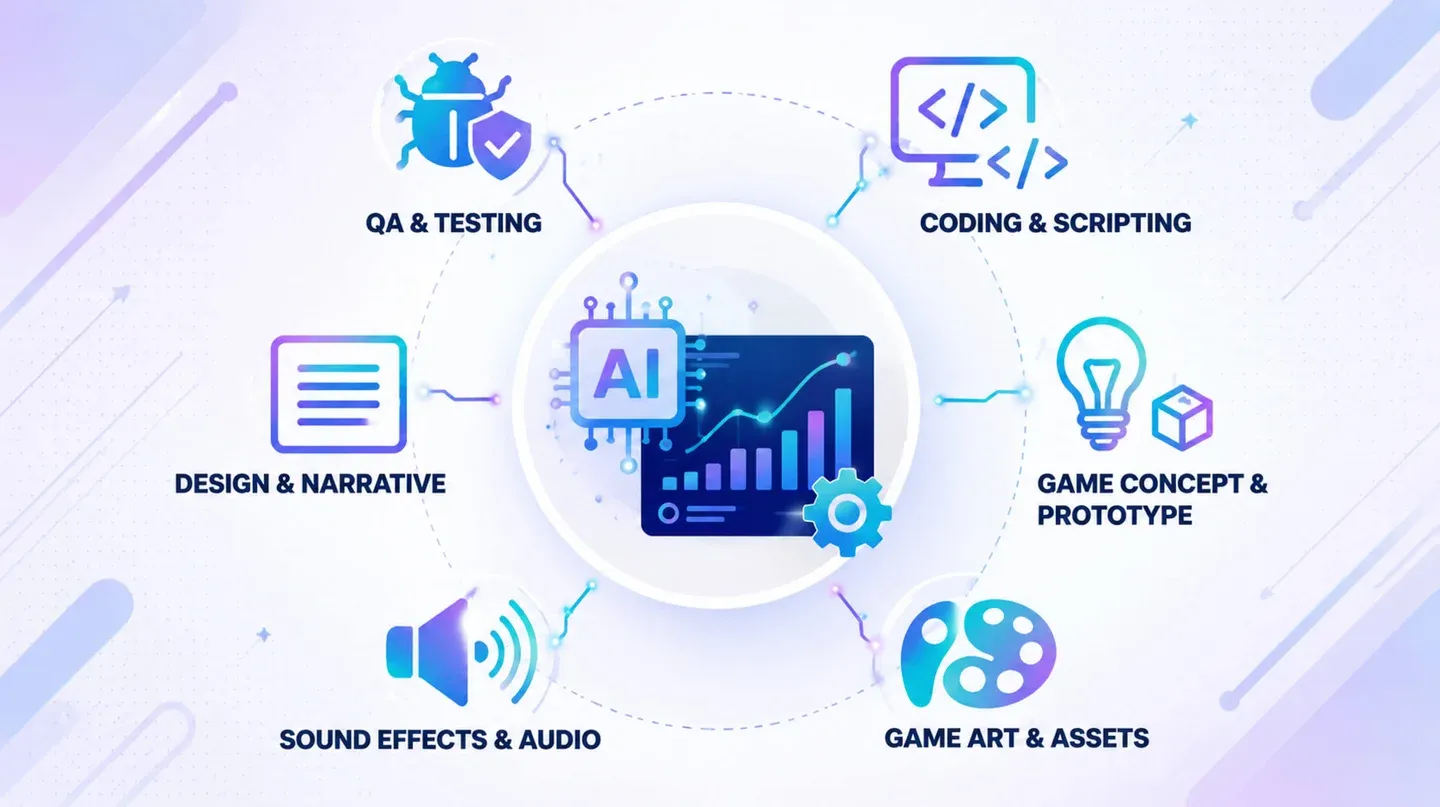
AI pipeline tools in development
The timing and the industry context
The announcement lands at a moment when Epic Games itself is going through significant turbulence. Earlier this year, Epic laid off more than 1,000 employees, roughly 20% of its workforce, as engagement with Fortnite declined. CEO Tim Sweeney was explicit that AI was not behind those cuts, but the broader industry conversation about AI and engine development is impossible to ignore.
Several major studios and dozens of tech companies have cited AI-driven efficiency as a reason to restructure. For an engine built with AI at its foundation, that context is either a headwind or a tailwind depending on how developers feel about the technology. The Immense Engine is clearly betting on the latter.
Building in Europe also carries strategic weight. European game development has grown considerably, with studios in Sweden, Poland, the UK, Germany, and France producing some of the most technically ambitious games of the past decade. An engine with European roots, European support infrastructure, and presumably European data compliance baked in could appeal to studios that have found American-headquartered tools occasionally misaligned with their operational needs.
What developers will actually want to know
Pro tip: the real test of any new engine is not the announcement, it is what the licensing model looks like and how the documentation holds up six months after launch.
Unreal Engine shifted to a royalty model years ago, taking 5% of gross revenue after a product earns $1 million. Unity's pricing controversies in recent years showed exactly how much licensing terms matter to developers at every scale. The Immense Engine has not yet detailed its commercial terms publicly, and that will be a defining factor in how seriously studios consider it as an alternative.
What most players and developers miss in these announcements is the support ecosystem. An engine is not just its renderer or its physics system. It is the community, the tutorials, the third-party asset marketplace, and the engineers available for hire who already know the toolset. The Immense Engine is starting from zero on all of that, which is a real challenge regardless of how technically impressive the core technology turns out to be.
A genuine challenger or a niche tool
The honest answer is that it is too early to say. The games industry has seen ambitious engine projects that never escaped early access, and it has also seen scrappy newcomers eventually carve out genuine market share. The credentials here are legitimate. A former Epic technical director is not building a hobby project.
The AI-first architecture could genuinely differentiate the engine for studios that want to build production pipelines around generative and assistive tools rather than working against the grain of a traditional engine. European studios looking for alternatives to American platforms have a concrete reason to pay attention.
For a broader look at how new tools and technologies are landing in actual games, our game reviews track how engine and tech choices show up in finished products. And if you want to go deeper on the technical side of game development, our gaming guides cover everything from engine basics to advanced production workflows. The Immense Engine's next milestone will be a public build or a developer preview, and that is when the real evaluation begins.