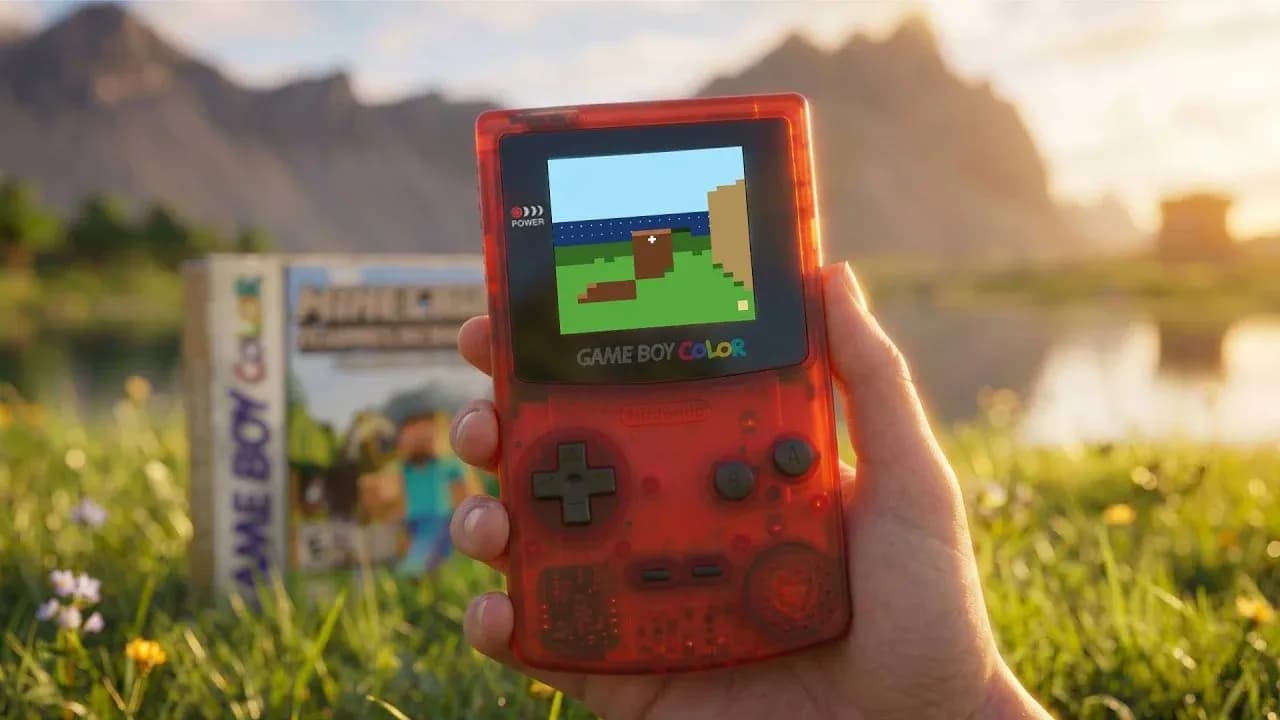


A YouTuber has done what nobody asked for but everyone needed: got Minecraft running on a Game Boy Color, in 3D, on hardware that launched in 1998 and was never intended to push anything resembling a three-dimensional world.
Game of Tobi posted the project this week, and the results are genuinely impressive given the constraints. This is not a 2D approximation or a flat block-pusher dressed up with pixel art. The Game Boy Color version renders a recognizable 3D world you can actually walk around in, break blocks, place blocks, and even visit a Nether dimension.
What Tobi actually built
The key here is what Tobi was going for from the start. As they explain in the video, the goal was not just a Minecraft-flavored experience but something that "is recognisable as a 3D world where you can walk around." The Game Boy Color predates portable 3D gaming hardware by years, so pulling this off required some real creative engineering.
The port is not a full Minecraft build. There is no health system, no inventory management, and no mobs wandering around. You get a couple of worlds to choose from, the ability to break and place blocks, and the Nether, which Tobi added specifically because, as they put it, "I really want to do something with this."
Textures are turned off by default because enabling them tanks the frame rate to something unplayable. At half speed and in black and white, the ROM also runs on the original 1989 Game Boy, the Color's predecessor, which is either a bonus feature or a punishment depending on how you look at it.
The controls situation
Here is the thing: the Game Boy Color's limited button layout creates some real friction. Movement appears to be handled by the D-pad, while looking around requires holding a separate button and pressing the D-pad simultaneously. Moving and looking at the same time seems practically impossible on the original hardware, which puts a ceiling on how playable this actually is in practice.
That said, "playable" is doing a lot of work here. This is the kind of project where the achievement is getting it running at all, not shipping something that competes with the Nintendo Switch version.
Why this matters beyond the novelty
Running Doom on unexpected hardware has been a community sport for years, with ports turning up on vapes, charging stations, and basically anything with a display. Minecraft has not quite reached that same status yet, but Tobi's project feels like the starting gun.
What most players miss about these experiments is that they push real understanding of hardware constraints. Fitting any kind of 3D rendering into the Game Boy Color's processing headroom is not a trivial problem, and the solutions engineers find in these builds often inform legitimate emulation and homebrew development.
Minecraft already runs on Nintendo Switch, most handheld gaming PCs, and phones. The Game Boy Color port is not going to replace any of those. But as a proof of concept for what the community can extract from 1998 hardware, it is hard not to be impressed. Check out our in-depth Minecraft review if you want a reminder of just how far the full game has come, or browse the Minecraft guides collection to get more out of the version you are already playing.