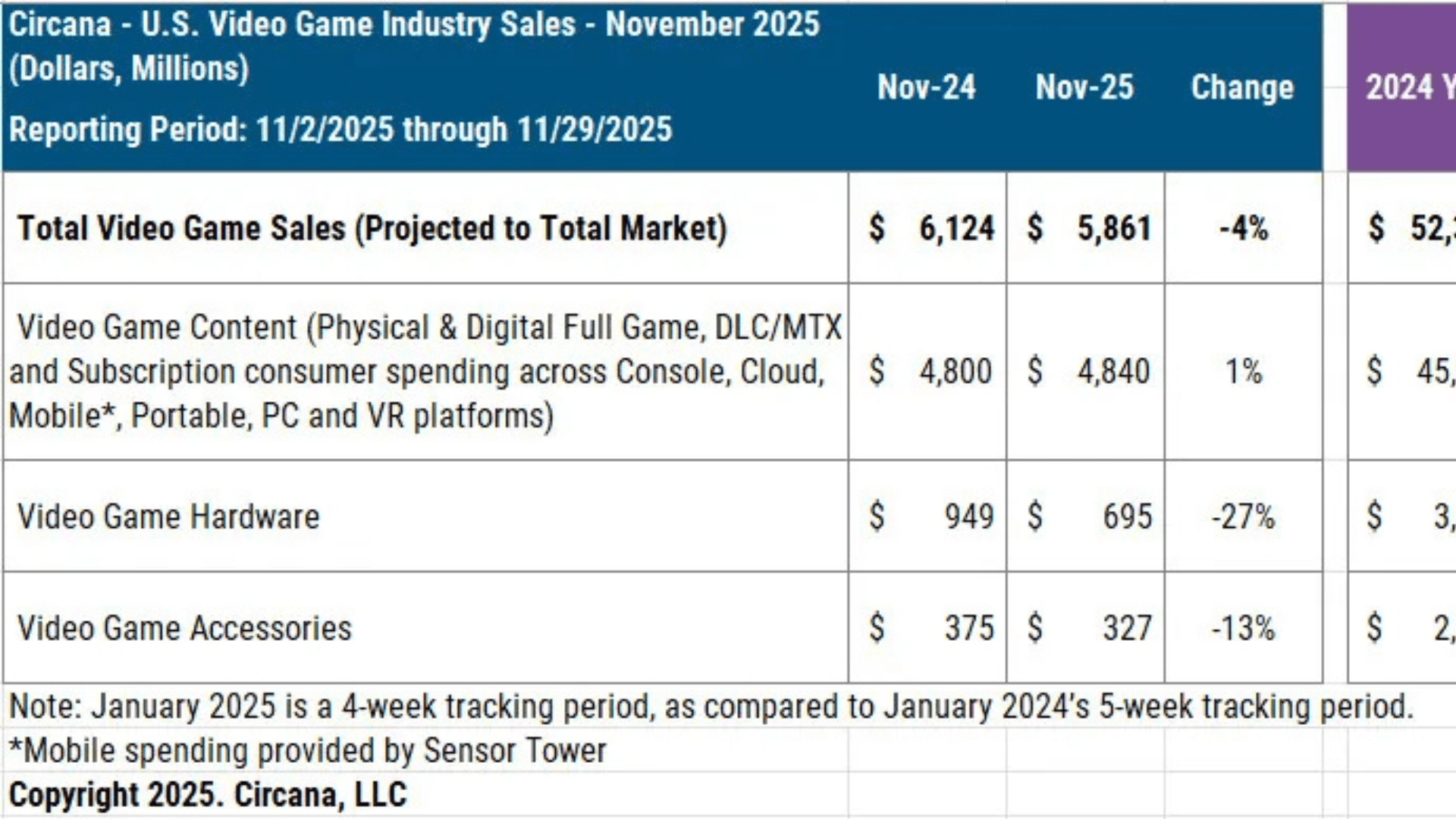

November 2025 was a challenging month for video game console sales in the United States. According to new data from Circana, Microsoft, Sony, and Nintendo all sold fewer units than they did in November 2024, reflecting a rare downturn in the holiday shopping period. Total spending on gaming hardware fell to $695 million, down 27% from $949 million in the previous year, marking the lowest November hardware sales total since 2005.
Unit sales painted an even starker picture. Approximately 1.6 million consoles were sold in November 2025, the lowest November figure reported by Circana since 1995, when 1.4 million units were sold. This highlights a notable decline in the market, despite the current generation featuring PlayStation 5, Xbox Series consoles, and Nintendo Switch 2 systems compared to the original PlayStation and Super Nintendo era.

Performance Breakdown: Xbox, PlayStation, and Nintendo
Sales declines were widespread across all three major manufacturers. Circana analyst Mat Piscatella reported that Xbox Series unit sales fell by more than 70% year-over-year. PlayStation 5 sales were down by over 40%, and combined Switch and Switch 2 sales declined by more than 10% compared to the previous year.
Nintendo’s figures were notable because the Switch 2 launched in June 2025 and sold roughly 10 million units in its first four months. Despite that early momentum, combined Switch hardware sales in November were lower than the original Switch’s sales for the same month in 2024.
Pricing may have played a role in the declines. The average price of consoles from the three major companies reached $439 in November 2025, an 11% increase compared to 2024. PlayStation 5 pricing remained relatively stable due to promotions, while Xbox Series prices increased by about 30%, and Switch/Switch 2 pricing rose by 70%, reflecting the newer system’s higher cost.
Hardware Highlights Beyond the Big Three
Not all gaming hardware experienced declines in November. Circana highlighted the NEX Playground, a motion-controlled gaming device priced at $250, which saw strong sales during Black Friday. The device reportedly outsold Xbox consoles during the holiday weekend, signaling continued interest in niche gaming hardware.
Software and Industry Updates
Despite the weak console sales, software and platform developments remained active. Netflix announced the return of FIFA-branded video games, while previews of an updated Animal Crossing title generated attention among players. These developments suggest that while hardware sales faced headwinds, interest in gaming content and experiences remains steady.
Source: Circana
Frequently Asked Questions (FAQs)
Why did U.S. console sales drop in November 2025?
Sales declined due to a combination of higher average prices for consoles, slower year-over-year demand, and potentially limited new hardware releases outside of the Switch 2 launch.
Which consoles were most affected?
The Xbox Series saw the largest decline, dropping over 70% year-over-year. PlayStation 5 sales fell by more than 40%, and combined Switch/Switch 2 sales were down over 10%.
Did Nintendo’s Switch 2 help offset losses?
Although the Switch 2 sold well after its June launch, combined Switch hardware sales in November 2025 were still lower than the original Switch’s performance in November 2024.
Were any consoles or hardware performing well?
The NEX Playground, a motion-controlled gaming system, performed strongly, outselling Xbox consoles during Black Friday.
How does this compare historically?
Total hardware spending in November 2025 was the lowest since 2005, and unit sales were the lowest since 1995, indicating a significant downturn in the U.S. console market.
Are software sales also declining?
While hardware sales dropped, software and game-related announcements, like FIFA returning on Netflix and updates to Animal Crossing, show continued engagement in gaming content.
Could pricing changes be the main reason for lower sales?
Pricing likely contributed, as average console costs rose 11% year-over-year, with notable increases for Xbox Series and Switch 2 systems, potentially affecting consumer purchasing decisions.