
Most games tell you when you've won. Stardew Valley never does, and that's the entire point.
The farming sim from solo developer ConcernedApe has been running strong since its February 2016 release, and a big reason players keep returning is that the game refuses to impose a single definition of success. No final boss. No credits roll. Just a piece of land, a town full of characters, and a completely open question: what do you actually want to do here?
The design philosophy behind player-driven goals
From the moment you start a new save, Stardew Valley asks you to make choices that shape your entire experience. The farm map selection alone, with 8 options including the fishing-focused Riverland Farm, the combat-oriented Wilderness Farm, and the aesthetics-friendly Meadowlands Farm, signals early that there is no default correct path. Each map comes with trade-offs that nudge players toward different playstyles. The Riverland Farm, for example, is built around a character who fishes exclusively, and fishing generates enough income to sustain a full playthrough without ever touching a crop.
Here's the thing: that kind of specialization is completely valid. Stardew Valley never penalizes you for ignoring half its systems.
The features that make self-directed play actually work
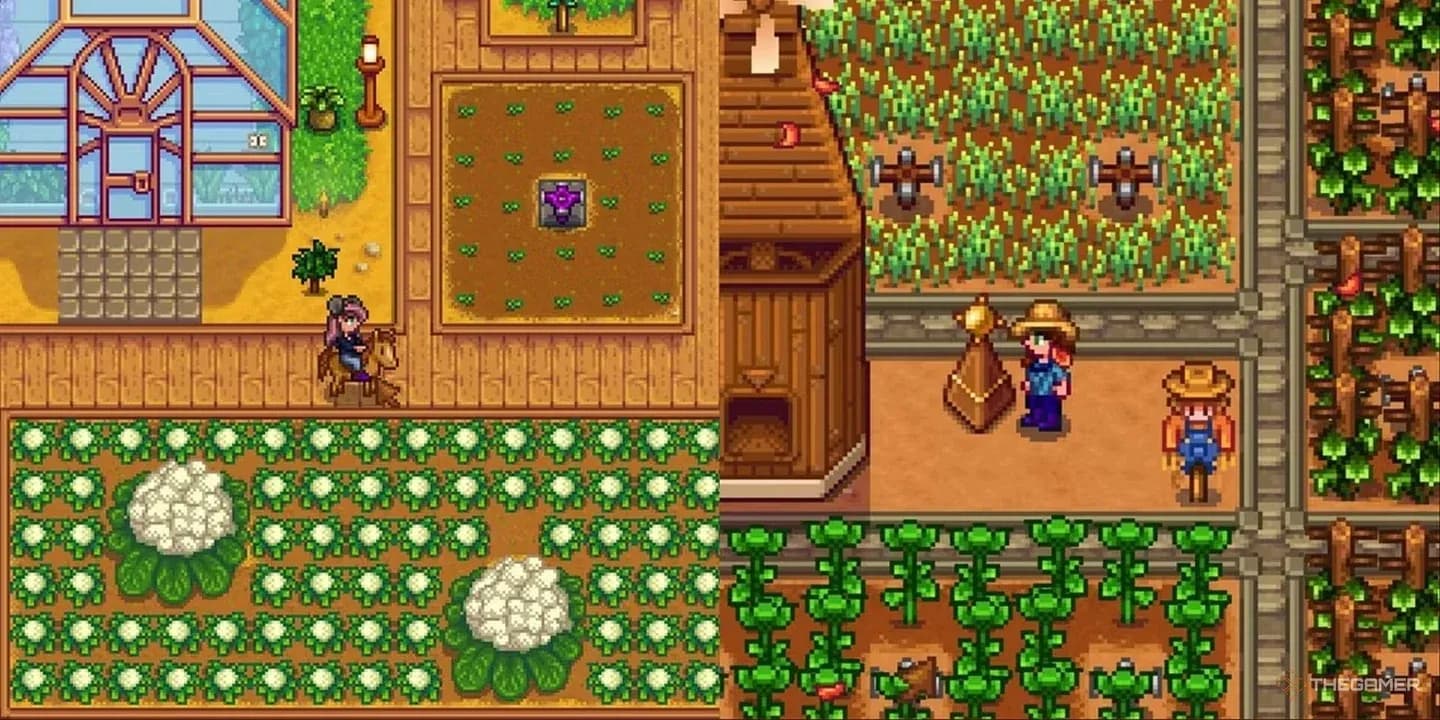
Open farm design is the foundation. You can convert every tile into crop rows, leave the land wild, or spend most of your time decorating. Decorative items are available through seasonal festivals, vendors, and crafting, and the placement system gives enough flexibility to build something that looks genuinely personal. The game rewards the aesthetic farmer just as much as the profit-maximizing one, because the reward is whatever you decided it was.
Relationships work the same way. All 12 marriage candidates are available regardless of player character gender, and there is no time pressure on building those connections. What most players miss is the Krobus option: the underground merchant can move in as a platonic roommate, offering the same gift value as a full marriage candidate without any romance involved. A game acknowledging that a non-romantic relationship can be just as meaningful as a marriage is genuinely rare.
info
Krobus as a roommate provides gifts of equivalent value to marriage candidates, making the platonic path mechanically comparable to romance.
Late-game progression gets a similar treatment. Unlocking Calico Desert via the bus and Ginger Island via the repaired boat both require resources and relationship milestones, so reaching those areas becomes a personal benchmark of progress. New NPCs, recipes, and ingredients give players who have cleared the early goals somewhere meaningful to go next.
The Joja vs. Community Center split, and what Perfection actually means
The closest thing Stardew Valley has to a main story is the choice between restoring the Community Center by gathering resources for the forest spirits, or taking the Joja Mart route and simply paying for town restorations directly. Thematically they point in opposite directions, but mechanically both paths are legitimate. The game does not punish the Joja route, even if the Community Center path is the more celebrated one.
For players who want a concrete finish line, the Perfection tracker exists. Hitting 100% Perfection unlocks additional content that leans more emotional than functional, which works well for players who want to feel genuine completion without grinding for stat upgrades. It's an optional ceiling rather than a mandatory target.
The key here is that Stardew Valley layers these systems without locking any of them behind the others. You can chase Perfection, ignore it entirely, specialize in mining, build a wine empire, or spend three in-game years decorating your farmhouse. None of those approaches is treated as less valid than the others.
No fail state means the goals are actually yours
There is no game over in Stardew Valley. Passing out from exhaustion or getting knocked out in the mines costs you some gold and items, but nothing is permanent. That absence of punishment is what makes player-defined goals feel real rather than performative. You are not racing against a timer or a threat. You are just building something, at whatever pace makes sense to you.
For players who want structure, the Steam achievement list and in-game Perfection score provide clear milestones. For players who want none of that, the game stays out of the way entirely. That balance is harder to design than it looks, and it's a big part of why Stardew Valley still pulls people in years after release. For more on games built around player freedom, browse more guides covering the best sandbox and simulation titles worth your time. Make sure to check out more: