
The Assassin’s Creed franchise has remained one of Ubisoft’s most recognizable series for nearly two decades. Since its debut in 2007, the franchise has shifted between stealth-action gameplay, large-scale RPG mechanics, naval exploration, and historical storytelling across multiple eras.
Here are the top 10 Assassin’s Creed games of all time, ranked based on gameplay quality, historical settings, story execution, and overall influence on the series.
10. Assassin's Creed Unity
Assassin’s Creed Unity launched with technical problems that overshadowed many of its strengths. Over time, however, the game gained recognition for delivering one of the franchise’s most detailed open-world cities. Revolutionary Paris remains one of the strongest settings in the series, supported by dense crowds, large interiors, and improved parkour systems.
The stealth-focused gameplay also returned the franchise to its original design philosophy. Cooperative multiplayer missions added another layer to the experience, even if they were underused. Unity’s reputation improved significantly after post-launch updates addressed most of its early issues.
9. Assassin's Creed Shadows
Assassin’s Creed Shadows finally brought the franchise to feudal Japan, one of the most requested settings in the series’ history. The dual protagonist structure allows players to alternate between stealth-oriented gameplay and direct combat approaches, giving the experience more variety than recent entries.
The game also introduces dynamic weather systems and seasonal changes that affect stealth and exploration. While Shadows continues the RPG direction introduced in Origins, it balances those mechanics with a stronger emphasis on assassination gameplay.
8. Assassin's Creed III
Assassin’s Creed III marked a major transition for the franchise. Set during the American Revolution, the game introduced larger wilderness environments, naval combat mechanics, and a new protagonist in Connor Kenway.
Although Connor divided opinions compared to Ezio Auditore, the game expanded the scale of the series considerably. Naval missions became one of the standout additions and directly influenced the development of Black Flag. The historical backdrop also gave the franchise one of its most politically focused narratives.
7. Assassin's Creed
The original Assassin’s Creed established the core identity of the franchise. Its focus on social stealth, free-running, and historical conspiracies created a formula that Ubisoft would expand for years afterward.
Altaïr Ibn-La’Ahad remains one of the series’ most important characters, and the game’s atmosphere still stands apart from later entries. While mission variety was limited compared to modern installments, the first game introduced many systems that became central to the franchise.
6. Assassin's Creed Valhalla
Assassin’s Creed Valhalla expanded the RPG structure introduced in Origins and Odyssey with a Viking-focused narrative centered on Eivor. The game emphasized large-scale exploration, settlement management, and combat-heavy gameplay.
England’s open world delivered significant environmental variety, while raids and territory alliances gave the campaign a broader sense of progression. Although Valhalla’s length became a common criticism, the game succeeded in blending Norse mythology with the franchise’s overarching lore.
5. Assassin's Creed Revelations
Assassin’s Creed Revelations served as the conclusion to Ezio Auditore’s story while also tying together the narrative arcs of Altaïr and Desmond Miles. Constantinople provided a fresh setting, supported by refined traversal mechanics and a more mature tone.
The game focused less on introducing major gameplay innovations and more on delivering narrative closure. That approach worked in its favor, particularly for long-time fans invested in the franchise’s early storylines.
4. Assassin's Creed Origins
Assassin’s Creed Origins reinvented the franchise after several annual releases led to franchise fatigue. Ancient Egypt became one of the most visually impressive settings in the series, while Bayek emerged as one of its strongest protagonists.
Origins shifted the franchise toward RPG mechanics, introducing level progression, loot systems, and redesigned combat. Despite those major changes, the game retained enough stealth and exploration elements to feel connected to earlier Assassin’s Creed titles.
Its origin story for the Hidden Ones also gave the franchise a stronger historical foundation.
3. Assassin's Creed IV: Black Flag
Black Flag remains one of the franchise’s most popular entries because of its naval gameplay and open-world exploration. Edward Kenway’s journey as a pirate captain delivered a different perspective compared to previous Assassin protagonists.
Sailing across the Caribbean, boarding ships, and upgrading the Jackdaw became the core appeal of the experience. While the Assassin-versus-Templar conflict played a smaller role, Black Flag succeeded because it prioritized player freedom and exploration.
The game’s pirate setting also helped separate it from the more urban-focused structure of earlier titles.
2. Assassin's Creed Brotherhood
Assassin’s Creed Brotherhood refined nearly every mechanic introduced in Assassin’s Creed II. Rome served as a large interconnected city filled with side activities, political conflicts, and assassination opportunities.
The Brotherhood recruitment system became one of the game’s defining features, allowing players to build and command their own group of Assassins. Multiplayer was also introduced for the first time, adding another layer to the franchise.
Ezio Auditore remained at the center of the story, and Brotherhood represented the character at the height of his influence within the Assassin Order.
1. Assassin's Creed II
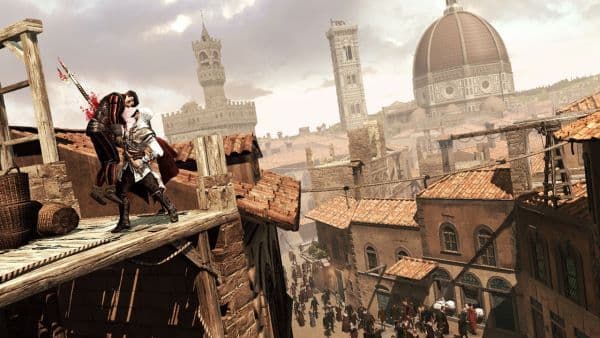
Assassin’s Creed II remains the defining game of the franchise. It improved nearly every aspect of the original title, from mission design and combat to exploration and storytelling.
Ezio Auditore quickly became the face of the series, supported by a revenge-driven narrative that evolved into a larger story about power, legacy, and freedom. Renaissance Italy provided memorable cities including Florence and Venice, while the expanded economic systems and side activities added more depth to the overall experience.
Most importantly, Assassin’s Creed II established the formula that shaped the franchise for years afterward. Even with the RPG-focused direction of modern entries, many fans still view AC2 as the benchmark for the series.