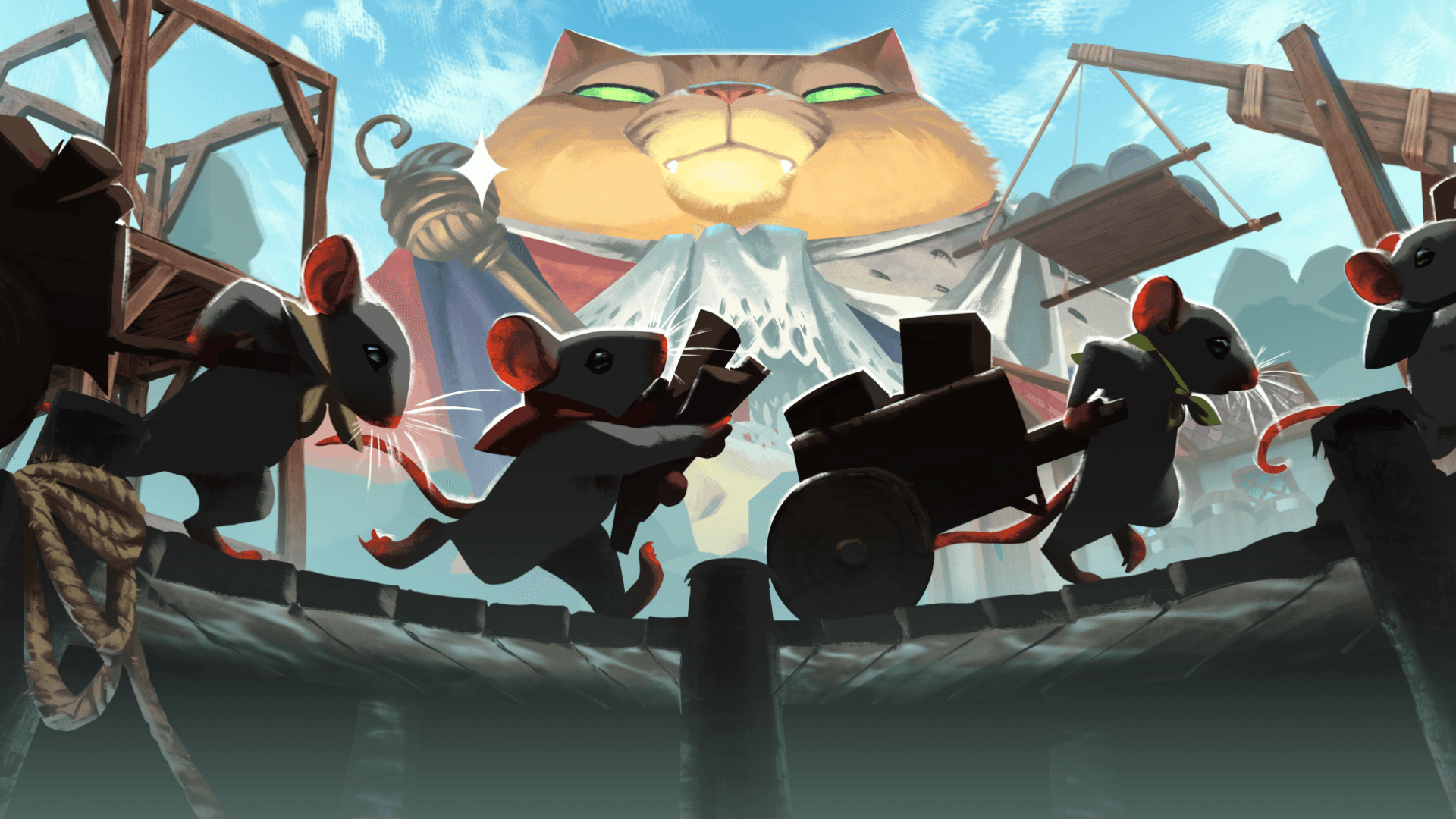

Whiskerwood, developed by Minakata Dynamics and published by Hooded Horse, is a vertical sandbox city-builder currently in Early Access on the Epic Games Store. Players lead a colony of mice who work, build, and pay taxes to an empire of demanding cats. While the concept may appear playful, its mechanics focus on resource management, logistics, and layered simulation systems.
A systems-first prototype that found its identity
The original concept for Whiskerwood did not include the now central theme of mice versus cats. Early development centered on deep city-building systems and sandbox flexibility. The early prototypes used placeholder NPCs, and the visual identity came later in the process. Once the team introduced mice and cats into the design, the pairing became inseparable from the experience.
After wrapping up development on Railgrade, Minakata Dynamics began prototyping new ideas internally. The team unknowingly split into two separate efforts, both exploring variations of survival-focused city-building. One concept emphasized core gameplay loops, while the other leaned heavily into simulation systems such as pollution and heat management. The studio merged the strongest elements of both, anchoring development to the more polished gameplay prototype and folding in the more detailed simulations over time.
A focus on vertical city-building
Whiskerwood's primary twist on traditional colony builders is vertical expansion. Each settlement exists on a small island with limited horizontal space, encouraging players to build upward rather than outward. Verticality brings its own challenges. Taller structures increase travel time, while wider builds create heating inefficiencies. Players must constantly weigh these trade-offs as they construct and optimize their mouse-powered economy.
Iteration has been central to development. Minakata Dynamics refined the core loop until they discovered what drove player engagement. Taxation became the key motivator. Tax payments to the cat overlords give expansion purpose and put pressure on decision-making. This mechanic encourages players to push harder for productivity, ultimately reinforcing the vertical design philosophy.
Power imbalance as a gameplay engine
In Whiskerwood, the Claws empire represents the authoritarian ruling class of cats. Their demands serve as both narrative backdrop and gameplay tension. The cats issue unreasonable requests, applying pressure on player efficiency and economic planning. Antagonists naturally drive conflict, allowing the team to introduce narrative stakes without heavy exposition.
The tax system and the cat hierarchy blend cleanly into the gameplay. They provide a reason to grow the settlement, upgrade infrastructure, and optimize logistics. While players are free to experiment and build creatively, the looming presence of the cats ensures that the stakes remain consistent.
Traits, personality, and mouse-level decision making
Each mouse—referred to as a Whisker—arrives with unique traits that influence productivity and social interactions. Some mice are cooperative and efficient, while others might create friction in the colony. One trait, simply called "Rude," can lower morale by upsetting nearby Whiskers. These personal behaviors encourage players to adapt rather than micromanage, reinforcing that NPCs are not just units but individual characters within the simulation.
Real-world mouse behavior influenced the design of many mechanics. Whiskers work together, dig tunnels, and build nests, mirroring natural mouse tendencies. The game encourages players to shape settlements in a way that feels authentic to how colonies might function rather than forcing artificial patterns.
Rebellion is the long-term goal
While the Early Access build emphasizes building, resource management, and taxation, the long-term structure hints at potential rebellion. Players can explore smuggling, research, and long-term planning to reduce dependency on the Claws. Economic strength eventually opens the path to defy the cats' authority.
Whiskerwood does not push players toward a single win condition. Instead, it gives them systems to interact with and space to decide how far they want to challenge the cats' rule. The journey toward freedom depends on how efficiently players design their settlement and how well they manage the individual strengths and weaknesses of their mouse population.
Whiskerwood is available now in Early Access on the Epic Games Store.
Frequently Asked Questions (FAQs)
What type of game is Whiskerwood?
Whiskerwood is a sandbox city-building sim with vertical construction, resource management, and character-driven systems.
Is Whiskerwood a strategy or survival game?
It blends colony management and strategy elements. Survival pressure comes from taxation and resource limitations.
Does Whiskerwood have combat?
Combat is not the core focus. Instead, tension comes from economic pressure and meeting the demands of the cat overlords.
What makes Whiskerwood different from other city-builders?
Vertical construction is central to progression, and each mouse has individual traits that impact how the settlement functions.
Is Whiskerwood related to web3 or blockchain?
No. Whiskerwood is a traditional PC game and has no connection to web3, crypto, NFTs, or blockchain technology.
Where can you play Whiskerwood?
The game is available now in Early Access on the Epic Games Store.