Search games, articles, guides...CtrlK
Sign InGet Started
Master Once Human's updated calibration blueprints and accessories system to craft the most powerful weapons in the game.

Written by Nuwel
Content Writer
See more GAMES.GG guides on Google
Add us as a preferred source and our guides show up first in your results.

Once Human Leveling Guide: Reach Level 50 Every Season Fast
Hit Once Human's level 50 cap before the seasonal reset with the most efficient XP routes, Memetic tips, and progression priorities.

Once Human Stargazy Pizza Guide: Craft the Best Underwater Build
Learn how to craft Stargazy Pizza in Once Human, find the recipe location, and pick the best fish for your build.

Once Human Version 2.3.5: Survive the Underground Update
Everything you need to know about Once Human's v2.3.5 update: new deviants, Devourer mechanics, weapon buffs, and blueprint overhaul.
Once Human's weapon calibration system went through a significant overhaul in the January 21, 2026 update, and if you haven't caught up, you're likely wasting resources on a system that no longer works the way you remember. The old workbench-based calibration is gone. Blueprints now attach directly at the crafting stage, stats are streamlined, and accessories have been standardized across rarities. Here's everything you need to know to build weapons that actually perform.
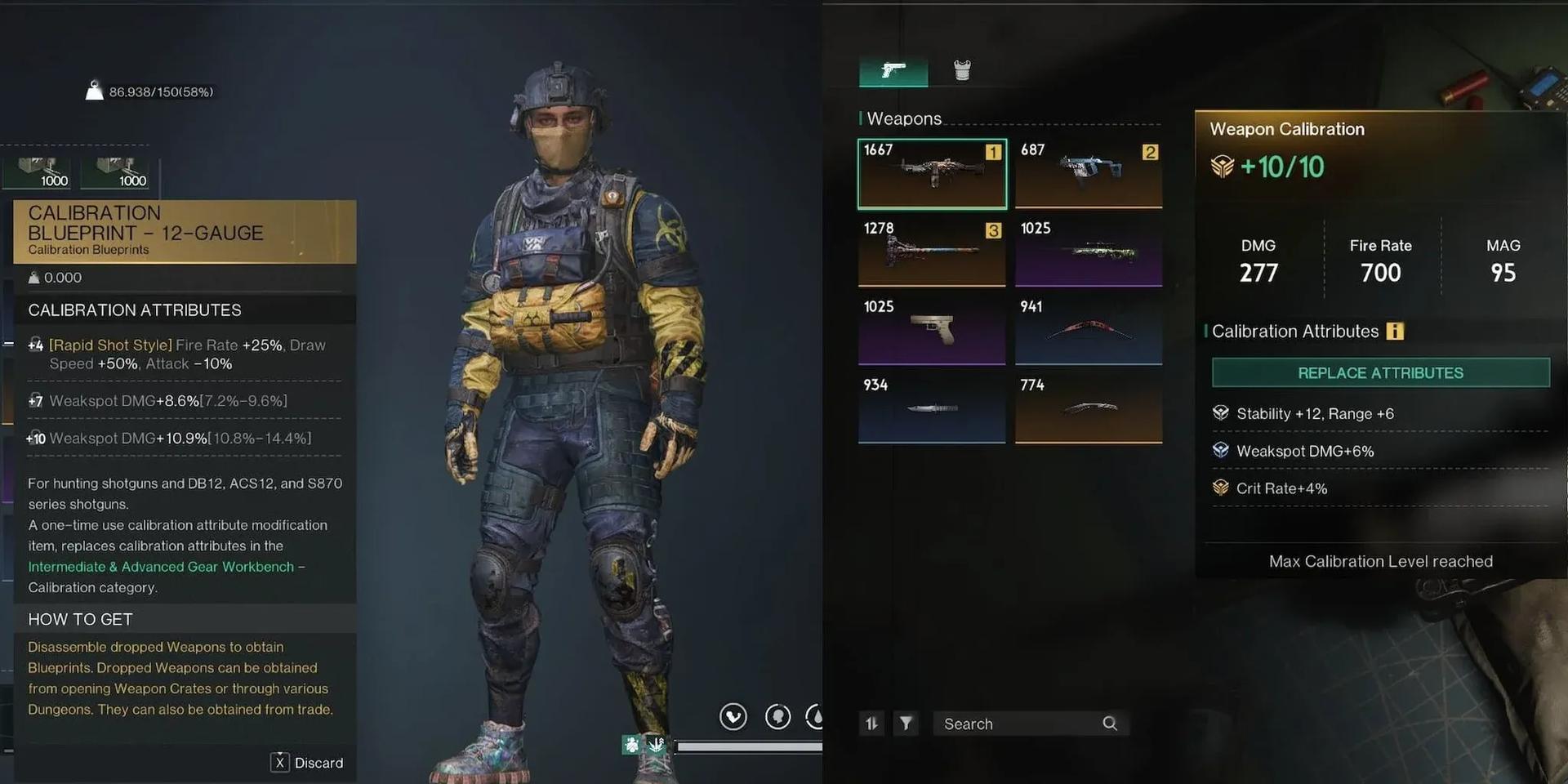
The calibration feature as it existed has been removed. You can no longer take a crafted weapon to a gear workbench and apply or swap calibration blueprints after the fact. Instead, calibration blueprints are now applied during the weapon crafting process itself, and their attribute effects activate at that point.
Weapons that were already calibrated before the update keep their stats untouched, so you don't lose progress on gear you already built. Old blueprints you had in your inventory can be taken to the Disassembly Bench to exchange them for new blueprints of the same name. One important warning: if you use the Disassembly Bench inside Eternaland, you'll receive Astral Sands instead of new blueprints. Make sure you're using the correct bench.
Players at level 40 and above (excluding RaidZone and Deviation: Survive, Capture, Preserve scenarios) received a compensation mail with self-selectable Legendary-quality refined blueprints and a Weapon Rename Card.
The new blueprint system is cleaner than the old one. Each blueprint still carries its style attribute (the main effect that defines how the weapon behaves), but the sub-attribute structure has been compressed.
Previously, blueprints rolled two separate random sub-attributes from a pool that included Crit Rate, Crit DMG, Elemental DMG, and Weakspot DMG. Under the updated system, those two slots collapse into one, with the value cap equal to the combined maximum of the old two attributes. You also always get one guaranteed attack bonus attribute, with the value scaling by rarity up to a 50% attack bonus at Legendary.
Here's how the attribute structure changed:
| Attribute | Before (Legendary) | After (Legendary) |
|---|---|---|
| Attack bonus | Not guaranteed | 33%–50% (always present) |
| Sub-attribute 1 | Elemental DMG 6%–8% | Merged into one slot |
| Sub-attribute 2 | Elemental DMG 9%–12% | Elemental DMG 15%–20% |
The result is fewer attributes to track but higher peak values on the ones that remain. For most builds, this is a net positive since you're no longer gambling on whether two separate rolls land on useful stats.
Blueprint calibration effects vary by weapon category. These style attributes remain the primary reason to choose one blueprint over another, since they define the weapon's playstyle entirely.
| Blueprint | Style | Effect |
|---|---|---|
| Heavy Melee | Hard-striker Style | Heavy Attack DMG +40%, Melee Stamina Cost -25% |
| Speed Melee | Light-striker Style | Movement Speed +12.5%, Light strikes continuously increase Melee Attack Speed up to +30% |
Heavy Melee favors slow, high-impact hits and reduces the stamina cost that makes sustained melee punishing. Speed Melee rewards rapid light attacks and gives you a movement speed bonus on top, making it the stronger pick for mobile melee builds.
| Blueprint | Style | Effect |
|---|---|---|
| Heavy Assault Rifle | Heavy Style | Magazine Capacity +75%, Reload Speed -30% |
| Precision Assault Rifle | Precision Style | Attack +25%, Range +40%, Fire Rate -10% |
| Rapid Assault Rifle | Rapid Shot Style | Fire Rate +20%, Reload Speed +40%, Attack -10% |
The Heavy Assault Rifle blueprint is the go-to for sustained fire builds where you want to minimize reloads. Precision trades fire rate for raw damage and range, which suits mid-to-long range engagements. Rapid splits the difference with better fire rate and reload at the cost of some attack.
| Blueprint | Style | Effect |
|---|---|---|
| Handy Sniper | Portable Style | Mobility +50 while firing, Movement Speed +12.5% while holding, Speed +50% while holding |
| Rapid Sniper | Rapid Shot Style | Bolt-pulling Speed +50%, Reload Speed +50%, Attack -10% |
| Steady Sniper | Stabilized Style | Stability +75, significant aim shake reduction |
Steady Sniper is the default choice for players who want to land consistent shots at range. Rapid Sniper is worth considering if you're running a semi-aggressive sniper build where follow-up shots matter. Handy Sniper is niche but genuinely useful if you're using a sniper in mobile content.
| Blueprint | Style | Effect |
|---|---|---|
| Assault SMG | Assault Style | Attack +20%, Magazine Capacity -25%, Accuracy -50 |
| Heavy SMG | Heavy Style | Magazine Capacity +60%, Reload Speed -30% |
| Light SMG | Lightweight Style | Reload Speed +150%, Magazine Capacity -30% |
| Blueprint | Style | Effect |
|---|---|---|
| 12-Gauge | Rapid Shot Style | Fire Rate +25%, Magazine Capacity +45%, Attack -10% |
| 16-Gauge | Lightweight Style | Reload Speed +150%, Magazine Capacity -30% |
| 20-Gauge | Heavy Style | Magazine Capacity +60%, Reload Speed -30% |
| Blueprint | Style | Effect |
|---|---|---|
| Assault Machine Gun | Assault Style | Attack +25%, Magazine Capacity -30%, Stability -50 |
| Rapid Machine Gun | Rapid Shot Style | Fire Rate +10%, Accuracy -50, Fire Rate +10% after 2s continuous fire |
| Steady Machine Gun | Stabilized Style | Stability +40, Stability +60 when squatting |
| Overflow Style (unnamed) | Overflow Style | Reload extra ammo equal to 50% of shots fired in last 20s, extra ammo gains Attack +8% |
The Overflow Style LMG blueprint is particularly interesting for sustained combat. After testing sustained fire scenarios, the compounding attack bonus on overflow ammo adds up quickly in extended fights.
| Blueprint | Style | Effect |
|---|---|---|
| P22 | Rapid Shot Style | Fire Rate +25%, Magazine Capacity +40%, Attack -15% |
| Portable Pistol | Portable Style | Mobility +50 while firing, Movement Speed +12.5% while holding |
| Precision Pistol | Precision Style | Attack +25%, Range +40%, Fire Rate -10% |
| Precision Crossbow | Precision Style | Attack +12.5%, Range +20%, Reload Speed -25% |
| Portable Crossbow | Portable Style | Mobility +30 while firing, Weapon Switching Speed +35% |
Three seasonal blueprints exist outside the standard weapon categories:
The accessories overhaul runs parallel to the blueprint changes. Two specific problems drove the redesign: too many overlapping reload attributes causing confusion, and inconsistent bonus values across accessories of the same type making comparisons unnecessarily difficult.
The fix for reload attributes was consolidating everything into a single Reload Efficiency stat. The conversion isn't one-to-one. A Reload Speed +10 bonus (flat) converts to Reload Efficiency +8%, while a Reload Speed +10% bonus converts to Reload Efficiency +3%. These are maximum conversion ratios and actual values vary by weapon type.
The practical effect: a weapon with no accessories has a base reload time of 3.634 seconds. Equipping a Tactical SR Mag under the new system brings that to 3.16 seconds (previously 3.3 seconds with the old Reload Speed +15 stat). The new system actually delivers faster reload times across the board after conversion.
| Scope Type | Rare | Epic | Legendary |
|---|---|---|---|
| 2x Scopes | 2.0x zoom, Accuracy +4% | 2.0x zoom, Accuracy +6%, Aiming Speed +15% | 2.0x zoom, Accuracy +6%, Mobility +20%, Aiming Speed +20% |
| 6x Scopes | 6.0x zoom, Accuracy +4% | 6.0x zoom, Accuracy +8% | 6.0x zoom, Accuracy +12%, Stability +5% |
| Muzzle Type | Rare | Epic | Legendary |
|---|---|---|---|
| Flash Hiders | Stability +10% | Stability +16% | Stability +22%, Bullet Velocity +10% |
| Brakes | Accuracy +10% | Accuracy +16% | Accuracy +22%, Bullet Velocity +10% |
| Suppressors | Range +10%, Stability -12% | Range +15%, Stability -12% | Range +20%, Bullet Velocity +10%, Stability -12% |
Suppressors consistently sacrifice stability for range across all rarities. If you're running a build that already compensates for stability through a Steady-style blueprint or armor bonuses, the range gain at Legendary (+20% plus Bullet Velocity) makes suppressors genuinely competitive.
| Magazine | Old Effect | New Effect |
|---|---|---|
| Tactical Pistol Mag | Reload Speed +16, Mobility +5 | Reload Efficiency +16%, Accuracy +8%, Mobility +10% |
| Extended Rifle Mag | Magazine Capacity +8, Reload Speed -13 | Magazine Capacity +10, Reload Efficiency -9% |
| Tactical SR Mag | Reload Speed +15, Mobility +7 | Reload Efficiency +15%, Accuracy +8%, Mobility +10% |
| Large LMG Drum Mag | Magazine Capacity +20, Reload Speed -20 | Magazine Capacity +20, Reload Efficiency -14% |
The Extended Rifle Mag actually got a slight buff: the capacity went from +8 to +10 rounds, and the reload penalty dropped from -13 (flat speed) to -9% (efficiency). For LMG users, the Large Drum Mag penalty also softened from -20 flat to -14% efficiency.
With the system changes settled, here's how to think about weapon construction going forward:
For more guides covering Once Human and other survival games, browse more guides at GAMES.GG to stay current with the latest strategies and system breakdowns.