


Path of Exile's Mirage league (patch 3.28) does not just add a new mechanic on top of the existing endgame structure. It rebuilds the Atlas from the ground up, replacing layout-locked map drops, Cartographer's Chisels, and Favoured Maps with a far more flexible tier-based system. Whether you prefer blasting Breach Hives, delving for fossils, or running Expedition logbooks, the new Atlas gives you real agency over how you farm. Here is everything you need to navigate it confidently from day one.
What Changed With the Atlas in PoE 3.28 Mirage?
The single biggest shift is how map items work. Previously, a dropped map was tied to a specific layout at a specific tier, so finding a Tier 10 Mesa was the only way to run Mesa at that tier. In Mirage, map items are simply "Tier X Maps." You pick up a Tier 10 Map and use it to open any Tier 10 (or lower) layout you have already revealed on the Atlas. Map sustain becomes dramatically less frustrating, and you never get locked out of your favourite layout again.
The Atlas itself has also been restructured. Your journey now starts at the center of the Atlas and expands outward, with one Voidstone slot anchored in each of the four corners. All endgame content, including Unique Maps, boss encounters, and special nodes, is physically placed on the Atlas and revealed as you explore the fog of war. Interacting with the Map Device opens the Atlas directly, and the device defaults to the last layout you ran, so re-running a map takes just a couple of clicks.
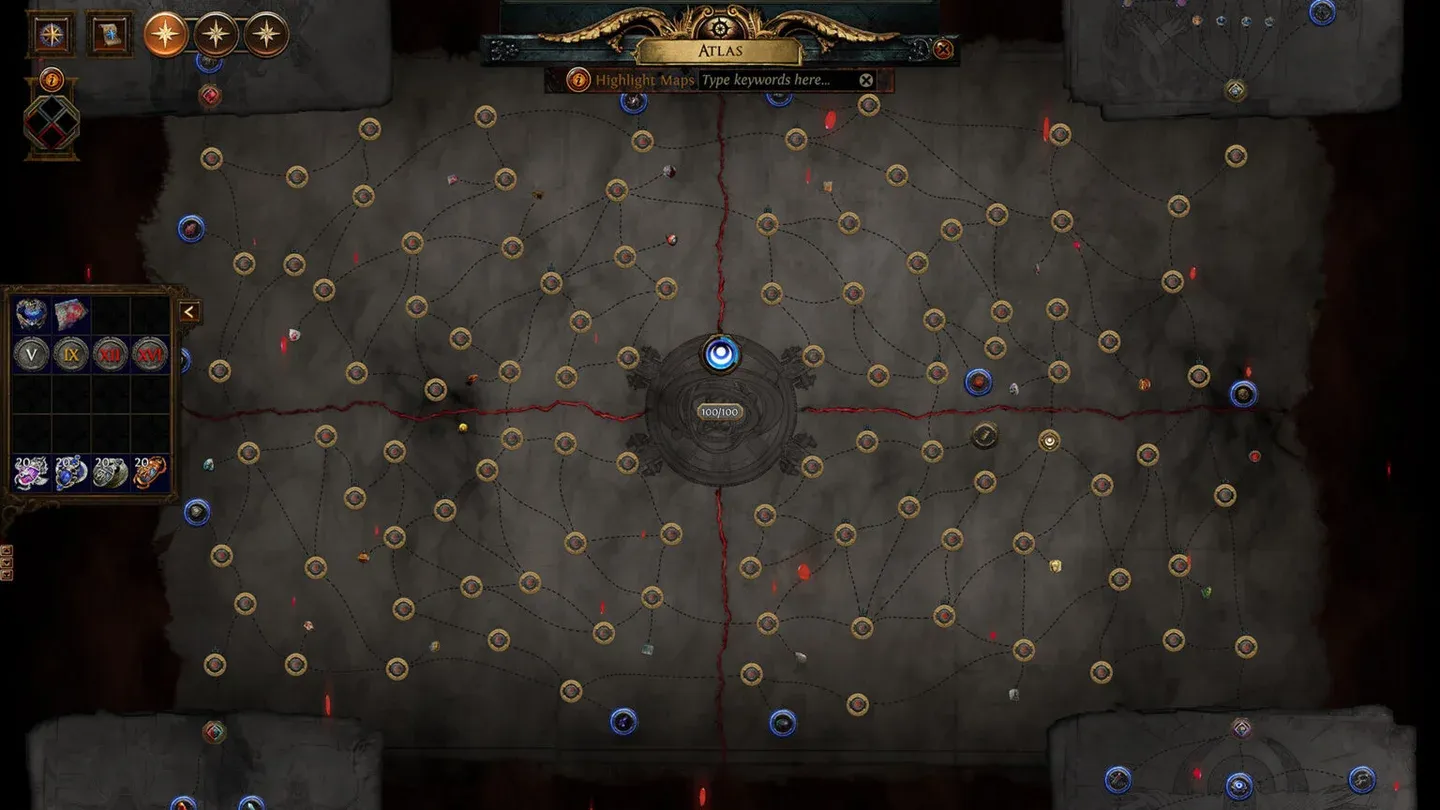
New Atlas center-origin layout
What Systems Were Removed?
Several legacy systems have been cut entirely to reduce friction:
- Cartographer's Chisels no longer drop, and Map Device crafting options are gone. The associated bonuses have been redistributed to other reward systems.
- Favoured Maps are no longer needed since you can freely choose any revealed layout.
- Scouting Reports can no longer be obtained.
- Memory Skills / Petal Skills in Originator-influenced areas have been removed. Petals now grant a higher chance to find items with Memory Strands instead, and some former Petal skill effects appear as new Altar bonuses at the end of Memory Thread maps.
- Several frustrating map modifiers have been removed, including "Players and their Minions deal no Damage for 3 out of every 10 seconds," Petrification Statues, and the Impale reflection modifier.
How Do Arcane Astrolabes and Shaped Regions Work?
Arcane Astrolabes are the replacement for the old Sextant system. Using an Astrolabe on an Atlas map creates a Shaped Region, a cluster of maps in that quadrant that all gain the Astrolabe's specific content type. Examples of Astrolabe types include:
Each time you complete the Astrolabe content in a map, the influence is removed from that specific map but the remaining maps in the region gain an additional modifier, making them progressively harder and more rewarding. Once you clear every map in the Shaped Region, Eagon takes you to one of four Memory Vaults, each tied to a specific quadrant. Notable vault rewards include:
- Arkhon's Vault: Choose a Unique item.
- Zealot's Vault: Choose a valuable Currency item.
Because each vault corresponds to a fixed quadrant, you can target the one you want by choosing where to apply your Astrolabe.
Astrolabe Shaped Region spread
How Do Voidstones Work in Mirage?
Voidstones have been reworked significantly. They now grant global bonuses to all your maps while socketed, rather than simply upgrading map tiers the way they did before.
- Decayed Voidstone: Obtained by defeating both the Shaper and the Elder (or Uber Elder). Grants a chance for Shaper or Elder influence on map opening.
- Eldritch Voidstone: Obtained by defeating both the Searing Exarch and the Eater of Worlds. Boosts Eldritch Altar mechanics and allows overlapping altar buffs.
- Incarnation Voidstone (from Incarnation of Dread): Enables Atlas Bosses to drop Astrolabes and the new Exceptional Support Gems. After obtaining this stone, items with Memory Strands can drop from all Atlas maps, not just Originator maps.
- Originator Voidstone: Earned by defeating all three Incarnation bosses (Fear, Neglect, and Dread). Enables Exceptional Support drops from specific Atlas Bosses. There are 40 Exceptional Supports available in Mirage.
How Do You Earn 138 Atlas Passive Points?
The total number of Atlas Passive Points has risen to 138 in Mirage. Here is how they are distributed:
- 100 points from completing 100 core maps (at appropriate rarity and corruption level for each tier).
- 10 points from Unique Maps. There are around 20 Unique Maps available, and you only need to complete 10, so you can skip the ones you dislike.
- 5 points from completing all Nightmare Maps.
- 11 points from Maven Invitations and boss group encounters.
- 12 points from Pinnacle Eldritch Bosses.
- 6 bonus points (2 per Incarnation boss) from the Threads of the Originator quest line.
Additionally, every 4 Atlas Bonus Objectives you complete grants +1% Map Item Quantity, so thorough mapping pays off beyond just unlocking nodes.
Atlas passive tree overview
What Are the Best Early Atlas Tree Priorities?
For league start, the goal is fast progression, map sustain, and unlocking higher tiers without over-juicing maps before your build can handle the difficulty. A reliable early path focuses on:
- Shaping the Mountains (10% increased Rare Monsters in maps), Shaping the Skies (10% increased Magic Monsters), and Shaping the World (Map Boss has a 5% chance to drop an extra map one tier higher). Together these give you roughly 50% increased chance for map drops to be one tier higher.
- Shrine wheel nodes: Start with the guaranteed Shrine node for a free shrine in every map, then pick up duration and effect nodes. Shrines provide significant movement speed, damage, and survivability buffs that speed up early progression.
- Nico pathing for Sulphite buffs: Movement speed and maximum elemental resistance bonuses from Sulphite events are especially strong in early red maps.
- Block unwanted mechanics to increase the spawn rate of what you actually want. Early blocks worth considering: Breach, Legion, Expedition, Harvest, and Abyss. You can unblock and test mechanics once your build is stable.
- Scarab nodes for early scarab drops, since scarabs are highly valuable at league start and do not make maps significantly harder.
Aim for around 31 to 35 points in this early route so you have flexibility to adjust as the meta settles. Delay heavy juice wheels and pack-size nodes until you are comfortable in red maps.
Top Farming Strategies for PoE Mirage League
Delve: Best for Fossil Farming
Delve stands out in Mirage because fossils now drop exclusively from Delve, not from Heist, Delirium, or any other mechanic. With that drop pool consolidated, fossil prices are expected to be elevated at league start.
Start running Delve meaningfully from Act 8 onward, targeting depths 250 to 350 for a reliable balance of fossil density and manageable difficulty. Depths past 500 offer greater rewards but demand stronger builds and capped Darkness Resistance.
For the Atlas tree, prioritize nodes that increase Niko encounter chance and sulphite yield, such as Frantic Mining and Mining Byproducts. The Sulphite Infusion Atlas Passive now grants 400 Sulphite for completing a White Tier map, 700 for Yellow, and 1000 for Red (doubled from the previous values), so higher-tier maps fill your sulphite capacity much faster.
Inside the mine, crack walls aggressively with dynamite to find hidden fossil and resonator stashes. Upgrade your sulphite capacity first, then alternate between Darkness Resistance, Light Radius, and flare/dynamite capacity.
Expedition: Logbooks and Vendor Currency
Expedition remains one of the most consistent currency generators, particularly when combined with the new Expedition Scarab of Infusion, which causes logbooks to drop with four implicit modifiers.
The mandatory Atlas Keystone for Expedition is Extreme Archaeology, which lets you detonate the entire site in one mega-explosion while applying all Remnant modifiers simultaneously. Pair it with the Distinguished Demolitionist radius nodes for even larger explosions. Take Buried Knowledge for increased logbook quantity from runic monsters.
For vendors, focus on Tujen (raw currency) and Dannig (logbooks and Tujen currency). Roll logbooks for high quantity and pack size, prioritizing Knights of the Sun and Blackscythe Mercenaries logbooks for the best returns.
Heist: Contracts and Blueprints
Heist has received significant Atlas passive buffs in Mirage. The Secret Stash Notable now grants +30% chance for a Smuggler's Cache per map (up from +12%), and the small passives leading to No Honour Among Thieves each grant +20% chance for an additional cache (up from +10%). With the full Heist wheel, most maps will contain multiple Smuggler's Caches.
Prioritize Deception contracts (fastest to run, most profitable) and use Gianna for blueprint reveals. Focus blueprint runs on Currency, Replica, and Experimental Base reward rooms. Speed is more important than full clearing: most profit comes from volume.
With 138 Atlas points available, you can comfortably spec into Heist and pair it with Expedition or another mechanic simultaneously.
Breach and Betrayal: Hive Farming
Breachlords content has transitioned to the Keepers of the Flame core league system, replacing the old Breachstone loop with Breach Hives and Unstable Breaches. The new Atlas Keystone Dimensional Foothold guarantees a Breach Hive in every map.
The Breach Scarab of the Incensed Swarm causes Ailith's skills to enrage the Hive, increasing difficulty and reward for subsequent waves. Pair this with the Protracted Siege notable (more Alith skill uses, more waves per Hive) and Evolving Hives (more monsters per wave) for a highly lucrative loop.
Add Betrayal (Jun) nodes for veiled and fractured item drops. The Pillage and Plunder Atlas Passive now grants a 5% chance for veiled items from Syndicate members to drop with a Fractured Veiled Modifier, which commands a premium in the early league economy.
New League Mechanic: How Does Mirage Work?
Within your maps, you can encounter and free Djinn imprisoned by Afarud Warlocks. After defeating the Djinn's physical form, Varashta offers you entry into the Astral Realm, a mirrored copy of the map you are currently running.
Before entering, you choose one of three Wishes that modify the Mirage: these can transform what monsters drop, add special caches, or provide coins for enhancing your gems. Each of the three Wish types causes affected monsters to drop their corresponding Coin type:
- Coin of Knowledge: Corrupts a level 20 Skill Gem, imbuing it with a random Intelligence Support effect.
- Coin of Power: Corrupts a level 20 Skill Gem, imbuing it with a random Strength Support effect.
- Coin of Skill: Corrupts a level 20 Skill Gem, imbuing it with a random Dexterity Support effect.
Inside the Astral Realm, fight through monsters and Afarud mages to reach the tether holding the Djinn. Shattering the chain frees the Djinn and completes the encounter. You can only have 1 imbued Skill Gem per active link, so plan your gem setup before spending coins.
SSF-Specific Atlas Priorities
Solo Self-Found players face tighter constraints since trade is not available for filling gear gaps. The most reliable approach in Mirage SSF focuses on:
- Breach and the Genesis Tree: Breach Hives provide strong early-game items and crafting flexibility without requiring trade access.
- Essence farming: Deterministic crafting from Essences is invaluable for building multi-resistance and high-life gear when you cannot buy what you need.
- Delve (Nico nodes): Fossils are exclusive to Delve in 3.28, making Nico pathing essential for SSF crafting power spikes.
- Map sustain nodes: Maintaining a healthy map pool and tier sustain is more critical in SSF to avoid progression bottlenecks.
- Expedition and Betrayal as secondary pivots: Once gear improves, these mechanics add crafting bases and currency throughput that help round out missing item slots.
Avoid spreading Atlas points too thin. Specializing in two or three mechanics you understand well will outperform a diluted generalist setup in SSF.