
Scritchy Scratchy looks like a casual clicker about scratching lottery tickets. Spend ten minutes with it and you will realize it is actually a tightly designed economy simulator that punishes impulse spending and rewards players who understand the underlying systems. The gap between players who stall out at a few thousand dollars and players who hit jackpots consistently comes down to a handful of decisions made in the first hour of play.
What should you do first in Scritchy Scratchy?
Your opening minutes are spent at the sink, scrubbing dishes to build starting capital. The first few plates are completely safe and hand you a reliable few dollars to get moving. Once scratch tickets unlock, that changes: every plate you wash carries a flat 10% chance of breaking, and no amount of careful mouse movement affects that probability. It is a pure dice roll, so do not stress about scrubbing technique.
The single most important early decision is how you distribute your first upgrade points. The game gives you three core scratching stats, and dumping everything into one of them is a trap that will cost you later.
Luck compounds across every single action you take, so it should receive consistent investment throughout your entire run, not just early on. Coin size and scratch area are useful quality-of-life upgrades, but pouring resources into them at the expense of Luck is the most common beginner mistake.
How do you read cards to avoid losing money?
Not every ticket is worth scratching completely. Several card types contain penalty symbols that actively drain your wallet if you fully reveal them, and learning to spot them before committing is what separates profitable runs from debt spirals.
Snake Eyes dice cards
Dice-based tickets penalize you heavily for revealing a face showing the number one. The trick is that dice faces with a one always lack dots in at least one corner. Scratch only the extreme corners of a die first. Blank corners signal danger before you expose the full face, letting you abandon the die entirely.
Scratch My Back turtle shell cards
The turtle shell is divided into segments hiding either jellyfish symbols (big payout) or plastic bag symbols (penalty). Scrape away a tiny sliver of each segment before committing. If you catch the edge of a plastic bag, skip that segment and move to the next one.
Lucky Cat and Apple Tree trap cards
These two are responsible for more early-game bankruptcies than anything else. The Lucky Cat hides black cats, and the Apple Tree hides worms. Both symbols steal money the moment you fully uncover them.
The peeking technique is your defense: scratch only a small portion of each circle. If you spot a cat ear or a worm tail, stop your mouse immediately and discard the card. You only take the penalty on full reveals, so partial scratches cost you nothing.
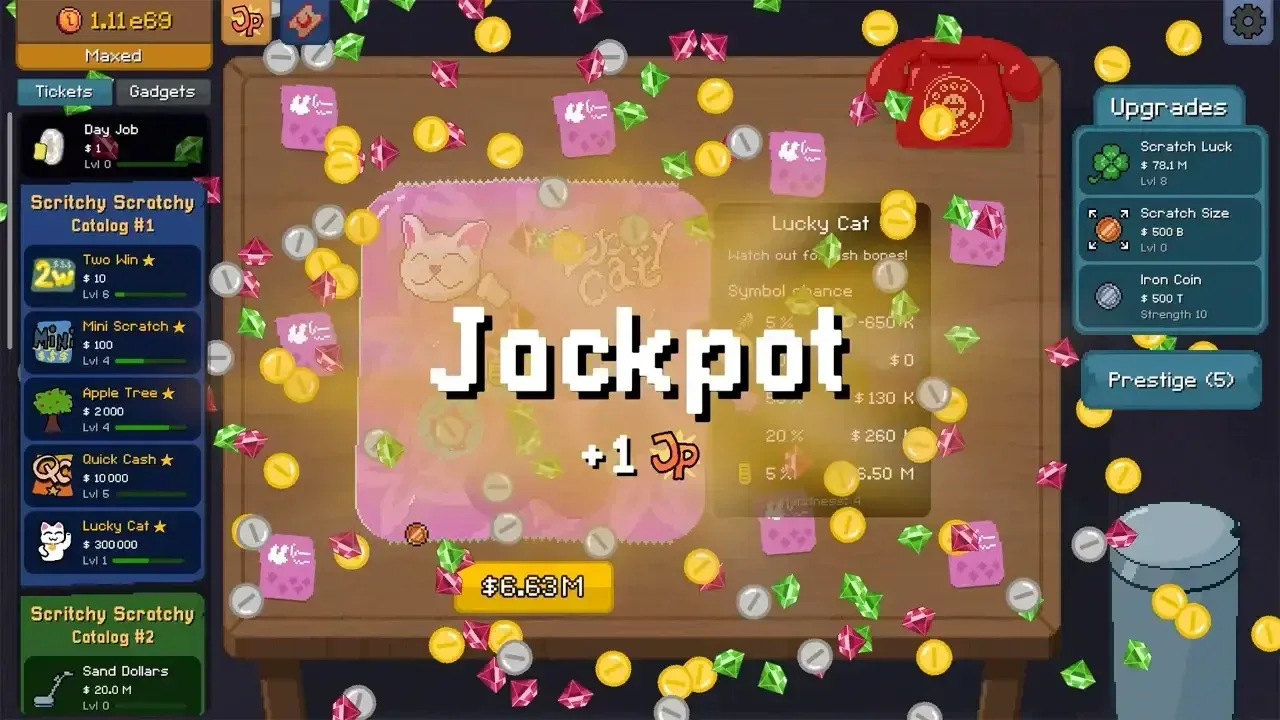
Ticket upgrade tree overview
How does automation work in Scritchy Scratchy?
Manual scratching gets the job done early, but your wrist and your patience both have limits. The automation systems are what turn a decent run into a self-sustaining income loop.
The auto scratcher and fan
The scratch bot and fan work together to process tickets without manual input. Upgrading the autobot should be a consistent priority, because each improvement compounds over time. A slightly faster bot running continuously outperforms a burst of manual scratching every time. Invest in autobot upgrades as soon as you can afford them, then reinvest the increased income into further upgrades.
Where did the spacebar go?
If you played the Next Fest demo, you probably remember tapping Space to accept winnings after clearing a ticket. That feature was moved in the full release. It is now a purchasable upgrade sitting in the bottom left column of the rightmost upgrade tree. Grabbing this early is one of the best quality-of-life purchases in the game.
Spells for high-value cards
Once you unlock the spellbook on your desk, clicking the spell button clears an entire ticket instantly. Save spell uses for your highest-value cards to maximize the return on each cast.
Mundo: from useless to essential
Mundo, the waving lucky cat statue, looks completely pointless when you first buy him. He processes scratched tickets pushed into his zone, but his early speed is painfully slow. Do not write him off.
Once you reach the prestige system and unlock his Picky Eater upgrade, Mundo transforms entirely. He gains the ability to detect penalty symbols on incoming tickets and automatically discards them rather than cashing them in. He goes from desk decoration to financial safety net in a single upgrade.
What about Dishbot?
Dishbot cannot tackle the large pile of dirty dishes until you unlock the prestige system. His strength requirement is tied to prestige progression, so do not expect him to pull his weight until you have your first reset under your belt.
What happens when you go broke?
Hitting zero dollars feels catastrophic, but it is not a soft lock. The phone on your desk lets you take out a loan to get back in the game. Take it. Rebuilding from a loan is always better than restarting from scratch.
The catch is significant: loan interest sits at 6,000%, and carrying debt applies debuffs that reduce your efficiency (including a noticeably smaller scratch area). Pay the loan off as fast as possible by returning to safe, reliable cards until your balance recovers.
How does the prestige system work?
Progression eventually hits a wall when you encounter the Final Chance card. This card cannot be won. It is designed to lose, and triggering it activates the prestige system.
Prestiging resets your current run but awards Prestige Points you can spend on permanent buffs that carry over into every future run. The temptation is to prestige the moment the option appears. Resist it.
A reset without a meaningful permanent buff is just lost time. Build your fortune first, learn every trap card by heart, and only pull the trigger on prestige when you have enough points stockpiled to buy something that will actually change your next run. The difference between a weak prestige and a prepared one is the difference between a slightly easier repeat of what you just did and a genuinely faster path to the jackpot.
Building a stable run from the start
The players who struggle in Scritchy Scratchy are almost always the ones who scratched everything in front of them without reading the symbols first, or who dumped resources into scratch power while ignoring Luck. The game rewards patience and system knowledge over raw clicking speed.
Learn the penalty symbols on each card type. Invest in Luck before anything else. Automate as early as possible. Do not prestige until you are ready. Those four habits will carry you further than any single upgrade purchase.
For builds, achievement lists, and a full upgrade path breakdown, browse the guides section at GAMES.GG to find everything you need across the full library of indie and incremental games.