


The right weapon changes everything in Smalland
In Smalland: Survive the Wilds, your weapon is never just a damage number. Every item carries a specific damage type, and the creatures you fight have hard-coded weaknesses and resistances shown directly on their health bars. Pick the wrong tool against the wrong bug and fights drag on twice as long. Pick the right one and they end fast. This guide breaks down every weapon and tool across all crafting stations, with the stats you need to make smart decisions at each stage of progression.
How does the damage system work?
Before getting into individual weapons, the core mechanic worth understanding is damage typing. Each weapon deals one or more of the following damage types: Edged, Blunt, Piercing, Poison, and Fire. Creatures have a weakness shown on the left side of their health bar and a resistance on the right. Matching your weapon's damage type to a creature's weakness makes fights noticeably faster.
All melee weapons also have two attack modes. Basic attacks are quicker but hit lighter. Heavy attacks are slower but deal significantly more damage. Ranged weapons work differently: they have no heavy attack and instead charge up before firing. Harvesting tools like hatchets and pickaxes can technically deal damage in a fight, but their combat numbers are much lower than dedicated weapons. Use them for gathering, not combat.
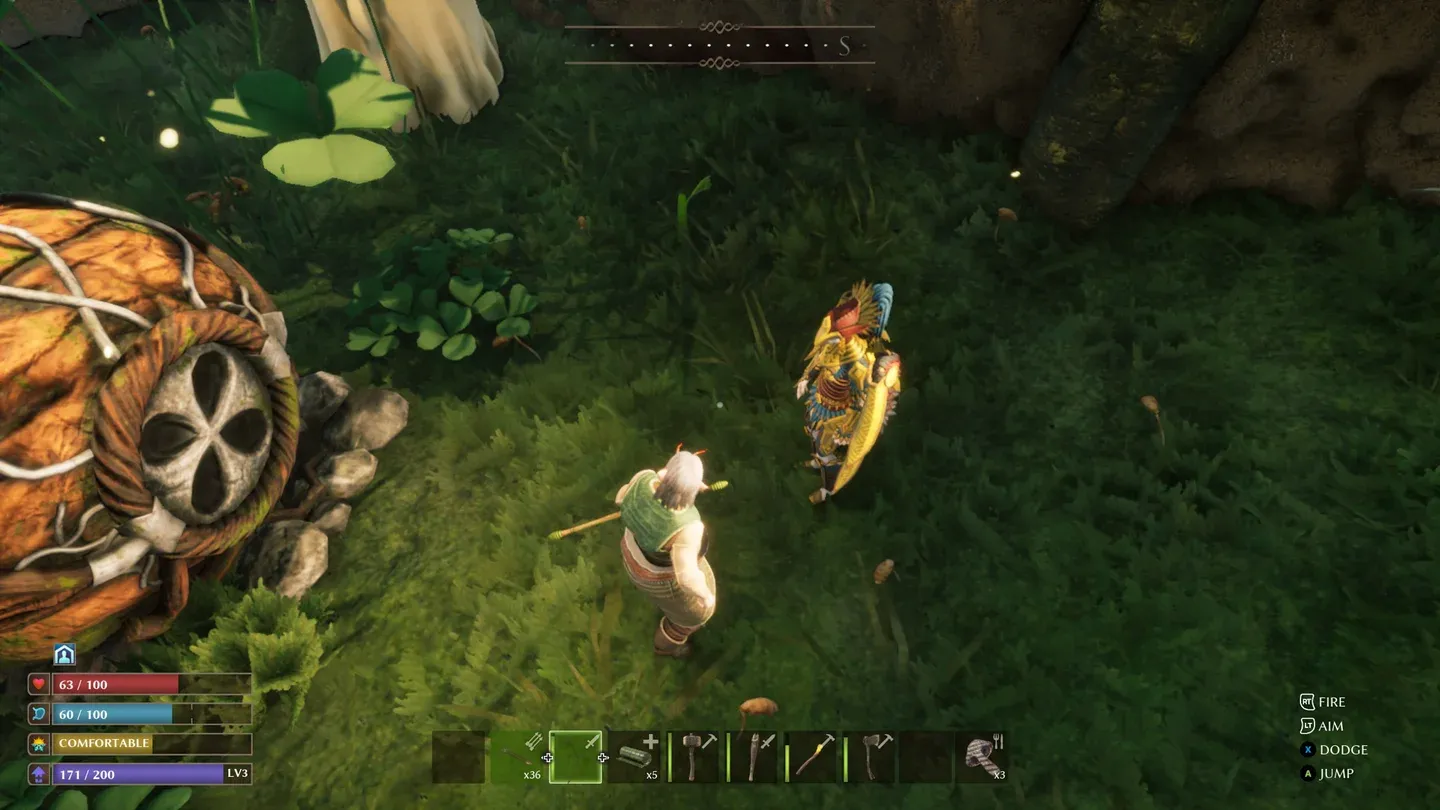
Check weaknesses before fighting
What can you craft at the Workbench?
The Workbench is your starting point and covers a wider range of items than any other station. Early game, you are working with wood and fiber. The Wood Club deals 6-8 Blunt damage with a blocking power of 6 and durability of 160. The Wood Sword steps up to 8-11 Edged damage with a blocking power of 7 and 200 durability. Both cost only basic wood and fiber, making them your first real combat options.
For ranged play, the Simple Bow fires at Piercing damage 12-14 with low accuracy and cuts your movement speed by 40% while drawn. It requires 8 Fiber, 10 Wood, and 4 Resin. Don't forget to craft Wood Arrows separately (3 Wood + 2 Fiber each) before heading into a fight.
Once you have access to Chitin from fallen creatures, the mid-tier Workbench weapons become available. The Chitin Axe hits 20-30 Edged damage with only 15 stamina usage, making it one of the more stamina-efficient melee options at this stage. The Chitin Spear reaches 20-28 Piercing damage with 25 stamina usage. Both require Silk Thread and Refined Wood in addition to Chitin, so you need to have progressed through the Loom and Spindle first.
The Poisoned Mace is a standout mid-game pick: it deals Blunt 10-16, Piercing 10-16, and Poison 12-14 simultaneously. That triple damage type coverage means it will hit something's weakness almost regardless of the target. It costs 5 Poison Glands, 10 Insect Stings, 2 Bark, 2 Fiber String, and 4 Refined Wood.
Healing items from the Workbench
The Workbench also produces your healing consumables. The Simple Bandage restores 3 health per second over 10 seconds and costs just 2 Fiber. The Healing Patch extends that to 20 seconds using 1 Fiber and 1 Honey Crumble. The Clay Bandage runs for 30 seconds and requires 1 Fiber and 1 Clay. Carry a stack of whichever tier you can afford before any serious encounter.
What does the Stonecutter add to your arsenal?
Building a Stonecutter opens a significant jump in weapon quality. Flint-tier weapons are the main draw here, and every one of them requires obtaining Flint as a recipe unlock.
The Flint Sword deals 16-22 Edged damage with 20 stamina usage and 240 durability. The Flint Spear hits 18-22 Piercing with 30 stamina usage. The Flint Hatchet doubles as a harvesting tool with 60 Harvest Damage and 6-9 Edged combat damage, making it the best all-purpose tool at this tier.
For ranged, the Composite Bow is the Stonecutter's headline weapon. It fires at 21-26 Piercing damage with high accuracy and a velocity of 75, but only cuts movement by 40% compared to the Chitin Bow's 60%. It requires Lizard Claws, Iron Ingots, Silk Thread, Heavy Chitin, Fiber, and Refined Wood. The Blowgun is an alternative ranged option that fires darts instead of arrows. It has low accuracy and a brutal -70% movement penalty, but pairs with Poisoned Darts (+4 Poison) and Urticating Darts (+6 Poison) for stacking poison damage on targets weak to it.
The Serrated Sabre is worth highlighting separately. It deals 12-16 Edged damage, which sounds modest compared to Flint-tier swords, but it has a durability of 3000, far beyond anything else at this stage. It requires Serrated Chitin (from mantises), Herptile Leather, and a Tibial Spine. If you can farm the materials, the durability alone justifies crafting it.
The Stinger Lance is the other standout here: 20-28 Piercing plus 12-14 Poison damage on every hit, requiring Insect Stings, Textile Patches, Refined Wood, and Heavy Chitin.
What are the best Forge weapons?
The Forge is where Smalland's weapon progression peaks. Iron-tier weapons are a substantial upgrade across all categories, and the late-game Pyrite and Aetherin weapons push damage numbers even further.
For melee, the Iron Scythe deserves attention: 21-35 Edged damage with a 10% Critical Hit Chance (double the standard 5%) and 20 stamina usage. The Iron Axe reaches 24-36 Edged with only 20 stamina. The Iron Hammer hits 39-45 Blunt but costs 30 stamina per swing.
The Morningstar deals both 21-28 Blunt and 21-28 Piercing simultaneously, meaning it covers two damage types on every hit. It requires Iron Ingots, Lizard Claws, Fiber, Resin, Fiber String, Refined Wood, and Charcoal.
Late-game options include the Viper Sabre (24-33 Edged, 1400 durability, requires a Snake Fang), the Telson Hammer (24-33 Blunt, 1400 durability, requires a Scorpion Telson and a schematic), and the Rodent Spear (20-27 Piercing, 1400 durability, requires Mouse Hide).
For the highest single-hit damage in the game, the Hand Cannon fires Iron Ammo for 225-556 Piercing damage. It requires 2 Flint, 10 Pyrite, 10 Iron Ingots, 5 Reishi Leather, and 10 Ironwood, and is unlocked by completing a quest for the NPC Granger. The ammo itself (Iron Ammo) is crafted at the Apothecary Table using 5 Iron Ingots and 10 Firesand.
The Aetherin Hammer tops the blunt damage chart at 32-37 with a blocking power of 24 and 1200 durability. The Aetherin Greataxe reaches 20-27 Edged with the same durability. Both require interacting with the Aetherin Forge, a separate station from the standard Forge.
What tools do you actually need?
Harvesting tools follow a clear progression tied to the resources you need to gather. The Wood Hatchet (20 Harvest Damage) handles early soft plants. The Crude Hatchet (35 Harvest Damage) cuts moderately hard stems. The Flint Hatchet (60 Harvest Damage) handles the toughest plants from the Stonecutter tier.
For mining, the Mandibular Pickaxe (30 Harvest Damage, requires a Bull Ant Mandible) is your first real pickaxe. The Flint Pickaxe and Spike Pickaxe both reach 50 Harvest Damage. The Iron Pickaxe (80 Harvest Damage) and Pyrite Pickaxe (100 Harvest Damage) are the endgame mining tools.
The Flint Shears are a specialized tool with 40 Harvest Damage specifically designed to cut open Spider Cocoons. You cannot open them without shears, so craft a pair before heading into spider territory.
The Grapple Gun (crafted at the Loom and Spindle using 10 Fiber String and 10 Chitin) is a traversal tool that lets you hook onto surfaces for mobility. It requires consumable Hooks (2 Fiber String + 1 Chitin each), so keep a large supply.
What special weapons are worth pursuing?
Beyond standard crafting, several weapons are available through other means. The Queen's Grace sword (24-33 Edged, 1400 durability, blocking power 20) is gifted by The Elder and cannot be crafted. The Mandibular Greataxe (20-27 Edged, 1200 durability) is purchased from the NPC Mirmek using Contribution Points.
The Wyrdweaver Table unlocks two magic staves. The Gnarled Wooden Staff allows casting spells including Frost Shard, Fire Shard, Poison Shard, and Heal. The upgraded Wyrdweaver Staff adds Greater Heal, Shockwave, Meteor Storm, and the Wyrd Greathammer and Wyrd Greatsword spells. It requires obtaining the Wyrdweaver Eye to unlock.
For more detailed breakdowns of individual encounters and builds, the full Smalland: Survive the Wilds guides collection covers combat strategy, creature weaknesses, and progression tips in depth. Smalland sits comfortably among the more mechanically dense action games in the survival genre, and understanding your loadout is half the battle.