
Your ship starts grounded. Here's how to change that.
Soulmask's Shifting Sands expansion hands you a boat early and then makes you earn actual flight. The gap between "floating on a river" and "flying over the desert" is a specific boss fight, a pyramid loot run, and a handful of anti-gravity parts that most players don't know to prioritize. This guide covers the full route: from claiming your first hull, through the Sobec Crocodile breakthrough, and into Falcon-Class progression at tribe level 3.

What ships are available in Shifting Sands?
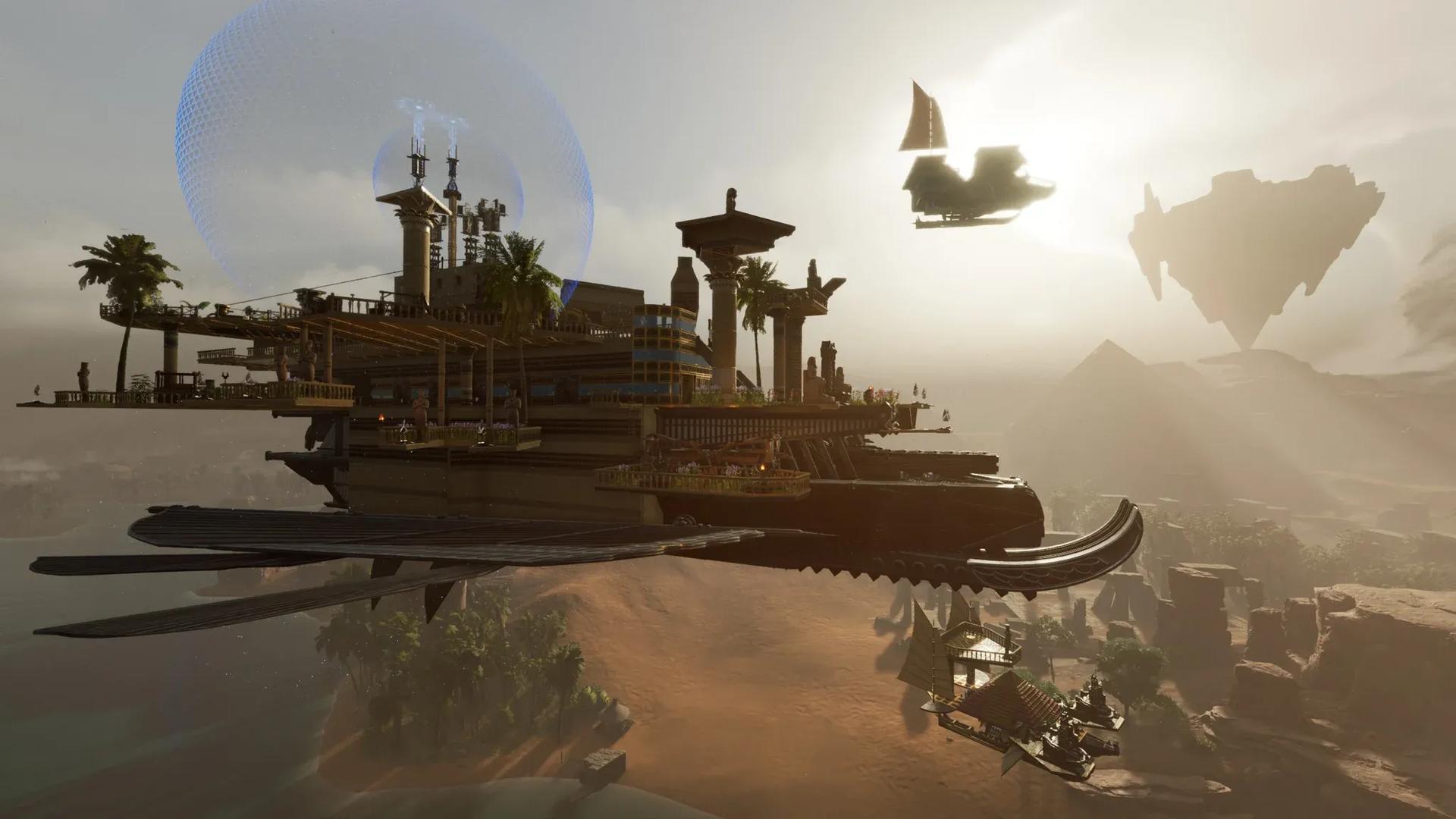
Shifting Sands introduces fully modular vessels that operate on water, sand, and land before you unlock flight. Hull classes determine how much you can build on deck:
| Hull Class | Approximate Part Limit | Notes |
|---|---|---|
| Thatch Boat | Very small | Basic starter option |
| Small Wooden | ~30 parts | First flying-capable hull |
| Falcon-Class | ~60 parts | Sweet spot for most players |
| Shark-Class | 100+ parts | Steel Age, heavy modules |
Build limits scale directly with hull class, and crew capacity follows the same pattern. Small Wooden hulls are limited in crew space, while Falcon and Shark give room for a full production line.
How to get your first ship
The entry path is straightforward, but skipping steps costs materials.
- Claim a Tribe Boat from River Delta or coastal camps. Don't spend resources yet.
- Research Shipbuilding Technique in the Technology tab. This unlocks the basic Thatch Boat and opens the path toward Small Wooden hulls.
- Build a Small Wooden hull at a shipyard or workbench. Add a rudder and sails, then place basic deck foundations. Keep the build light.

The starter ship's real value isn't speed. It's stability. The early ship gives you somewhere to dump loot, place workbenches, test early build pieces, and move between river and delta points without committing to a land base yet.
How do you unlock flight in Soulmask Shifting Sands?
The first real flight unlock is tied to one specific route: Sobec the Crocodile.
Step 1: Progress to the Sobec route
Ship progression and tribe progression overlap at this point. Reaching Sobec requires pushing through the early desert content far enough that the pyramid area becomes accessible. You'll need premium fresh meat or an equivalent offering to summon him.
Step 2: Defeat Sobec Crocodile
Once Sobec is down, the pyramid behind the fight opens. This is the turning point for airship play.
Step 3: Loot the pyramid thoroughly
The key rewards from this pyramid run are:
- Marine anti-gravity skid (installs underneath the hull)
- Two wings (one per side)
- Small anti-gravity engine parts
- 6 small power crystals
Those 6 power crystals fuel approximately 12 hours of flight on a small ship setup. That runtime holds true in version 1.0 testing and matches what most players report in practice.
Step 4: Install the parts
The confirmed first-flight configuration:
- Marine anti-gravity skid mounted underneath
- One wing on each side
- Small anti-gravity engine in the engine slot
- 6 power crystals loaded into the engine
Step 5: Take off
Once fueled and installed, the ship lifts off the waterway entirely. That's the moment Shifting Sands stops feeling like a boat DLC and starts functioning like an actual airship expansion.
What does first flight actually change?
The main benefit isn't raw speed. It's routing freedom. Once airborne, you can:
- Land near points of interest instead of navigating rivers to reach them
- Approach desert locations from any direction
- Use the ship as a repositioning tool rather than a water-locked transport
- Scout airship camps before committing to a fight
That flexibility is what makes the Sobec route worth prioritizing over other early progression paths.
What are airship camps and how hard are they?
Airship camps are progression checks, not free loot stops.
Small airship camp: Expect sand bandits guarding a parked airship, explosive red barrels, and a dangerous giant ballista. The explosive barrels are worth triggering deliberately since nearby chests can contain extra power crystals.
Medium airship camp: A significant step up. These have a massive force field protecting defenders, and battering rams can damage the shield but break after a single hit. If a camp feels like it's resisting everything you throw at it, that's usually a signal you're hitting a ship-stage progression wall rather than a pure combat difficulty problem.
Should your ship be a floating base or a travel ship?
Both are valid, but the right choice depends on where you are in progression.
Travel-first ship:
- Lighter deck
- Better for fast map routing
- Easier to manage early on
- Best when your land base is already stable
Floating base ship:
- More storage and utility placement
- Tribe workers can craft passively while you fly
- Better for long expeditions away from your land base
- Requires Falcon or Shark hull to do well
Don't force a cluttered floating base on your first Small Wooden flyer. A slow, overloaded hull is harder to control and easier to crash. Save the full mobile civilization setup for Falcon-Class or later.
You can also attach smaller ships to a main hull so everything travels together when you fly, which lets you specialize vessels across a fleet rather than cramming everything onto one deck.
How do you reach Falcon-Class airship progression?
The next major breakpoint is tribe level 3.
Reaching tribe level 3 unlocks Premium Shipbuilding in the Technology tab. The next ship goal becomes crafting a Falcon-Class hull at approximately 60 parts. That's the practical sweet spot for most players: enough deck space for a real crew setup without the massive material costs of the Shark-Class.
After the Falcon-Class body is crafted, the ship still needs follow-up components:
- Wings
- Sails
- Rudder
- Medium anti-gravity engine
- Medium power crystals
This is where players commonly stall. The bottlenecks at this stage include metal plates, iron wire, large ingot costs, medium anti-gravity engine requirements, and engine cores. Crafting the Falcon-Class body does not mean the ship is ready to fly. Think of tribe level 3 as opening a new phase of progression, not completing one.
For late-game players in the Steel Age, Advanced Shipbuilding unlocks the Shark-Class at 100+ parts. The Shark supports heavy modules including cannons, ballistas, energy shields, and large storage. The Ray-Class, a large solar airship designed around a giant main cannon, also becomes craftable at shipyards in the Steel Age through Advanced Shipbuilding, though the material costs are substantial.
Ship crew and automation
Once you're on a Falcon or Shark hull, the ship becomes a mobile production platform. Place crafting stations, bonfires, beds, and storage directly on deck. Tribesmen assigned to specific roles can gather nearby while landed, craft passively while flying, or defend with deck weapons. The Work Type dropdown on each station controls their behavior, and enabling crafting table autoplay with maintained stock levels through the cog icon keeps things running without constant attention.
For more survival and building guides across Soulmask and other games, browse more guides at GAMES.GG.
Airship progression at a glance
| Stage | Unlock Condition | Key Parts | Notes |
|---|---|---|---|
| Starter ship | Early chest sequence | Ship materials, workbenches | Use as mobile base first |
| First flight | Beat Sobec Crocodile | Anti-gravity skid, 2 wings, small engine, 6 crystals | ~12 hours flight per fuel load |
| Small airship camps | After first flight | N/A | Ballista and explosive barrels present |
| Medium airship camps | Mid progression | Siege tools needed | Force field requires battering ram or better |
| Falcon-Class | Tribe level 3 + Premium Shipbuilding | Wings, sails, rudder, medium engine | ~60 part hull |
| Shark-Class | Steel Age + Advanced Shipbuilding | Heavy modules, cannons | 100+ parts |
| Ray-Class | Steel Age + Advanced Shipbuilding | Giant cannon slot | Massive material cost |