
Personality is the single most consequential choice you make when creating a Mii in Tomodachi Life: Living the Dream. It shapes how they talk, how they spend their time in their room, what decorations they gravitate toward, even the color of their house. Get it wrong and your carefully crafted Mii will feel completely off. Get it right and the island starts to feel genuinely alive. Here's everything you need to know to hit the exact personality you want, every time.
How does the personality system work?
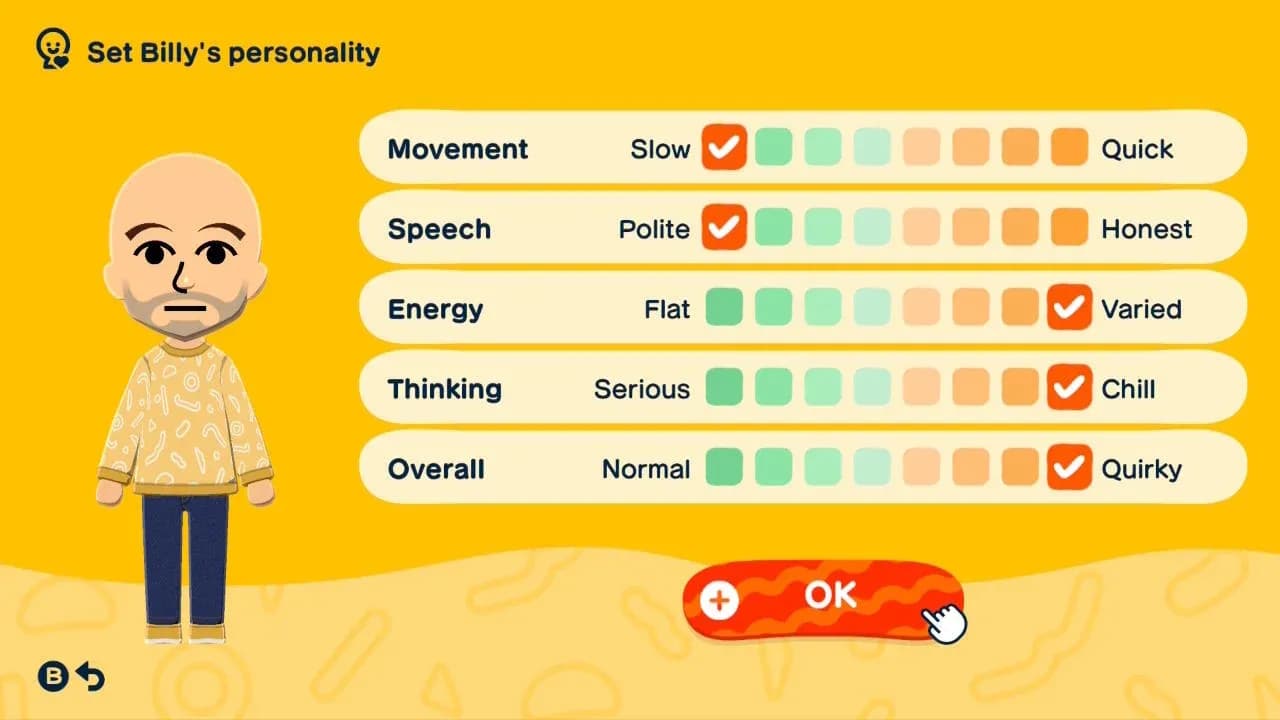
When creating or editing a Mii, you adjust five sliders: Movement (Slow to Quick), Speech (Polite to Honest), Energy (Flat to Varied), Thinking/Attitude (Serious to Chill), and Overall (Normal to Quirky). Each slider has 8 positions, assigned point values from 0 to 7 left to right.
The game then adds together your Speech + Movement score and your Thinking + Energy score separately. Those two totals determine which of the 16 personalities your Mii receives. The Overall slider has no effect on personality at all — it only influences speaking style and conversation content. You can set it wherever you like without worrying about it.
Personalities are grouped into four broad categories: Considerate (Easy-Going), Outgoing (Energetic), Reserved, and Ambitious (Confident). Each group contains 4 distinct types, for 16 total. Some personality names differ slightly between regions — for example, what North America calls Sweetie, other regions call Softie. The gameplay effect is identical either way.
The four personality categories


Complete personality chart
The table below shows every personality, its category, the required Speech + Movement total, and the required Thinking + Energy total. The rightmost columns provide working example slider configurations you can use as reliable starting points.
| Personality (Alt. Name) | Category | Speech + Movement | Thinking + Energy | Example Slider Values |
|---|---|---|---|---|
| Sweetie (Softie) | Considerate | 0–3 | 12–14 | Movement 2, Speech 1, Energy 7, Thinking 7 |
| Cheerleader (Optimist) | Considerate | 4–7 | 12–14 | Movement 8, Speech 1, Energy 6, Thinking 7 |
| Buddy (Carer) | Considerate | 0–3 | 8–11 | Movement 1, Speech 2, Energy 6, Thinking 6 |
| Daydreamer (Dreamer) | Considerate | 4–7 | 8–11 | Movement 5, Speech 4, Energy 5, Thinking 5 |
| Charmer | Outgoing | 8–11 | 12–14 | Movement 3, Speech 7, Energy 7, Thinking 7 |
| Go-Getter (Adventurer) | Outgoing | 12–14 | 12–14 | Movement 8, Speech 6, Energy 7, Thinking 6 |
| Merrymaker (Bubbly) | Outgoing | 8–11 | 8–11 | Movement 6, Speech 6, Energy 6, Thinking 6 |
| Dynamo (Hot-Blooded) | Outgoing | 12–14 | 8–11 | Movement 8, Speech 8, Energy 1, Thinking 8 |
| Strategist (Patient) | Reserved | 0–3 | 4–7 | Movement 1, Speech 1, Energy 8, Thinking 1 |
| Perfectionist | Reserved | 4–7 | 4–7 | Movement 4, Speech 4, Energy 5, Thinking 4 |
| Observer (Introvert) | Reserved | 0–3 | 0–3 | Movement 1, Speech 1, Energy 1, Thinking 4 |
| Thinker | Reserved | 4–7 | 0–3 | Movement 6, Speech 3, Energy 1, Thinking 1 |
| Achiever (Busy Bee) | Ambitious | 8–11 | 4–7 | Movement 1, Speech 8, Energy 7, Thinking 2 |
| Visionary (Leader) | Ambitious | 12–14 | 4–7 | Movement 8, Speech 8, Energy 8, Thinking 1 |
| Rogue (Individualist) | Ambitious | 8–11 | 0–3 | Movement 4, Speech 8, Energy 1, Thinking 2 |
| Maverick (Headstrong) | Ambitious | 12–14 | 0–3 | Movement 8, Speech 6, Energy 2, Thinking 2 |
What makes each personality category different?
Considerate personalities
The four Considerate types (Sweetie, Cheerleader, Buddy, Daydreamer) all share a gentle, supportive quality. They prioritize others, avoid conflict, and tend toward warmer, more emotional dialogue. The Sweetie leans empathetic and sentimental. The Cheerleader is the upbeat one who lifts everyone's mood. The Buddy is the reliable friend who quietly keeps the peace. The Daydreamer drifts through island life at their own pace, idealistic and unhurried.
If you're building a Mii based on someone calm or nurturing, Considerate is the obvious fit. The differences between the four come down to energy level and how outwardly they express that warmth.
Outgoing personalities
Charmer, Go-Getter, Merrymaker, and Dynamo all sit in the high Speech + Movement range. These Miis are louder, more expressive, and quicker to draw attention. The Charmer has a magnetic, stylish quality. The Go-Getter is impulsive and playful. The Merrymaker turns awkward moments into fun ones. The Dynamo is the hot-headed one who charges ahead and sweeps others along.
Even within this group the personalities feel distinct — a Charmer has a radiant, polished energy while a Dynamo is more like a bull in a china shop. Same category, very different vibes.
Reserved personalities
The four Reserved types sit at the lower end of both score pairs. The Observer (lowest scores across the board) barely shows outward emotion but has a lot going on internally. The Thinker is composed and analytical. The Strategist is steady and conflict-averse. The Perfectionist values order and consistently does things by the book.
These personalities produce quieter, more introspective Miis. They're a good fit for characters you want to feel mysterious or self-contained.
Ambitious personalities
Achiever, Visionary, Rogue, and Maverick all share high Speech scores and low Thinking + Energy totals (Serious end of the scale). These Miis are driven, direct, and self-assured. The Achiever is productive and goal-focused. The Visionary takes charge and inspires others. The Rogue goes it alone and doesn't care what anyone thinks. The Maverick is the bold self-starter who executes first and asks questions never.
Can you change a Mii's personality later?
Yes, and the process is straightforward. Open the menu with X, select the Residents tab (second option), choose the Mii you want to edit, then scroll to the personality section near the bottom left of their character page. Adjust the sliders to match your target personality's values and confirm with +.
That said, changing a personality alters behavior and dialogue in ways that can affect that Mii's existing relationships with others on the island. For brand-new Miis, change freely. For established residents, keep an eye on the social balance before making sweeping changes.
What do personalities actually affect?
Beyond the obvious differences in how Miis speak, personality touches more systems than most players expect. Personality influences:
- Everyday behavior in their room and around the island
- Reactions when angry or upset
- Preferences for decorations and clothing
- Dialogue patterns and conversation topics
- House color (each personality type has a distinct motif color)
Miis within the same category still behave differently from each other. A Charmer and a Dynamo are both Outgoing, but their day-to-day presence on the island feels nothing alike. The category is a broad signal; the specific type is what actually defines the character.
For more Nintendo Switch 2 guides and walkthroughs, browse more guides on GAMES.GG.