

Vampire Crawlers throws a lot of numbers at you fast. Between Power Ups, card choices, and dungeon rewards, it's easy to grab stats that sound good without knowing what they actually do. Some buff your damage for a single battle. Others stick around for the whole run. Knowing the difference is the gap between a build that snowballs and one that falls apart at the halfway point.
What stats are in Vampire Crawlers?
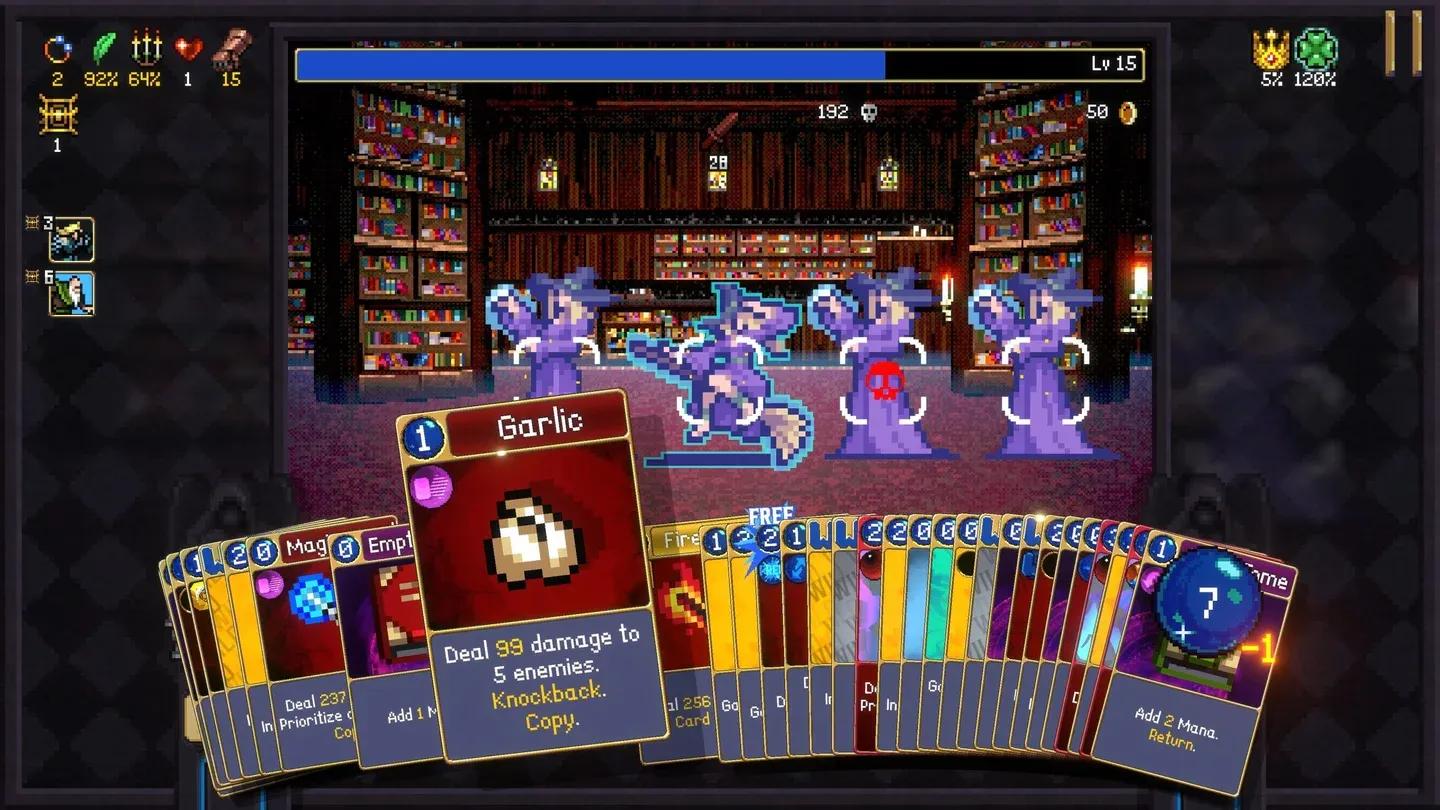
There are 18 stats in Vampire Crawlers, split across offensive, defensive, utility, and hybrid categories. You can check your current stats at any time on PC by pressing Escape, and the stats screen also appears whenever you're choosing Power Ups. Stats sourced from cards can be either temporary (lasting only until the end of a battle) or permanent (lasting until the end of a run).

Vampire Crawlers stats overview
Here's every stat in the game and what it does:
| Stat | Category | Effect |
|---|---|---|
| Max Health | Defensive | Increases max HP by 10% per rank |
| Recovery | Defensive | Heals 1 HP per rank after each encounter |
| Armor | Defensive | Grants +1 Armor at the start of each turn per rank |
| Revival | Defensive | Gives extra lives when your HP hits zero |
| Might | Offensive | Increases base card/weapon damage by 10% per rank |
| Area | Offensive | Adds splash damage to attack cards at 10% per rank |
| Amount | Offensive | Adds extra projectiles to cards and weapons |
| Hand | Utility | Draws more cards at the start of each turn |
| Growth | Utility | Multiplies XP gained |
| Greed | Utility | Increases coin rewards by 10% per rank |
| Reroll | Utility | Grants 2 rerolls per rank for card/level-up choices |
| Skip | Utility | Lets you skip a reward to gain XP instead |
| Banish | Utility | Removes a reward from the pool for the rest of the run |
| Curse | Utility | Enemies hit harder and appear more often, but XP and gold increase |
| Mana | Hybrid | Increases Mana gained at the start of a turn |
| Duration | Hybrid | Extends how long Crawlers stay active by 1 trigger per rank |
| Magnet | Hybrid | Enhances draw effects (e.g., Attractorb draws an extra card per +1 Magnet) |
| Luck | Hybrid | Boosts crit chance, item drop frequency, and quality of drops by 20% per rank |


Temporary vs permanent stats: why it matters
This is the distinction most players miss early on. Stats gained from cards fall into two buckets based on how long they last.
Temporary stats only apply until the current battle ends. These include Amount, Might, Recovery, Hand, Duration, and Area. They show up on the left side of your screen.
Permanent stats persist for the entire run. These include Growth, Greed, Luck, and Revivals. They appear on the right side of your screen.
This matters a lot when you're evaluating card choices. A card that temporarily boosts your Might by 30% is excellent if you're about to fight a boss, but it won't help you survive the next three encounters. A card that permanently adds a Revival, on the other hand, is a safety net that stays with you.
Offensive stats: how do Might, Area, and Amount work?
These three stats form the backbone of any damage-focused build.
Might scales all card damage by 10% per rank. If a card deals 30 damage and you have 20% Might, it now hits for 36. The scaling is straightforward and compounds well with high-damage cards.
Area adds splash damage at 10% per rank, letting your attack cards hit enemies beyond the primary target. This becomes significantly stronger in encounters with grouped enemies.
Amount adds extra projectiles: a card that fires 1 projectile for 30 damage becomes 3 projectiles for 90 total damage with +2 Amount. That's a 3x damage multiplier from a single stat, which makes Amount one of the most efficient offensive investments in the game.
Amount stat multiplying projectiles
Defensive stats: what keeps you alive?
Max Health is the most straightforward, adding 10% more HP per rank. Recovery heals 1 HP per rank after each encounter, which sounds minor but adds up over a long dungeon run. Armor absorbs incoming hits at the start of each turn, acting as a damage buffer before your HP takes a hit.
Revival is the most valuable defensive stat for runs where you're pushing into unfamiliar territory. Each rank gives you an extra life, meaning one mistake doesn't automatically end everything.
Utility and hybrid stats: what do Growth, Luck, and Curse actually do?
The utility stats handle the meta-layer of your run rather than direct combat.
Growth multiplies XP gained, letting you level up faster and access more card choices. Greed adds 10% more coins per rank, which feeds directly into Power Up purchases. Reroll grants 2 extra rerolls per rank for level-up and reward screens. Banish removes a specific reward from appearing again, which is useful for clearing out cards that would dilute your deck. Skip lets you pass on a reward entirely in exchange for XP.
Curse is the risk/reward stat. Enemies become stronger and more frequent, but the XP and gold gains increase to match. It's worth stacking if your build can handle the pressure.
Among the hybrid stats, Luck stands out. At 20% per rank, it affects crit chance, how often items drop, and the quality of those drops. Magnet enhances draw effects specifically: Attractorb normally draws 1 card, but with +1 Magnet it draws 2. Duration extends how many triggers your Crawlers remain active for, which directly amplifies their damage output over a fight. Mana increases the Mana you start each turn with, letting you play more cards per round.

Luck and Curse Power Up choices
For more guides covering Vampire Crawlers and other roguelikes, browse the latest guides on GAMES.GG.
Which stats should you prioritize?
There's no universal answer, but the stat that consistently overperforms is Amount. The projectile multiplication it provides scales harder than raw Might in most scenarios. Pair it with cards that already fire multiple hits and the numbers get out of hand quickly.
Luck at 20% per rank is also worth grabbing early. Better drops and higher crit chance affect every subsequent choice you make, so the earlier you invest, the more it pays off.
Banish is underrated. Clearing bad cards from your reward pool means you see better options more consistently, which tightens your build without spending Mana or dealing damage.
For defensive investment, Revival beats stacking raw HP in most situations. A second life is worth more than 10% extra health when a single unlucky encounter can spike your damage taken.