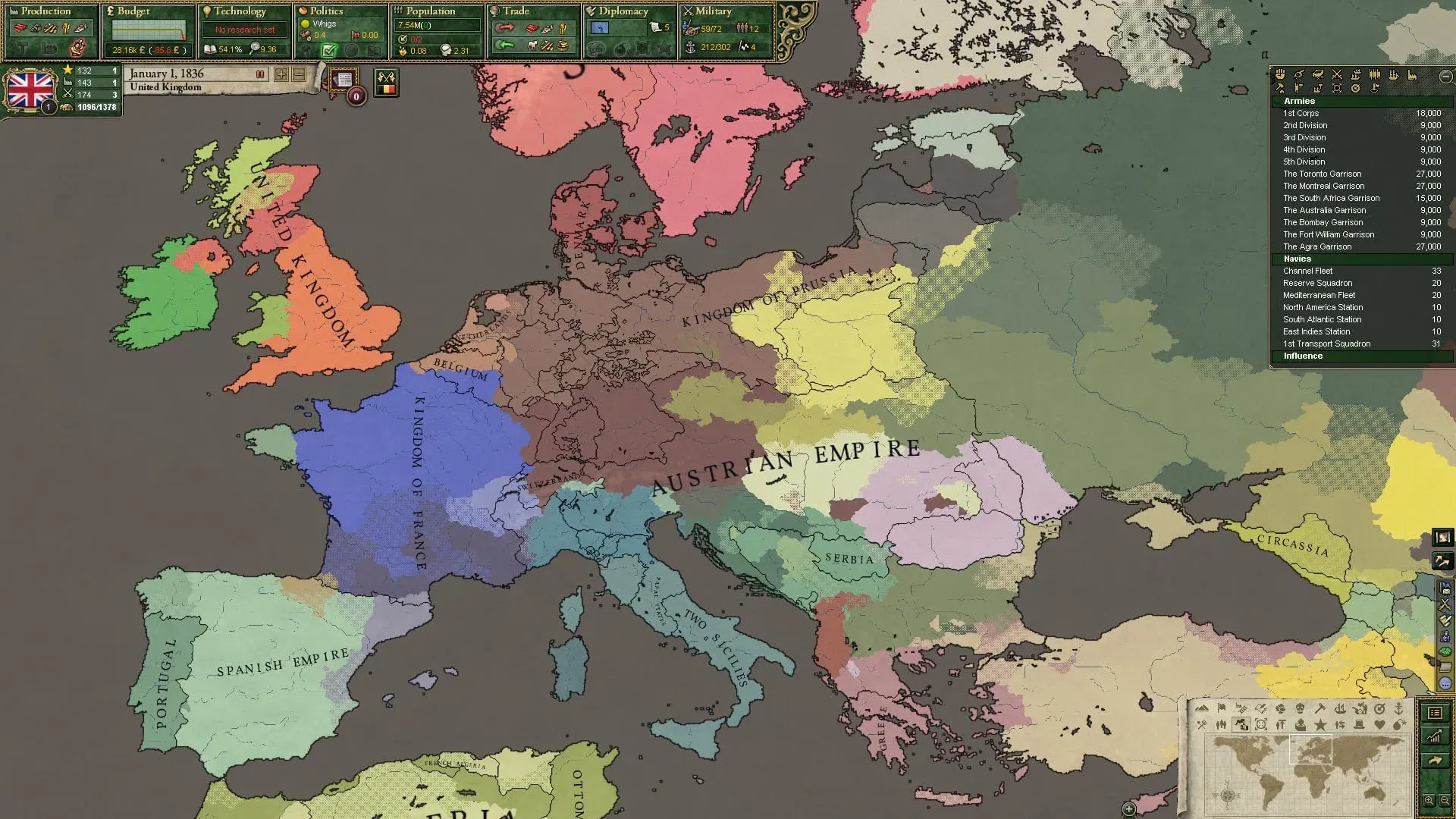


Laws in Victoria 3 are the backbone of everything your country does. They determine who holds power, how your economy generates wealth, what rights your population has, and whether your government survives long enough to reform anything. Every category connects to every other one, which means passing the wrong law at the wrong time can destabilize a government you spent thirty years building. This guide breaks down how the system works and what the key choices actually mean in practice.
How does law enactment actually work?
Enacting a law always runs through three stages, and the names of those stages change depending on your government type. A technocratic government sees drafting, review, and implementation. A democratic republic goes through initiative, research, and voting. The names are cosmetic, but the underlying mechanics are identical across all systems.
At each stage, one of four outcomes fires: success (move immediately to the next stage), progress (an event that boosts your enactment probability), controversy (an event that can push the probability up or down by 10-15%), or stagnation (an event that reduces your probability or adds a setback counter).
The stagnation mechanic is where most enactments die. Three setbacks and the bill fails outright. If you choose not to take the setback option when stagnation fires, your success probability drops further and future stagnation becomes more likely. You are almost always forced to accept the setback.
The base time per stage is 100 days. Governing principle laws take twice as long. Power distribution and economic system laws take 1.5 times as long. High government legitimacy (above 90) cuts that time by 25%, while low legitimacy (25-49) adds 50%. Unused authority also reduces enactment time by up to 25%.
You can negotiate with interest groups during enactment to raise your success probability or reduce stagnation. Political concessions apply immediately. Promises like constructing certain buildings or passing other laws have a fulfillment deadline, so plan accordingly.

Law enactment stage tracker
What happens when a revolution breaks out?
Every law you attempt to pass increases movement participation in political movements that oppose it, while decreasing participation in movements that support it. Half of that change applies immediately; the rest bleeds in at 1% per week toward the target value. When any political movement hits 75% participation, a revolution begins.
Revolutions can be a tool as well as a threat. If a revolution fails, the losing interest group takes a -100% modifier to its political power for 20 years, which effectively removes it from the political equation. Some players deliberately trigger revolutions to break the hold of reactionary interest groups blocking reform.
Since patch 1.8, the revolution mechanic changed significantly. The fighting now centers on the capital, barracks outside the capital cannot be removed as a trick, and strong incumbent political powers make revolutionary forces face a much harder civil war. Patch 1.5 also added diplomatic counteroffers, which means foreign powers with similar government systems will often intervene to support their ideological counterparts.
Power structure laws: the foundation of your government
Governing principles compared
The governing principle law is the most consequential single law in the game. It takes twice as long to enact compared to other laws, and interest group approval changes from it are doubled, meaning a single step up or down in ideology alignment shifts support by 10 points instead of 5.
Monarchy works best when paired with autocratic power distribution because the legitimacy from having the monarch's interest group in your cabinet is reliable. The downside is that successor interest groups are randomly assigned, so you can inherit a monarch whose ideology clashes with your entire political structure.
The parliamentary cabinet system is harder to reach than most players expect. Intellectuals and positivists actually prefer the presidential system over the parliamentary one, so if you are transitioning from a presidential republic, only radicals will push you toward a parliamentary system. The source material confirms this directly: if you want a parliamentary system, go straight from monarchy to parliament rather than routing through a presidential republic first.
Council Republic triggers a diplomatic penalty with countries using other government systems after patch 1.2, which is worth factoring into your foreign policy before committing.
Distribution of power: elections vs. authority
The power distribution law sits just below governing principles in importance and takes 50% longer to enact than standard laws. Its main function is determining how political power is calculated and what role elections play.
Autocracy gives the strongest legitimacy bonus from passport head of state inclusion (+30) and boosts noble and officer political power by 50%, but it disbands political parties on enactment and imposes a +50% legitimacy disadvantage from ideological conflict. This makes it very difficult to maintain once your society diversifies.
Oligarchy is the practical middle ground for reactionary playthroughs. It gives +50% noble power and +25% capitalist power, reduces ideological conflict penalties by 10%, and allows you to put multiple interest groups in your cabinet without elections tying your hands. Countries like the Papal States, Spain, and Sweden start here.
Technocracy received a significant buff in patch 1.10, gaining free corporate articles of incorporation and a higher maximum company count. It also unlocks a journal that eventually converts intellectual republican ideology into technocracy ideology, which causes intellectuals to oppose elections and support technocracy. That is a meaningful long-term investment.
For voting systems, the key distinction is what population can vote. Landlord suffrage restricts votes to nobles, capitalists, clergy, and officers. Wealth voting (plutocracy) extends to anyone with 20+ property. Limited suffrage (census voting) scales vote power by literacy rate, which benefits intellectuals and petty bourgeois. Universal suffrage grants equal votes to all adult males.
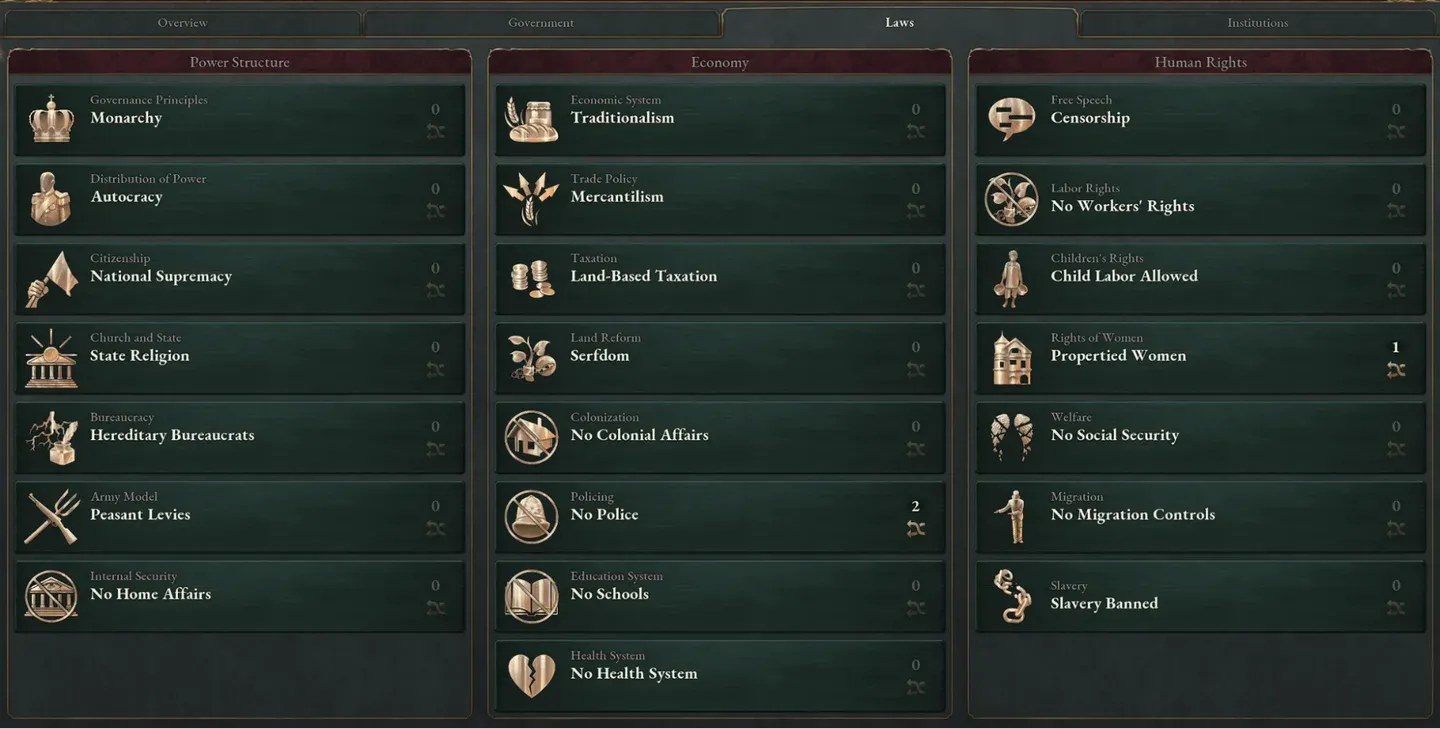
Power distribution law options
Economic laws: where the money actually comes from
Which economic system should you use?
The economic system law controls investment withholding contribution efficiency, government dividend reinvestment, and whether nationalization or privatization is available. Patch 1.7 overhauled building ownership and dividends substantially, so older guides are often outdated here.
Traditionalism is the starting point for most undeveloped countries and needs to go as fast as possible. It cuts investment withholding efficiency by 50% for every major occupation and reduces market access price impact by 15% across all regions. The only useful effect is a 25% reduction in administrative power population cost, which matters for large-population countries like Qing or Japan when transitioning.
Interventionism is the reliable workhorse. No interest group directly opposes it (only Luddite and anarchist ideologies oppose it, both fringe), it gives 25% government dividend efficiency, 50% private construction allocation, and free corporate articles of incorporation. The source material notes that below 50M national GDP, interventionism outpaces laissez-faire in withholding accumulation speed.
Laissez-faire becomes more efficient above that GDP threshold and offers +25% capitalist investment withholding contribution, 75% private construction allocation, and -25% loan interest rates. The tradeoff is that all buildings are forcibly privatized, nationalization is disabled, and military supply buildings will be downsized by the AI when their balance drops. Patch 1.9 removed the additional corporate slot bonus that made laissez-faire especially attractive, replacing it with free corporate articles of incorporation instead.
Cooperative ownership forces worker ownership of industrial and resource buildings, eliminating capitalist and noble dividends in favor of worker income. This raises the average standard of living faster than any other economic system, but collapses investment withholding contributions because workers have 0% contribution rate. Patch 1.10.3 added engineer and mechanic contributions, but they still fall short of noble and capitalist rates.
Command economy requires autocracy, technocracy, oligarchy, or a one-party system, plus Central Planning technology. It disables investment withholding entirely (except companies), forces nationalization, and gives +40% government dividend efficiency with +75% corporate government dividends. The government gets more money but the market loses private capital circulation.
Trade policy in brief
Mercantilism is the default for most countries and favors exports with a 25% export trade advantage and 50% higher export tariff maximums. Protectionism adds a 25% phase resistance bonus on top of higher tariff ceilings, which is particularly valuable in the late game when oil becomes a contested resource. Free trade removes tariffs entirely and gives a flat 25% trade advantage for both imports and exports, but reduces phase resistance by 25%.
Isolationism completely disables trade routes, which sounds catastrophic but gives +50% authority, +25% tax capacity, and +100% phase resistance. Countries like Joseon and Japan start here. The 1.9 patch raised the importance of trade significantly, which accelerated the timeline for removing isolationism.

Economic system law choices
Citizenship and church laws: managing your population
How acceptance scores work
Patch 1.8 replaced the binary discrimination/acceptance system with a scored acceptance system. Every pop group has an acceptance score calculated from characteristics: mainstream culture (+100), lineage characteristics, language characteristics, mainland bonuses, religious bonuses, and diplomatic relation bonuses. The score determines which acceptance tier a pop sits in, from full acceptance down to violent hostility.
Ethnocentrism (National Supremacy) is the standard for most European countries. It gives strong bonuses to fully accepted pops (+20% loyalists, +20% political power, +20% wages) but harsh penalties at violent hostility. Patch 1.10 subdivided lineage and language characteristics further, making acceptance management harder for multi-ethnic European countries.
Multiculturalism removes practical discrimination for all but the lowest acceptance tiers and is the only citizenship law that enables mass immigration from all cultures. It was nerfed in 1.10 to start non-matching cultures at open prejudice rather than full acceptance, but pops at second-class citizen status still receive the same treatment as fully accepted pops. The problem is enacting it: virtually every interest group with a citizenship perspective opposes it.
For church and state, the state religion law became significantly stronger in 1.10 because the default +10 mainland acceptance that previously applied to all citizenship laws was removed and moved to the No Colonial Affairs law. State religion is now the only law that can provide +25 acceptance points from diplomatic relations, making it the best tool for managing minority acceptance in countries where religion broadly overlaps.
State atheism (added in patch 1.3) converts 10% of the population to atheism on enactment and gives a +25% conversion bonus for 10 years. It strips clergy of their production methods in government buildings and universities, which causes intellectuals to absorb the political power clergy previously held. Use it deliberately, not accidentally.
Human rights laws: what they actually change
Labor, children, and women
Serfdom is the most damaging starting law in the game. It blocks qualification development for nobles, capitalists, scholars, bureaucrats, engineers, officers, and self-employed entirely. Clergy develop at 10% speed, farmers at 20%, employees at 10%, and mechanics at 5%. Combined with traditionalism, it prevents industrialization almost completely. Removing it requires overcoming intense landlord opposition, but the landlord movement in 1.8 has a mechanism where interest groups satisfied above +5 do not add to stagnation probability, so managing landlord satisfaction is the path forward.
Child labor allowed gives +30% dependent population income but adds +5% mortality to farmers, laborers, mechanics, and peasants. The income matters early but costs population growth and education access. Restricted child labor unlocks one additional level of Ministry of Education investment. Compulsory primary education removes all child labor events and adds two more Ministry of Education levels, which is required to break the level 4 cap.
Women's rights laws trade fertility rate for labor force participation. Legal guardianship gives +5% fertility. Women's property rights add +5% labor force rate. Women's labor adds +10% labor force rate but subtracts 5% fertility. Women's suffrage adds +15% labor force rate, grants 33% of dependent population the right to vote, and subtracts 5% fertility. Enacting women's property rights or women's labor while human rights and political activism technologies are researched activates the women's suffrage journal, which forces feminist ideology onto interest group leaders.
Slavery laws
Slave trade and hereditary slavery both attach a pro-slavery ideology to landowners on enactment, and the interest group support changes from slavery laws are doubled like governing principles. Abolishing slavery unlocks cultural exclusion and multiculturalism in the citizenship category. Colonial slavery (added in patch 1.10) is an intermediate step where slavery is legal in unincorporated states but not on the mainland.
For more guides on managing complex political systems in strategy games, browse more guides at games.gg.
Army recruitment and security laws
Before patch 1.5, professional army was the only viable military law. The 1.5 patch improved national militia and mass conscription substantially, and both are now competitive.
Peasant levies caps barracks at level 25 and maximum conscription at 25, has high morale loss, and blocks advanced training methods. The hidden problem is that it forces most officers to come from the nobility, and noble pops living in mansions do not qualify for officer roles, which means officer vacancies cannot be filled during wars. This is the primary reason Russia struggles militarily in most playthroughs.
Professional army gives 100% experience gain, -10% morale loss, and +50% officer political power, but only 1% conscription rate and a maximum conscription limit of 50. Since 1.5, it also reduces non-military pop attraction to the military interest group by 50%, so barracks construction is needed to maintain military political power.
National militia caps barracks at level 5 but allows 100 maximum conscription with 5% conscription rate and +50% phase resistance. It is the only recruitment law that adds a natural disaster damage reduction modifier (up to -25% for drought, flood, forest fire, and severe wind effects) through the homeland defense force security law.
Mass conscription gives 100 barracks cap, 100 conscription cap, 3% conscription rate, and +100% training speed. That training speed bonus became very significant after 1.5 lowered base army training speed. It is the late-game dominant option but requires navigating significant interest group opposition to reach.
For security laws, secret police unlocks the "Prepared Thinking" character interaction after patch 1.6, which allows assassination attempts on demagogues, politicians, and even monarchic successors. The success probability scales with your Ministry of Interior level. The homeland defense force became much easier to enact and maintain after patch 1.10 changed radical and liberal ideologies to support or neutral.
Education and health: long-term investments
Public schools give 12.5% education access per institution level (62.5% at level 5) and 12.5% cultural convergence. They require complete separation or freedom of conscience church law because state religion blocks them. Religious schools cost 20% less administrative power and give +10% clergy political power plus 20% conversion rate per level, with a hidden bonus of +20% clergy attraction per level that can push clergy political power above 40% in state religion countries.
Private schools save 40% administrative power cost compared to public schools and strengthen intellectual political power, but education access only scales with property (0.5% per property point), meaning lower-class pops see almost no benefit. Their value is primarily the administrative power saving, which becomes significant when combined with the "Advanced Research III" power block principle that reduces Ministry of Education administrative costs by up to 90%.
For health, national health insurance gives the best mortality reduction (-5% per level) and is the only law that directly reduces pollution effects by 15% per level. Private health insurance reduces mortality at -0.2% per property point per level, which only outperforms national insurance when average living standards exceed 25. Charity hospitals are the weakest option and primarily serve to maintain clergy political power in early-game religious playthroughs.