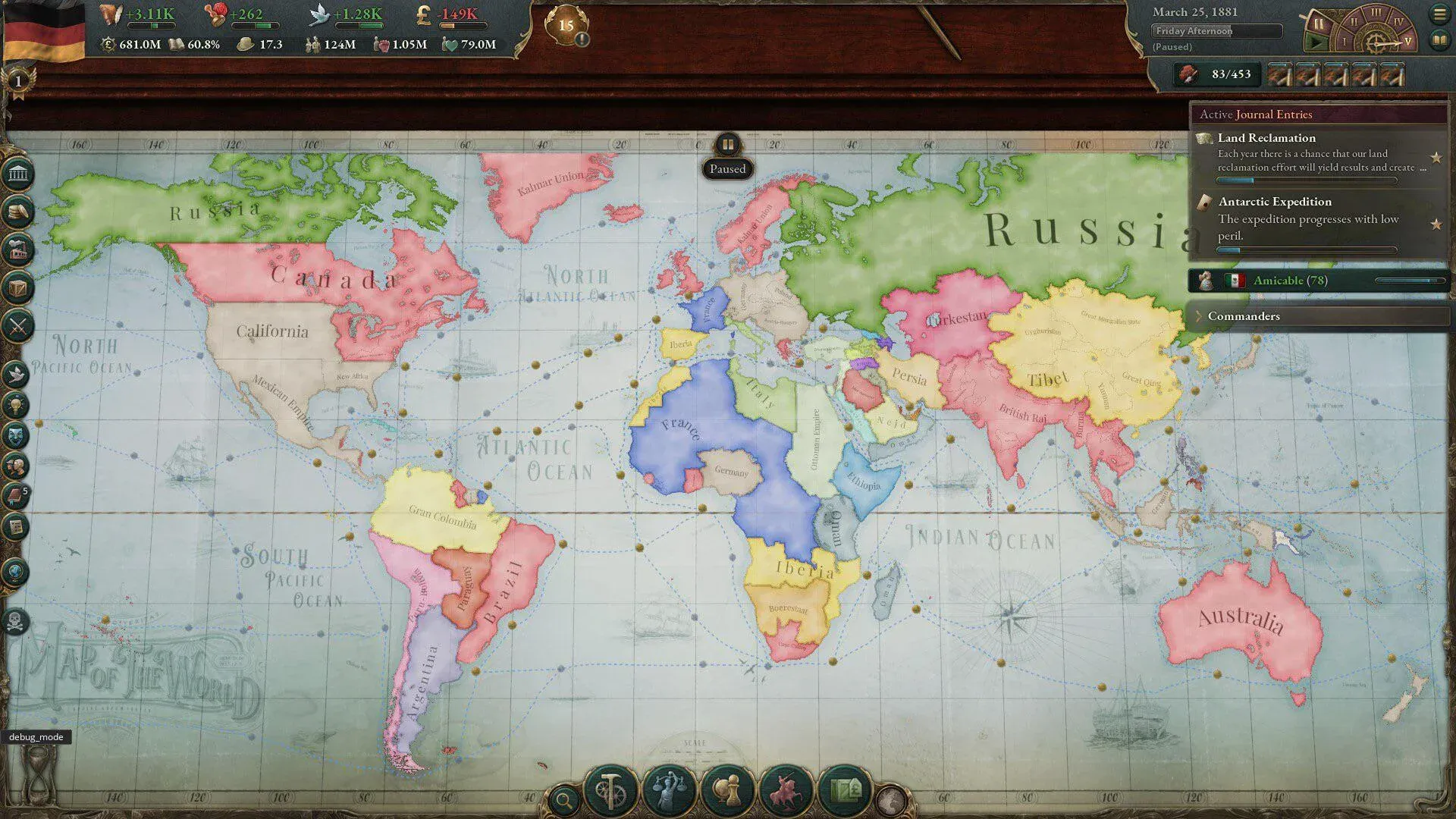


How does the Victoria 3 market actually work?
The market sits at the center of everything in Victoria 3. Every transaction your pops and buildings make flows through it, goods are never traded directly from producer to consumer but instead pooled into a single national market where buy and sell orders determine the price. Get a handle on how prices form, why shortages spiral out of control, and when to lean on trade versus domestic production, and the rest of the game clicks into place.
Understanding market price: the formula behind the numbers
Every good has a base price, which is what it costs when buy and sell orders are perfectly balanced. From there, the actual market price shifts based on how far apart those orders are, and it can swing anywhere from 25% to 175% of that base price.
The math behind it is straightforward once you see it in action. Take wood, which has a base price of 20. If there are 100 buy orders and 120 sell orders, the price lands at 17, a 15% drop because supply is outpacing demand. The formula caps price movement at 75% in either direction, so no good can ever be free or infinitely expensive regardless of how lopsided the orders get.
One thing worth understanding: the number of goods bought and sold do not have to match. All buy orders get filled and all sell orders get filled. The simulation creates or destroys the difference in value. When supply exceeds demand, extra value enters the economy. When demand exceeds supply, value is destroyed because buyers collectively pay more than sellers receive.
What is the local price and why does it differ from market price?
Market price is the national average, but your pops and buildings pay the local price, which blends the market price with what the state price would be if that state operated as its own isolated market. The weighting between the two is called Market Access Price Impact (MAPI).
MAPI starts at a base of 75% and gets modified by laws, technology, and state traits. Here is a full breakdown of what moves it:
MAPI is then multiplied by the state's actual market access percentage. So if your MAPI is 85% but market access is only 50%, the effective MAPI drops to 42.5%. An iron-producing state with no local consumption and 85% MAPI would sell iron at roughly 35.5 when the national market price is 40, losing about 11% compared to the market price. That gap directly cuts into the iron mine's profitability.
How does market access work?
Market access runs from 0% to 100% and represents how well a state connects to the national market. The basic calculation compares infrastructure supply to infrastructure usage. If a state has 45 infrastructure but 90 usage, market access caps at 50%.
Overseas states add another layer: they also need Ports and Convoys through a shipping lane. Without enough convoys to cover the supply network, overseas market access drops even if infrastructure is healthy. Fully isolated states sit at 0% market access and pay entirely local prices, which can be wildly different from the national average.
Low market access hurts in two directions simultaneously. The state contributes fewer buy and sell orders to the national market, weakening the price signal, and its pops pay prices that diverge from the national rate. Keeping market access high across all states is one of the most consistent ways to maintain a stable economy.
What causes shortages and how do you fix them?
A shortage triggers when buy orders for a good exceed sell orders by at least double. The shortage icon appears next to the good and the effects start immediately: every building using that good as an input takes a -5% throughput penalty, which then increases by -1% per day up to a maximum of -75%.
The recovery is slow too. Once the shortage resolves, the throughput penalty only decreases at 1% per day until it hits zero. That means a fully developed shortage at -75% takes 75 days to fully clear even after supply is restored.
What makes shortages dangerous is the cascade. Buildings losing throughput demand less of their input goods. Less profitable buildings may fire workers. Fewer workers means less production, which reduces demand for other goods further up the supply chain. The system can find a new equilibrium, but it might settle at a point where the throughput penalty is still partially active, dragging down productivity indefinitely.
The three practical fixes are:
- Increase domestic production of the good directly
- Import it from another market via trade
- Reduce consumption by switching production methods or downsizing buildings that use it as input
Trade, tariffs, and trade advantage explained
When two countries in different markets trade, the world market handles the exchange automatically. To access it, a market area needs at least one Port, or a transit rights treaty with a country that has an adjacent port. Countries under Isolationism cannot use the world market at all, though they can still arrange trade through Goods Transfer Articles in bilateral treaties.
How does trade advantage affect your prices?
Trade advantage is how dominant a country is in trading a specific good. At 100% trade advantage, a country gets a 25% better price on that good. The key detail is that trade advantage is zero-sum: any gain for one country comes at the expense of others, since the overall market price stays fixed.
There is also a monopoly bonus layered on top. If one market controls 100% of exports for a good, the world market price rises by 20%. At 50% control, the bonus is 10%. Trade advantage does not affect price in that specific scenario.
Building trade advantage comes from several sources:
- Base value of 100
- +2 per percentage of global production within the market area
- +0.5 per percentage of production controlled by a company with trade rights
- +1 per percentage of production that is prestige goods (export advantage only)
- +25% flat bonus for Free Trade law
- +5% for trade centers located in the market capital
- Up to +20% from trade capacity, further modified by banking technologies
Your trade policy law shapes the ceiling on what tariffs and subventions you can apply:
Tariff percentages are calculated from a good's base price, not its current market price. In a customs union, tariff income splits proportionally by relative GDP, with the market owner guaranteed at least 25%.
Customs unions and how they expand your market
A customs union merges multiple countries into one shared market under a single market owner. Three routes lead to one: subjects automatically join their overlord's market, Trade League power blocs are always customs unions, and other power blocs can become customs unions by reaching Market Unification III.
The customs union has one market capital, belonging to the market owner. Subjects transfer 50% or 75% of their convoys to the market owner, which matters a lot for maintaining supply networks across a large empire.
Power bloc principles can add flat tariff penalties on outside trade too. Both Market Unification II and Internal Trade II add +20% tariffs on all routes with non-bloc members, and these apply even to bloc members who have individually enacted Free Trade.
Supply networks, convoys, and overseas connections
The supply network is the sum of all shipping lanes a country maintains. Shipping lanes connect non-adjacent areas and are required both for overseas market access and for supplying overseas armies. Each lane has a convoy cost that scales with type and distance.
Convoys come from Ports, which require either clippers or steamers as inputs. If total convoy supply falls short of what the supply network demands, overseas market access suffers and army supply drops simultaneously. During wartime, enemy navies can use the Raid Convoys order to directly cut shipping lane efficiency and reduce convoy counts. Countering with Escort Convoys limits the damage.
A full naval blockade at 100% strength applies -75% world market access, -75% shipping lane efficiency, -50% migration attraction, and -75% throughput for Ports and Fishing Wharves. That combination can functionally cut an empire off from its overseas territories mid-war.
For more strategy guides covering Victoria 3 and other grand strategy titles, browse more guides on GAMES.GG.