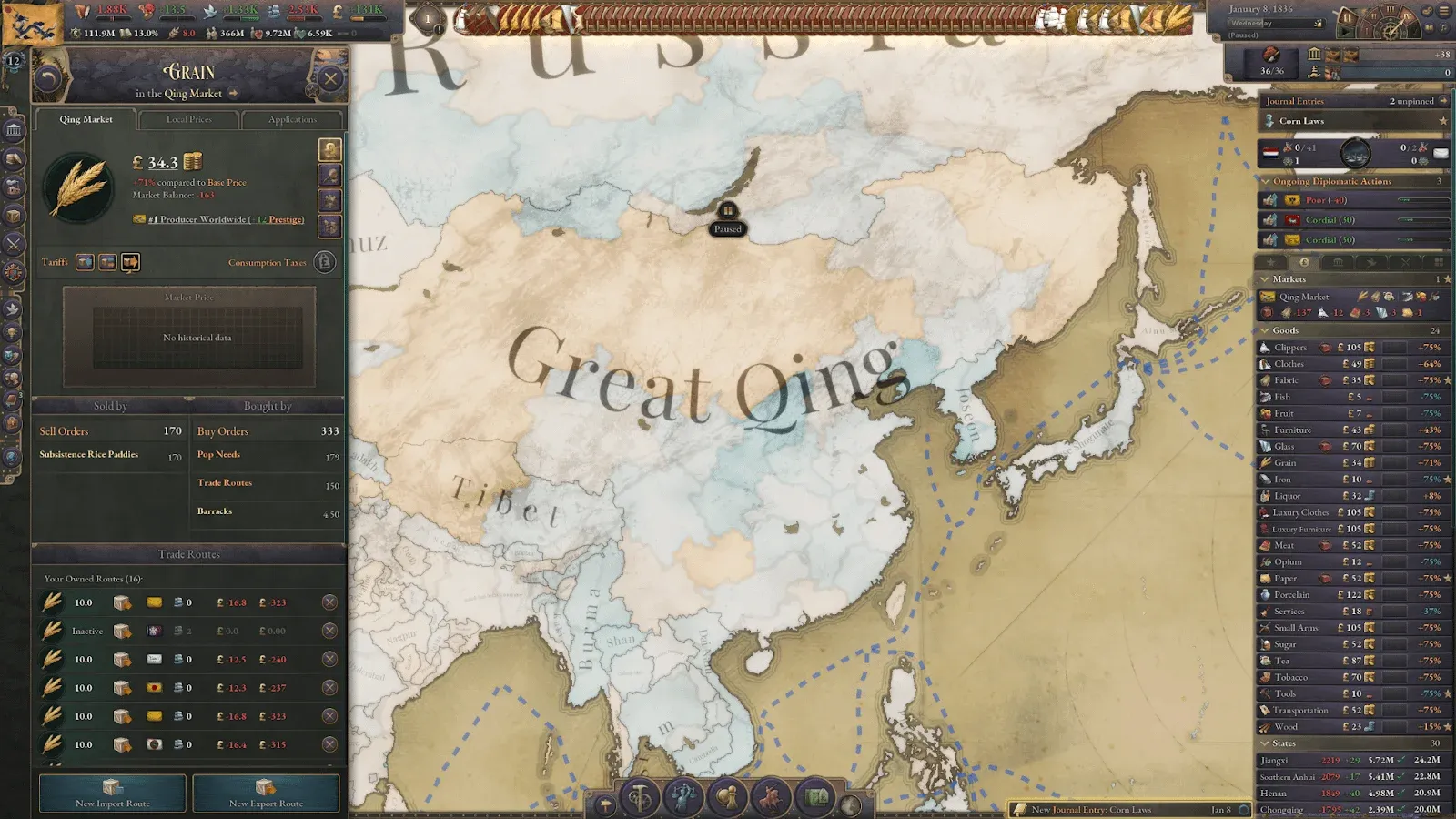


The sleeping giant that can actually wake up
Playing the Qing Dynasty in Victoria 3 is one of the most demanding starts in the game, and one of the most rewarding. You begin in 1836 as the world's most populous nation (366 million people, more than triple the next contender) with a GDP of $85.4M, a literacy rate of 15.1%, and a standard of living rated "Struggling" at 9.6. The opium crisis is already eating your military alive, European powers are circling, and your 485-battalion army is mostly irregular infantry with no artillery. The ceiling is enormous. The floor is very low.
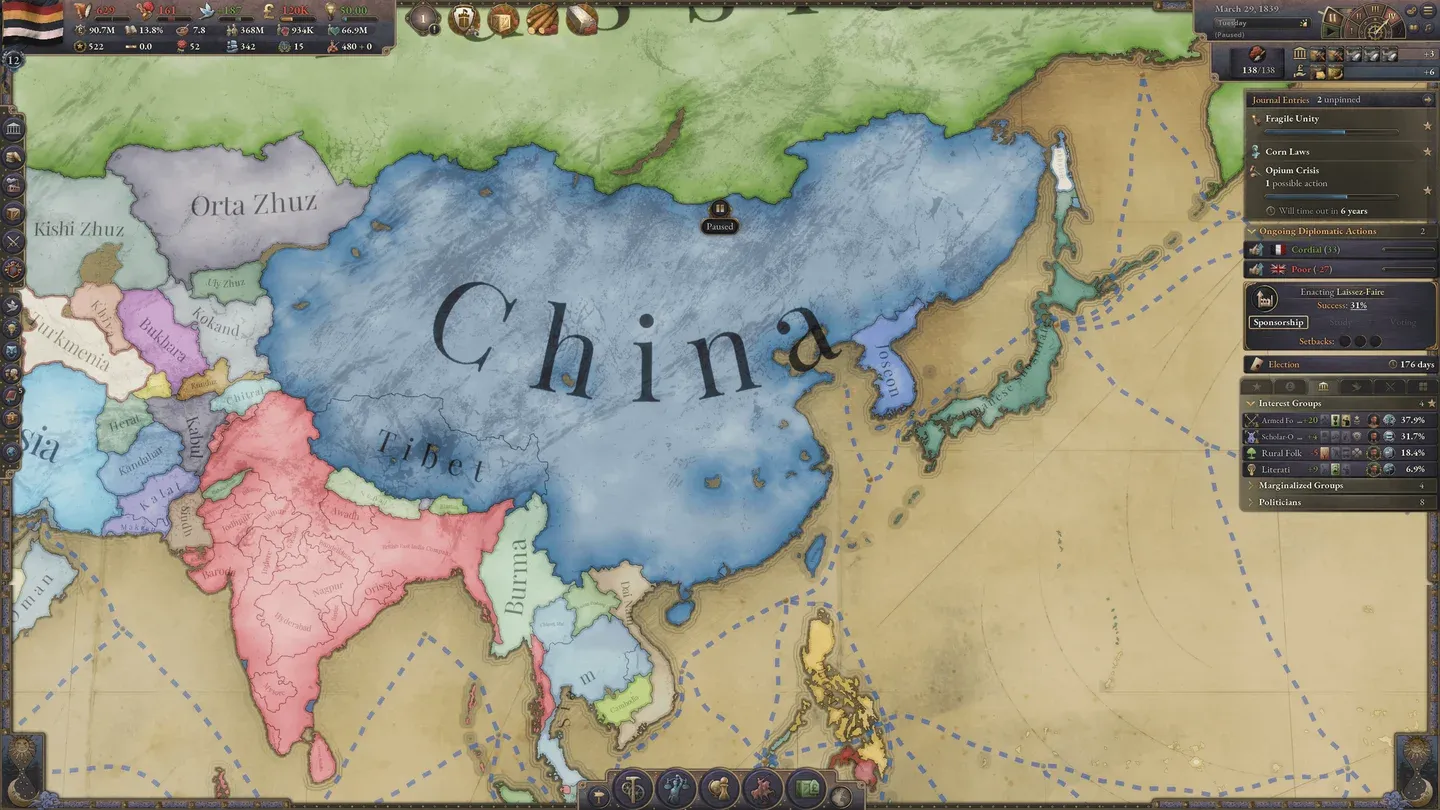
Qing starting position, 1836
What makes the Qing so different from other nations?
China starts as an unrecognized major power, which is a contradiction the game takes seriously. You have the highest nominal Prestige in the world and the largest population, but you are technologically behind every recognized European power and locked behind the Canton System trade law. This variant of Isolationism restricts all trade through a single state (Western Guangdong), applies a -25% debuff to Trade Capacity, and caps Trade Centers in that state at 50. Your market only includes Tibet, Joseon, and Lanfang at the start.
The Scholar-Officials (your Landowner interest group) hold government and carry the unique Scholar-Gentry ideology. This removes their opposition to changing the Economic System away from Traditionalism, which is a significant advantage most players miss. They also support Appointed Bureaucrats by default and do not block Landed Voting, making early political maneuvering more flexible than it looks.
How should you handle the laws in the early game?
Your starting law set is deeply conservative: Autocracy, Subjecthood, Serfdom, No Schools, Peasant Levies, and Closed Borders. Most of these will need to change eventually, but the order matters.
The most urgent economic unlock is getting off Traditionalism. Because the Scholar-Officials do not oppose this change (verified for version 1.9), you can push it earlier than most nations would expect. Landed Voting is worth passing to reduce the government ideology penalty, and the Scholar-Officials support it.
Closed Borders is a trap. The Protestant missions and Heavenly Kingdom events impose a steep cost for repealing it early, and keeping it closed prevents you from inviting agitators to start movements you actually want. Plan around this before you try to open up.
How do you survive the First Opium War?
This is the question every new China player asks, and the honest answer is: you probably lose it alone, and that is fine. There is insufficient time to strengthen the banner armies before the British arrive. The widespread opium addiction modifier halves your already poor offense and defense values at the start.
The most reliable approach on standard difficulty is to pursue a defensive pact with Russia before the war begins. Russia's more modern army is not affected by the opium modifier, and their forces can help resist British naval landings at Beijing and elsewhere. To actually force a favorable peace, use your small navy to land forces in undefended British colonies like Gambia or British Guiana to accumulate war exhaustion.
An alternative: start a diplomatic play in India (or any region where Britain will intervene) and back down once Britain joins. This buys a 5-year truce, which is enough time to enforce the opium ban and remove that devastating modifier.
Once the war concludes or the opium ban is enforced, the path to military modernization opens.
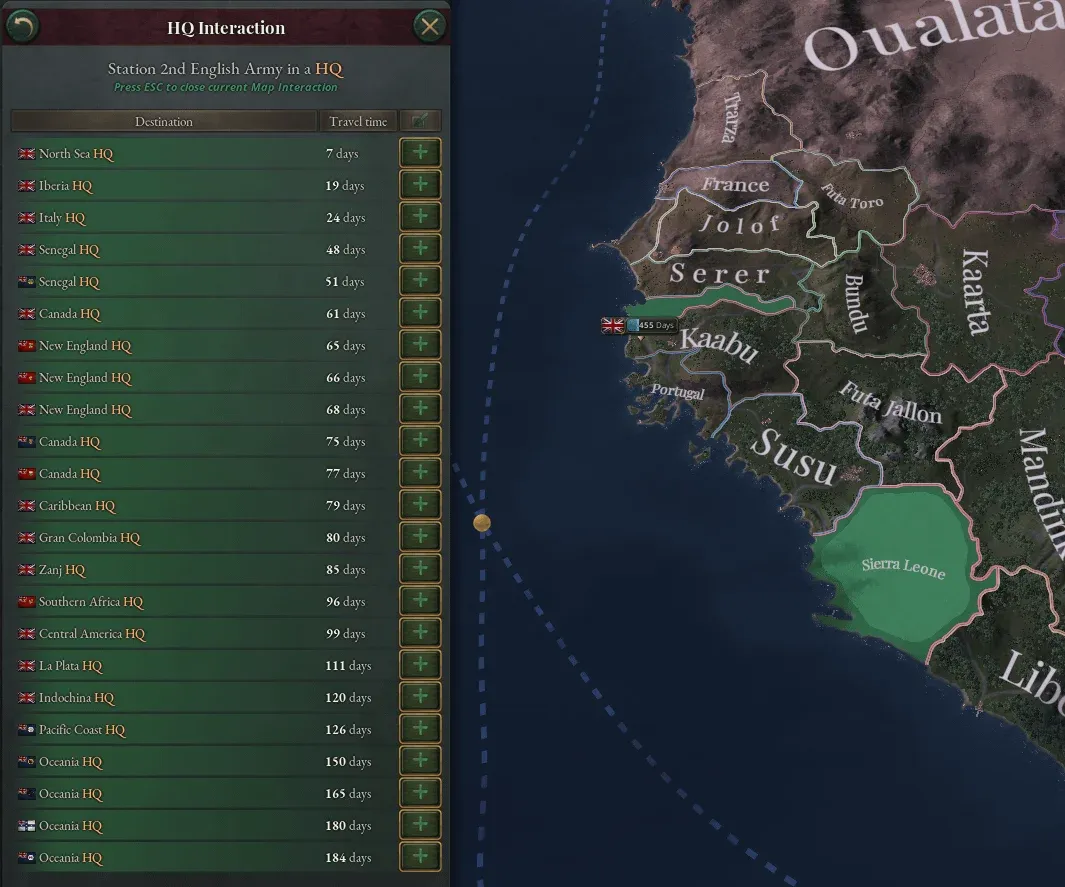
Starting army needs urgent reform
What is the right order for military upgrades?
China begins with 4 army technologies and 3 navy technologies unlocked. All barracks use No Organized Training. The 485 starting battalions are divided across 16 armies, composed entirely of Irregular Infantry and Hussars, with no artillery at all.
After the opium crisis is resolved, this upgrade path works best:
- Line Infantry technology first
- Mobile Artillery second
- With those two, upgrade all regulars to Line Infantry and build 50-60 battalions of Mobile Artillery split across your armies
- By the 1870s, add Skirmish Infantry and Triage
- Later, Shrapnel Artillery, which your industrial base should be able to supply by then
With around 600 battalions at that stage, you can challenge individual great powers and smaller neighbors alike. Recovery rate and kill rate matter less when you have overwhelming numbers, but you do need the same major infantry and artillery upgrades as your opponents.
A practical logistics tip: supplying armies with chocolate and liquor supplements for morale is very cheap for China, because sugar and liquor are typically abundant in the Qing market.
How do you build China's economy without it collapsing?
China's population is the game's greatest economic asset and its most demanding liability simultaneously. Building the economy fast enough to meet rising standard of living expectations requires relentless investment focus. Bureaucracy requirements for institutions are steep, and the most populous states carry deep tax capacity penalties for most of the century.
The sequencing rule worth memorizing: expand your raw resource base first, then scale manufacturing, then build offices and barracks. Reversing this order creates budget crises.
China starts with Light Industry in luxury consumer goods (luxury clothes, luxury furniture, porcelain) and the largest paper industry at game start, though it begins at a small deficit. The unique Sericulture production technology gives silk production an edge no other nation has at the start.
One critical note on rubber: China's vast territory contains ample coal, iron, lead, sulfur, and agricultural land, but has no domestic rubber. This needs to come from nearby regions or trade.
For investment rights: China's domestic market is so large that offering investment rights liberally does not crowd out domestic investors the way it might for smaller nations. This is a genuine advantage worth using.
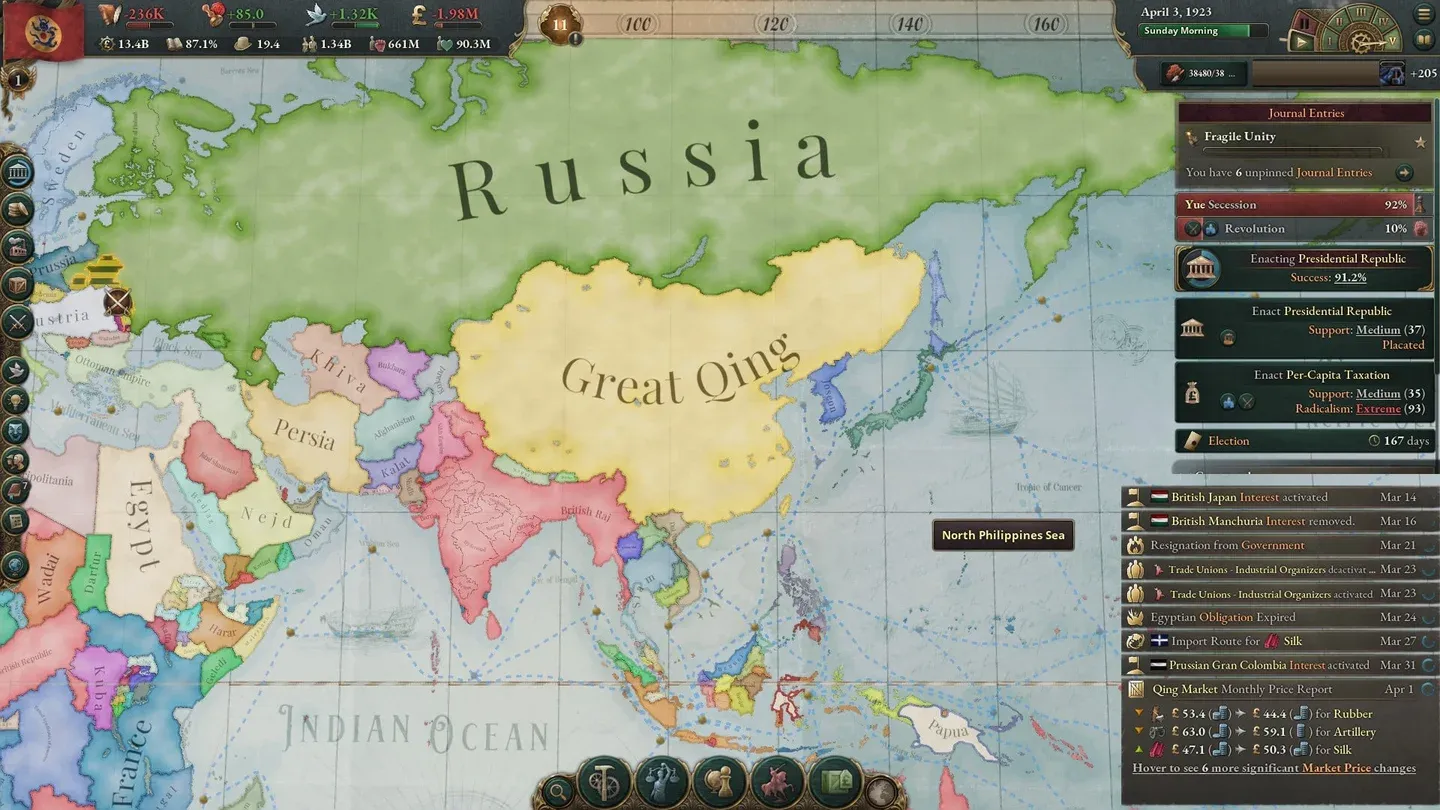
Resource-first construction order
On trade, the Canton System's -25% Trade Capacity debuff and the 50 Trade Center cap in Western Guangdong severely limit your trade potential until you repeal it. Repealing Canton System also unlocks the ability to found or lead a Power Bloc, which China easily qualifies for once that law is gone. The population size makes joining another bloc impossible, but leading one is straightforward.
Which companies should you prioritize?
China has several unique companies available. Here are the most strategically relevant ones:
The Kaiping Mining Company is the most accessible early target and its technology spread bonus directly accelerates modernization. Hanyang Arsenal becomes your military-industrial backbone once you reach the Breech-Loading Artillery tier.
How do you expand without starting a war you cannot win?
Early aggression is risky. Russia sits to the north and west, Britain to the southwest, and the Dutch in the southeast. That said, some early moves are viable.
Reclaiming Macau from Portugal is achievable even without full modernization, even with Britain as Portugal's ally. Joseon is already a tributary and will generally accept becoming a vassal. Lanfang (a small Hakka republic in southeast Asia) as a vassal facilitates Borneo conquest later.
For bigger ambitions, waiting until the mid-game when your military and supporting industries can actually challenge Britain and Russia if necessary makes sense. Central Asia and Indochina offer expansion opportunities with less great power friction than going east toward Japan early.
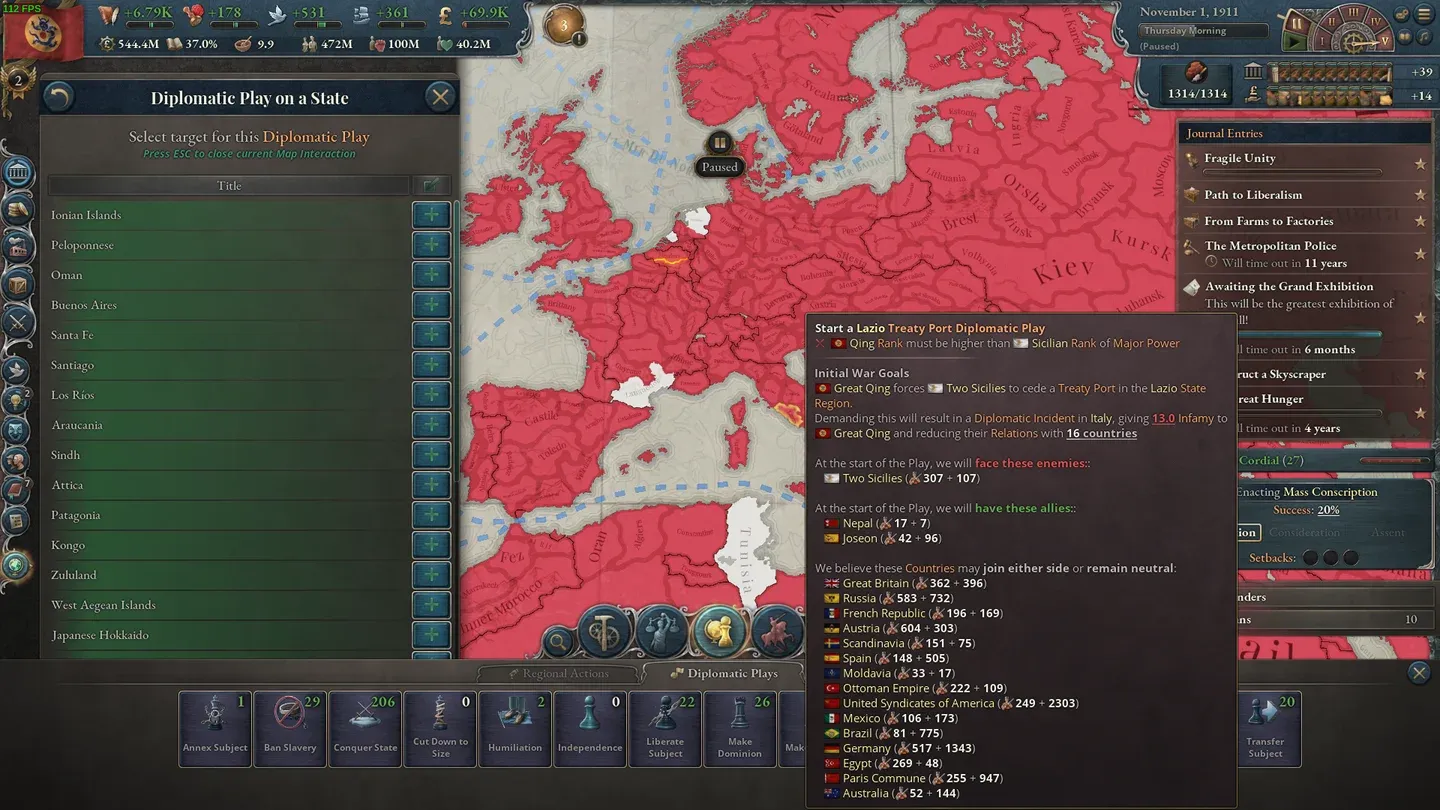
Diplomatic plays need a credible navy
Key characters to know
China's starting ruler is Aisin Gioro Daoguang, a Traditionalist with the Cautious trait. His heir, Aisin Gioro Yizhu (the future Xianfeng Emperor), is also Traditionalist. The most useful starting general is Luo Bingzhang, a Field Marshal with the Stalwart Defender and Wrathful traits and a Reformer ideology, which makes him politically useful as well as militarily.
Historical character templates that appear later include Zeng Guofan (Open Terrain Commander, available 1851-1870), Prince Gong Aisin Gioro (Experienced Diplomat, available 1853-1898), and Yuan Shikai (Ambitious, Persistent Reformer general, available 1885-1920). Sun Yat-sen appears as an agitator for the Petite Bourgeoisie with a Republican ideology between 1888 and 1925 if you own the Voice of the People DLC.
For more strategy content across Victoria 3 and other Paradox titles, browse more guides on GAMES.GG to keep your campaigns on track.