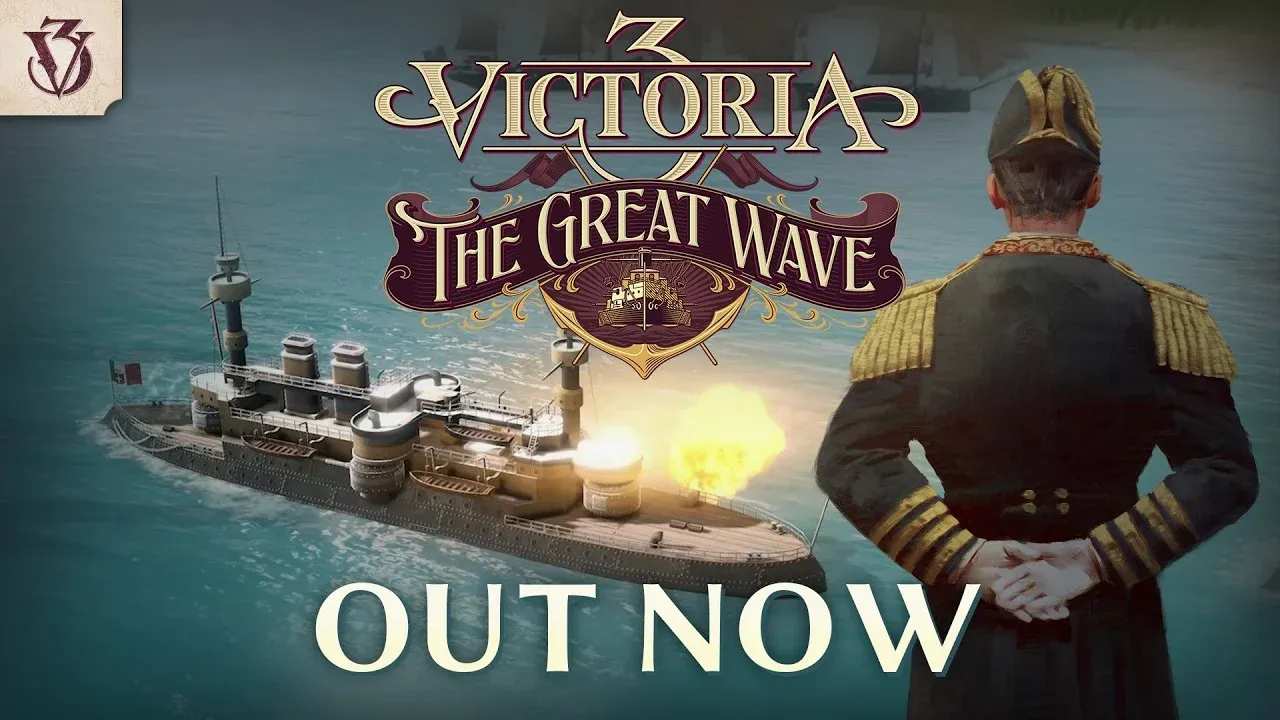


The Great Wave expansion for Victoria 3 is one of the most art-heavy releases the team has put out. The content splits into two distinct pillars: Japan and the navy. Both received full visual overhauls, new 2D assets, and a dedicated music approach that breaks from how the game has handled audio since launch. Released alongside the free Update 1.13 on April 28, 2026, the sheer volume of new art is easy to miss when you're busy managing interest groups and building railroads.
How did Paradox approach Japanese architecture?
The dev team made a deliberate choice to split Japan's buildings along the rural/urban divide rather than applying a single aesthetic across the board. Rural areas kept their Edo-period roots. Cities, by contrast, show the collision of tradition and Meiji-era modernization.
Rural buildings
Low-income rural housing draws from Gassho-zukuri and Nambu Magari-ya farm styles. Medium-income households use smaller Sukiya-zukuri buildings. High-income housing, reserved for the aristocracy and samurai class, blends Shoin-zukuri with the more informal Sukiya-zukuri for something that reads as an opulent manor rather than a generic wealthy residence.
The Rural Town hub includes period-specific details: a bathhouse typical of post towns along the Gokaidō road network, a temporary Kabuki stage, market stalls, and what appears to be a tea house. Farmland received unique models for silk plantations (complete with mulberry trees for silkworms), rice farms, livestock ranches, and wheat fields.
Urban buildings
Urban areas reflect the Meiji transformation more aggressively. Low-income city housing uses Nagaya long row houses with shared wells and toilets. Mid-income areas feature Machiya merchant quarters: two-story buildings with shop fronts and occasional rear gardens. High-income housing remains exclusive to the samurai class in cities as well.
The extremes of the era sit side by side. The most modern structure is modeled on the Ryōunkaku skyscraper, complete with its electric elevator. The most traditional military barracks take the form of a castle loosely based on Osaka, Matsue, and Tsuyama castles.
What's new with character art and clothing?
The team incorporated DNA for approximately 99 identifiable historical figures. Many more historical characters were added but lack surviving visual references, so their appearances were constructed from period context rather than direct likeness.
The DNA work was handled by community modder Lord R (of the Morgenröte mod), who Paradox brought in specifically for this release. Lord R's work on Japanese characters required careful judgment when source material was paintings or drawings with stylized features rather than photographs, as outlined in Dev Diary 180.
Clothing received a notable community contribution as well. Paradox worked with modder Miss Duce, creator of the Japanese Uniform Pack (JUP), to license a selection of her clothing assets directly into the base game for Update 1.13. These assets are free for all base game owners. The selected assets will be removed from the JUP mod at release since they're now part of the base game, though the mod itself continues with the remaining clothing.
How does the navy update look in practice?
The naval visual work is the largest single art undertaking in the update. Paradox researched, modeled, and textured 20 distinct ship types, each with four separate visual configuration categories. That means the actual number of unique visual states is considerably higher than 20.
How do ship configurations affect visuals?
Each ship's appearance changes based on four modifiable elements:
The team also built a code-based animation system rather than relying on traditional keyframe animation. All rocking motion, yaw, pitch, and tilt during idle and movement states are driven by mathematics. Turrets and casemates swivel to scripted positions when firing. The practical benefit is that future updates can adjust wave strength or wind direction independently of a ship's heading or firing state.
Naval combat dioramas
Rather than a static line-of-battle representation, Paradox went with what the team calls a "circle of battle": both fleets converge on a sea node and orbit each other around a central point until one side withdraws or sinks. The diorama keeps animating even when the game is paused, so there's always something to look at during a battle.
New visual effects and shaders allow for differentiated gunpowder smoke between earlier and later gun types, which is a small detail that adds up across a long campaign.
Strait control fortifications
Naval forts for controlling straits are modeled on Martello towers, the British-designed coastal fortifications found on most continents. The team chose this design because it's self-contained, can be built from locally available stone, and comes in a near-uniform shape that translates cleanly across different coastline types.
What does the Lacquer UI skin look like?
The Great Wave ships with a new UI skin called Lacquer. The design process started from a practical question: what materials would be used to construct this interface if it were a physical object? The answer was lacquered wood and earthy tones.
The final design centers on the Karahafu arch shape, which traditionally signals elegance and prestige at important building entrances in Japan. Ranma decorative panels appear prominently in the frame sections where header text sits. The color scheme is near-black dark brown with gold trim and red accents.
Buttons are finished in a copper tone rather than red (which UX convention associates with negative actions) and are noticeably brighter than the dark frame to maintain contrast. This is the first time Paradox changed the button material specifically to lacquered wood rather than plain wood.
What's in the new papermap skin?
The papermap, called Wakon Yosai, draws from Meiji-era ukiyo-e woodblock print aesthetics. The team focused specifically on Japanese naval history for the illustrated scenes, alongside mythological elements that are deeply embedded in the culture.
Specific illustrated scenes include:
- A depiction of the Battle of Port Arthur
- Japan's mythological creation by the deities Izanagi and Izanami
- The giant catfish Namazu causing the Ansei Edo Earthquake of 1855
- Kasa-obake (umbrella spirits) and frog humanoids in the Chōjū-giga animal caricature tradition
- Hidden frog illustrations and references to team members scattered across the map
How does the music work in The Great Wave?
The approach to music here is a deliberate departure from Victoria 3's previous instrumentation choices. The game has historically used symphony orchestra, chamber orchestra, or soloist formats. For The Great Wave, the team chose soloist instrumentation exclusively, because chamber and symphony orchestras weren't the dominant performance format in Japan during the Edo and Meiji periods.
The source material came from public domain songs and traditional pieces preserved through oral tradition or notation. Paradox worked with musicians experienced in historically accurate performance of traditional Japanese music to select and record the final tracks.
The release includes roughly 28 minutes of linear music performance. For context, the standalone Songs of the Homeland music pack clocked in at 46 minutes 51 seconds, so this is a substantial addition for content that sits within a larger expansion rather than a dedicated music pack. Tracks also continue with ambient or intermittent tails after the main performance ends.
Summary: what changed across art and audio in update 1.13
The depth of what Paradox packed into The Great Wave's visual and audio work is genuinely hard to appreciate from a changelog alone. The architecture alone required balancing Edo-period authenticity against Meiji-era transformation, the ship system required a completely new animation framework, and the music required sourcing and recording authentic period performances rather than adapting existing orchestral arrangements. For more coverage of Victoria 3 expansions and strategy content, browse more guides at GAMES.GG.