
Losing a veteran soldier in Xenonauts 2 hurts in a way few other tactics games replicate. That's because every stat point on your squad members was earned through real battlefield decisions, not handed out via a level-up menu. Understanding exactly how progression works, which attributes to prioritize, and how medals stack on top of everything else is the difference between a squad that crumbles under alien pressure and one that holds the line into the late campaign.
How do soldier attributes work in Xenonauts 2?
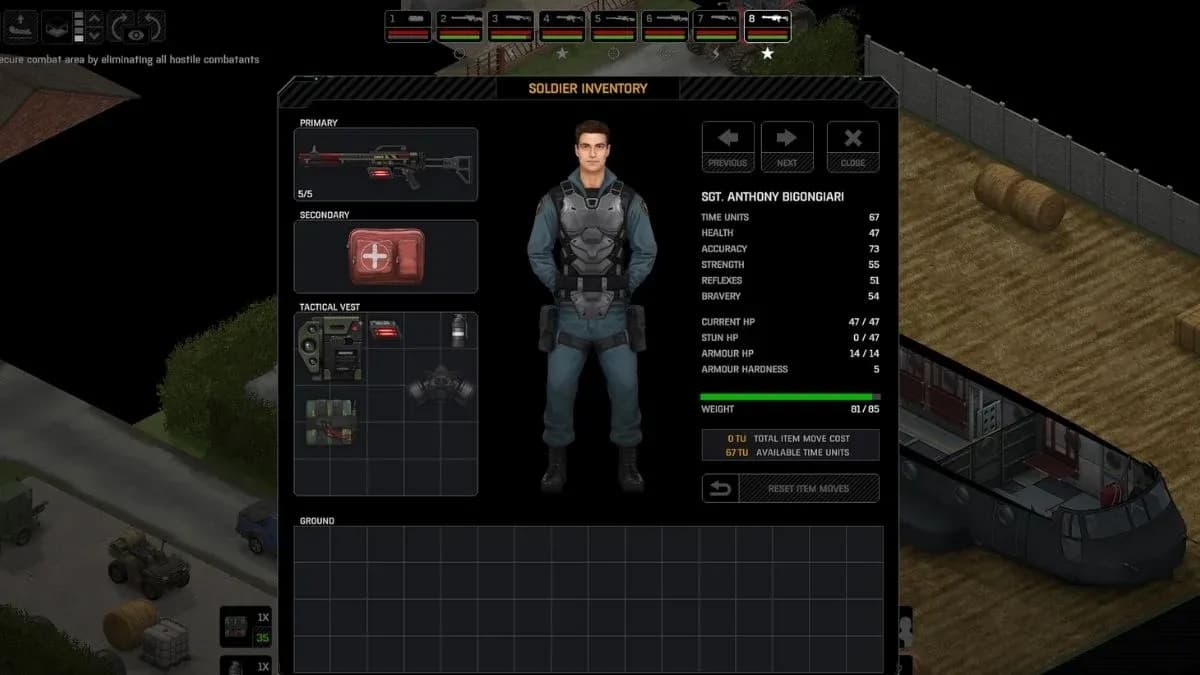
According to the Xenonauts 2 Official Wiki, each soldier carries six core attributes. These don't just sit in the background as abstract numbers. Every one of them ties directly to how your soldiers perform on the ground.
Six core soldier attributes
Here's what each attribute actually does:
- Time Units (TU): Governs how far a soldier can move and how many actions they can take per turn.
- Health: Sets the soldier's maximum hit points.
- Accuracy: Directly affects shooting precision against enemies.
- Strength: Controls maximum carry weight, grenade throw range, and recoil handling.
- Reflexes: Determines melee accuracy and how often a soldier triggers Reaction Fire when enemies move.
- Bravery: Affects morale outcomes and resistance to psionic attacks from alien units.
You can hover over any stat value in the UI to see the base number alongside all active bonuses and penalties. That transparency is genuinely useful when you're trying to figure out why a soldier is underperforming.

How does stat advancement work?
This is where Xenonauts 2 gets clever. Soldiers don't gain experience from a shared pool. Each attribute advances through specific actions tied to that stat, per the official wiki.
| Attribute | How to Earn Progress Points |
|---|---|
| Time Units | +10 per TU spent on movement |
| Health | +200 per increase in any other attribute |
| Accuracy | +20 per TU spent firing at enemies |
| Strength | +10 per TU spent moving while over 80% carry weight |
| Reflexes | +20 per unused TU at end of turn |
| Bravery | +50 per point of Suppression received |
Each attribute needs 1,000 Progress Points to gain +1. You can accumulate a maximum of 2,000 Progress Points per attribute per battle, so a single mission can theoretically yield 2 stat increases per attribute. Earning a kill also grants +200 Progress Points to every attribute simultaneously, which makes aggressive soldiers level faster across the board.
Diminishing returns on high-stat soldiers
Once a soldier has earned more than +5 increases in a single attribute, the cost per additional point rises. The official wiki documents the full scale:
| Progress Range | Cost Per Increase |
|---|---|
| +1 to +5 | 1,000 Progress Points |
| +6 to +10 | 1,250 Progress Points |
| +11 to +15 | 1,500 Progress Points |
| +16 to +20 | 1,750 Progress Points |
| +21 to +25 | 2,000 Progress Points |
| +26 to +30 | 3,000 Progress Points |
| +31 onward | 4,000 Progress Points |
The takeaway here is that spreading experience across multiple soldiers is more efficient than pouring everything into one. A squad of well-rounded veterans beats a single elite surrounded by greenhorns.
What are soldier ranks and why do they matter?
Rank in Xenonauts 2 is not cosmetic. It's calculated from the total number of stat increases a soldier has earned across all six attributes. More importantly, the highest-ranked soldier on a mission becomes the Mission Commander, and their rank directly affects the Bravery bonus or penalty applied to every other soldier during morale and psionic defence checks.
| Rank | Stat-ups Required | Commander Bravery Effect |
|---|---|---|
| Private | 0 | -10 |
| Corporal | 6 | -5 |
| Sergeant | 17 | 0 |
| Sergeant Major | 32 | +4 |
| Lieutenant | 50 | +8 |
| Captain | 70 | +12 |
| Major | 98 | +16 |
| Colonel | 128 | +20 |
Reaching Sergeant (17 stat-ups) is the first neutral breakpoint where the commander neither helps nor hurts. Getting to Sergeant Major at 32 stat-ups is where the real benefits begin.
What medals can soldiers earn, and what do they do?
Medals are automatic awards given when soldiers meet specific career milestones. Each medal grants +1 to all six attributes, and with 8 medals available per soldier, a fully decorated veteran picks up +8 across every stat purely from medal bonuses. That's a significant gain on top of normal progression.
Here are all 8 medals and what triggers them, according to the official wiki:
| Medal | Requirement |
|---|---|
| Award For Bravery | Complete a UFO Crashsite mission |
| Award For Courage | Complete a Terror Site mission |
| Award For Valor | Complete an Alien Base mission |
| Crimson Heart | Suffer 30 HP damage in a single mission |
| Crux Solaris | Eliminate 4 hostile units in a single mission |
| Distinguished Service Medal | Complete 10 missions |
| Gallantry Citation | Complete a mission where 50% of soldiers were casualties |
| Golden Star | Eliminate 5 hostile units |
The three mission-type medals (Bravery, Courage, Valor) come naturally as you progress through the campaign. The kill-based medals (Crux Solaris, Golden Star) reward aggressive play, and the Distinguished Service Medal just needs consistent deployment across 10 missions.
Building the best long-term squad
Putting all of this together, a few patterns emerge from the progression system:
- Deploy the same soldiers repeatedly. The Distinguished Service Medal at 10 missions and the natural stat gains from consistent play mean that rotating your core squad pays off over time.
- Let your best soldier lead every mission. Even a Sergeant at the helm is neutral on morale. A Colonel gives a +20 Bravery boost that can be the difference between a squad holding steady and one that breaks under psionic pressure.
- Chase kills actively. Every kill grants +200 Progress Points to all attributes simultaneously. A soldier who racks up kills levels faster in every stat, not just Accuracy.
- Accept that some soldiers will specialize naturally. Reflexes-heavy soldiers who hold fire become your reaction fire specialists. Strength-trained soldiers carrying heavy loads become your weapon platform units. Let the system push soldiers toward roles rather than forcing artificial builds.
For more strategy content and guides across tactical games, browse more guides at GAMES.GG.