

Deep Rock Galactic: Rogue Core drops you into a procedurally generated facility with a ticking clock, limited ammo, and a final boss waiting at the bottom. Most new players sprint for the elevator and die confused. The real game is everything happening between floors: the upgrades you grab, the events you pick, and the calls you make when two waves stack at once. This guide covers the systems that actually matter so your first few runs teach you something instead of just killing you.
What is the main objective in Rogue Core?
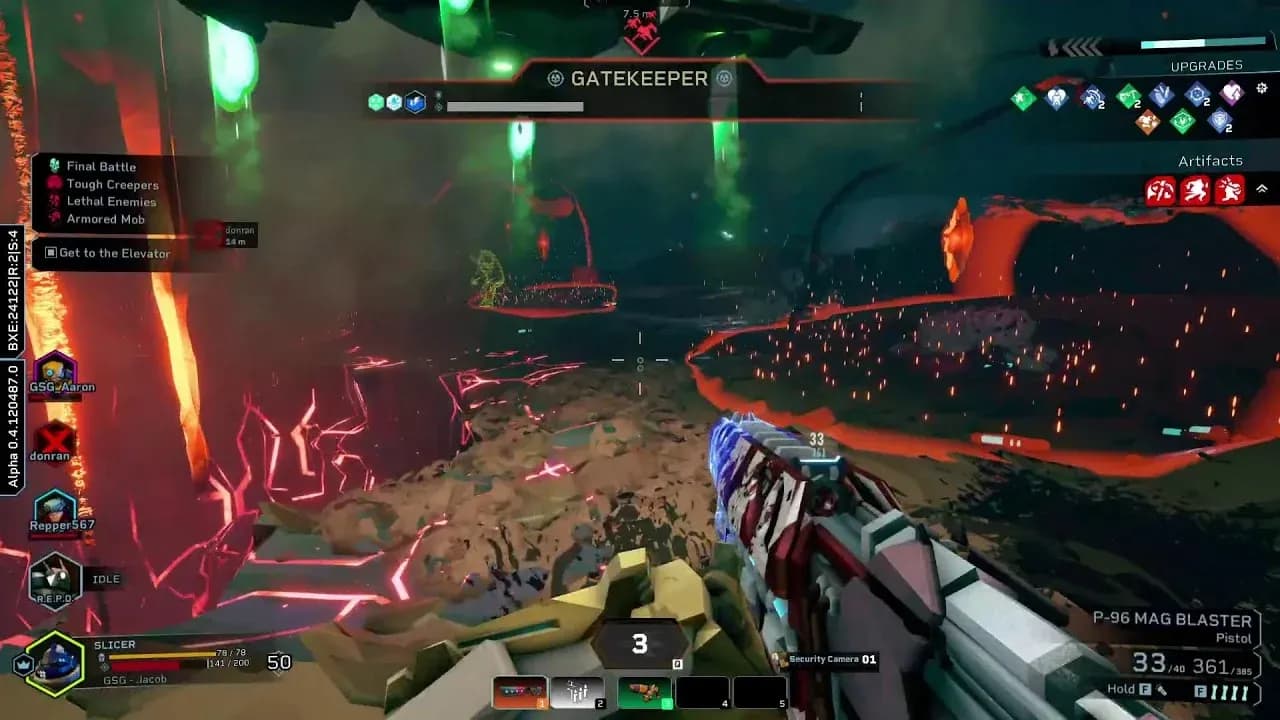
Every run has one goal: reach the Gatekeeper boss at the deepest level of the facility and defeat it. You get there by finding the elevator on each floor and descending further into the cave. Simple in theory. The problem is that rushing straight to the elevator without building your Reclaimer up first is a reliable way to get wiped by the Gatekeeper.
Each level contains resources and upgrade opportunities you need to actually survive the final fight. Expenite is the currency you spend on upgrades at the R.E.P.D.Bio-Boosters unlock class modifiers that shape your build. Workbenches let you swap and improve your weapons. On certain levels, Equipment Crates, Heavy Weapon Crates, and Artifacts also appear depending on the active Risk Vectors for that run. Expenite Events offer a large payout of Expenite in exchange for surviving a combat challenge.

R.E.P.D. upgrade station
The catch is that none of this is free time. There is a timer running the entire mission, and it does not care how many upgrades you still want.


How does the mission timer work?
The timer is the most punishing mechanic for new players to internalize. When it runs out, an endless wave of enemies spawns alongside Reaperworms, which are invincible enemies that grab downed players and drag them underground. A player killed by a Reaperworm cannot be revived until the next level. Multiple Reaperworms can appear at once, and combined with the endless enemy wave, they can wipe a team that is not already on the elevator.
Update 01 improved the timer's readability significantly. The final segment is now visually distinct to signal urgency, and there is an optional numerical countdown showing exactly when Reaperworms will appear. You can also now choose your Assault Pace from the Mission Map before a run:
| Assault Pace | Time Pressure | XP Rewards |
|---|---|---|
| Cautious | Low | Reduced |
| Standard | Moderate | Base |
| Reckless | High | Increased |
For your first several runs, Cautious gives you room to learn the cave layout and upgrade systems without the clock constantly threatening your neck. Switch to Standard once the loop feels natural.
What are the key survival skills for new players?
Speed and ammo discipline
The two things that kill new players most consistently are moving too slowly and burning through ammo on body shots. Speed matters because the faster you clear a floor, the more time you have to grab upgrades before the timer threatens you. Ammo matters because your supply is finite per level, and wasting shots on armored body parts instead of weakpoints means you will run dry before the final boss.
Ammo Resupply Pods spawn throughout caves, and there is always one right outside the elevator at the start of each level. The final level before the Gatekeeper has significantly more Resupply Pods than earlier floors, so do not panic-hoard ammo at the cost of missing upgrades.
Wave management
Multiple enemy waves can stack. Timer progression triggers waves. Expenite Events trigger waves. Starting the elevator triggers a wave. Triggering two of these at once means double the enemy count, and triple is possible if your timing is especially bad. The fix is simple: finish your Expenite Events before you start the elevator, and check the timer before committing to any long activity.

Expenite event enemy wave
How do Merits and progression work?
Merits are the backbone of long-term progression. They unlock higher tiers of Enhancements, additional Enhancement slots per Reclaimer, Ascensions, and Deployments. You earn Merits primarily by completing Directives at the Operations Command Terminal (OpsCom), and also through Deployments and Gauntlet completions.
The formula for Reclaimer Points earned per mission is: points × (2 + DataTerminalMult + CameraMult). As a concrete example: 2,000 base points with 5 Data Terminals (0.5 multiplier) and 8 Cameras (0.4 multiplier) yields 5,800 Reclaimer Points. Every 1,000 Reclaimer Points converts to 1 Chip, which you spend on Enhancements.
You earn Reclaimer Points whether you win or lose, so early runs where you die on the Gatekeeper still feed your progression. Do not skip the Cameras and Data Terminals just because a run is going badly.
What are Enhancements and how do you unlock them?
Enhancements are permanent passive upgrades that function similarly to perks. They come in multiple tiers and can increase max health, max ammo, weakpoint damage, and even grant new abilities. You spend Chips to unlock individual Enhancements and Merits to unlock higher tiers and additional Enhancement slots.
Each Reclaimer starts with only one Enhancement slot. Unlocking more slots costs Merits and must be done separately for each Reclaimer. Prioritize unlocking extra slots early since a single Enhancement rarely changes how a run plays out, but two or three stacked together can.
Update 01 added auto-equipping for the highest tier Enhancement when you unlock a new one, and stacked Enhancement tiers in the Loadout Terminal for a cleaner overview. Both are quality-of-life improvements that make managing multiple Reclaimers much less tedious.
For a full breakdown of every available upgrade, the Deep Rock Galactic: Rogue Core guide covering all Expenite upgrades covers each option by rarity and which ones to prioritize.
How do Ascensions work?
Ascensions are Rogue Core's version of Promotions from the original Deep Rock Galactic. Once a Reclaimer reaches level 15, they qualify for their first Ascension at a cost of 1,000 Merits. Each subsequent Ascension increases that cost by 1,000 Merits, and the requirement is tracked per individual Reclaimer, not globally.
Ascensions reset the Reclaimer back to level 1, but the benefits are significant. The first Ascension unlocks access to Gauntlets for that Reclaimer and allows them to equip Bio-Booster decks from other Ascended Reclaimers. You also receive a cosmetic pickaxe head that updates with each new Ascension tier.
One thing to know: a Reclaimer cannot level past 15 before Ascending. Any XP earned beyond that cap is wasted until you complete the Ascension. Each subsequent Ascension also requires more levels to complete, with each new Rank adding 3 more required levels (Bronze requires 15, Silver requires 18, and so on).
What changed in Update 01?
Update 01, released on June 17, 2026, was the first major content update for Rogue Core and changed several core systems that new players should know about.
The R.E.P.D. upgrade process no longer requires the full team to group up. Any Reclaimer can now initiate an upgrade, and the upgrade link connects to all players regardless of their location in the facility. This alone removes a significant amount of mid-run friction.
Upgrade Negotiations were also reworked. When one player selects an upgrade, it is replaced with a new option so everyone still gets the same number of choices. The "Skip for Health" option was removed, and health upgrades now appear alongside all other upgrade options. All upgrades within a single draft now share the same rarity tier, meaning the whole team either gets lucky together or picks from commons together.
Two new weapons were added: the Trident, an energy shotgun with a semi-automatic 3-shot mode and a chargeable barrage mode, and the Corrosive Sludge Pump, a heavy weapon that combines crowd control with armor-melting damage over time. A new flying enemy, the Voidkin Drifter, also entered the pool. It is highly mobile, only stops moving to charge its ranged attack, and its Void Bolts hit hard if you let it get surrounded.
Three new Risk Vectors were added: Drifter Surge (negative, spawns extra Voidkin), Bio-Booster (positive, adds a second Bio-Booster to the level), and Workbench (positive, adds a second Workbench).
Trident energy shotgun
How do cosmetics work?
There are two main cosmetic currencies: Scrip and Cosmetic Crates. Scrip is earned by completing a set number of Directives, with two additional Scrip available from Gauntlet completions. You spend Scrip at the Cosmetic Sheet in OpsCom or the Wardrobe to buy cosmetics for a specific Reclaimer.
One Scrip unlocks a cosmetic for one Reclaimer, with the exception of pickaxe parts and pickaxe paintjobs, which unlock for all Reclaimers with a single purchase. Cosmetic Crates appear in the caves during runs and contain unique cosmetics that cannot be obtained through Scrip. They are quick to loot and worth grabbing whenever you pass one.
Where should you go from here?
The systems in Rogue Core connect tightly. Getting your Enhancement slots open early, staying ahead of the timer, and learning when to skip an Expenite Event versus when it is worth the risk separates players who reach the Gatekeeper from those who do not. Once you have the basics down, pairing your Reclaimer with the right team setup makes a significant difference at higher Depths. The best team composition guide for Rogue Core breaks down which Reclaimer combinations work best and why.
For everything else, the full Deep Rock Galactic: Rogue Core guides collection covers every system in depth, from graphics optimization to co-op setup. Rock and Stone.