

Mostafa Salem
Head of Gaming Research
Directive 8020 is the fifth entry in Supermassive Games' Dark Pictures Anthology and the first to leave Earth entirely behind. Set aboard the colony ship Cassiopeia on a mission to Tau Ceti f, 12 light years from a dying Earth, it borrows freely from Alien, The Thing, and Event Horizon. The difference this time is that the borrowing feels intentional rather than accidental, and the story that surrounds those familiar bones is the best Supermassive has written for this series.
Gameplay
Here's the thing: Directive 8020 is two games stitched together. The first is a choice-driven narrative adventure in the Dark Pictures mold, where you switch between crew members, make dialogue decisions under pressure, and nail QTEs to keep people alive. The second is a light stealth game where you sneak past mimicking aliens using a flashlight and an electric baton.
The narrative side works well. The Turning Points system, available in Explorer mode, gives you a visual story tree that shows branching paths and the consequences of your decisions. It is similar to the path viewer in Detroit: Become Human, and it genuinely encourages replays because you can see exactly where your choices diverged from other possible outcomes. If you want to map every branch and save every crew member, our Turning Points and story tree guide covers the full decision map.
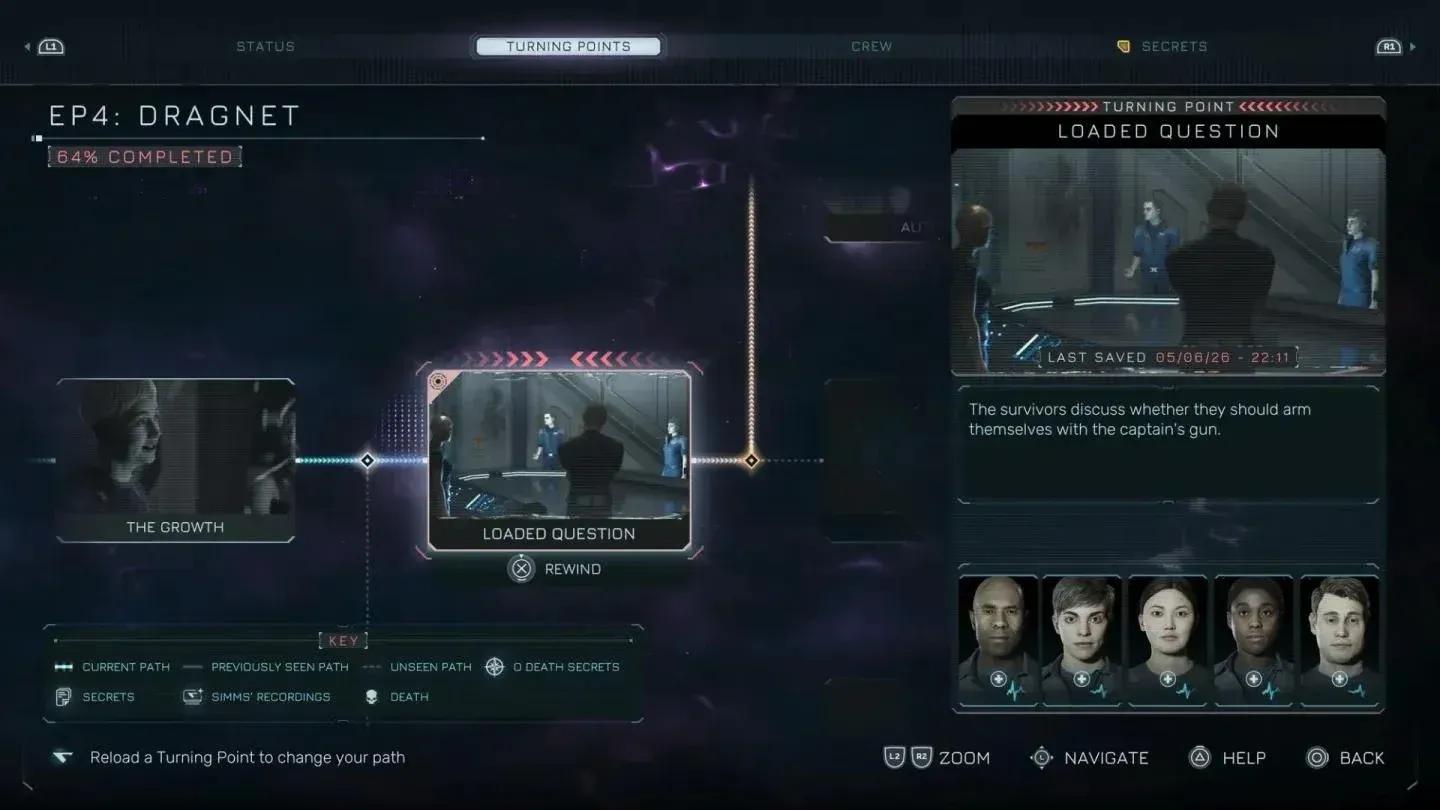
The Turning Points story tree
The stealth side is where the game loses ground. The concept is sound: the alien can mimic crew members, so you are never entirely sure who is safe, and sneaking through corridors while that paranoia builds should feel tense. Early on, it does. By hour five, it does not. The stealth never adds new mechanics, never increases in meaningful complexity, and the electric baton stun that saves you when spotted becomes a reliable safety net that deflates any real danger. One of the top-voted negative Steam reviews put it plainly: the stealth "doesn't iterate, it irritates." That is accurate. Roughly 6 of the game's 9 hours involve these sections, and the ratio is too high.
Two difficulty modes give you some control. Survivor mode is the traditional experience with standard QTE timing. Explorer mode eases the challenge and adds the Turning Points system. There are also accessibility options for QTE inputs, including a toggle-instead-of-mash option that several Steam players specifically called out as a welcome addition.
Graphics and audio
This is the best-looking Dark Pictures game by a clear margin. The Cassiopeia's corridors are detailed and oppressive, the lighting does real work in building atmosphere, and the facial animations are significantly more natural than previous entries. There are still occasional stiff expressions and a few lines of dialogue that land awkwardly, but the cast, led by Lashana Lynch as pilot Brianna Young, carries the material well.
The sound design is strong where it counts. Ambient noise in the ship's dead sections creates a persistent unease, and the alien audio cues are distinct enough that you can actually use them as gameplay information during stealth sections. The score stays understated for most of the runtime, which is the right call. Loud orchestral horror music would undercut the paranoia the game is trying to build.
Performance on PC was solid for most players at launch. Multiple Steam reviewers reported stable framerates at 4K with settings maxed, though a handful of audio glitches appeared in later chapters. Nothing game-breaking, but worth knowing.
Story and characters
The setup is familiar: Earth is dying, the Cassiopeia crew is humanity's best shot at finding a new home on Tau Ceti f, and something alien has breached the hull and started mimicking the crew. The first two hours lean hard into that familiarity, and there is a stretch early on where the game feels like it is going through motions you have seen before.
Then it stops playing it safe.
Without getting into specifics, the back half of Directive 8020 has a couple of revelations that genuinely reframe the earlier scenes. Character motivations shift, and the story earns those moments because it spent time making you care about the people involved. Cernan, the philosophical engineer missing his husband back on Earth, is a standout. Cooper, the medical specialist carrying guilt into the mission, gets a satisfying arc. Even Williams, the corporate CEO whose presence on the ship initially reads as pure plot device, becomes more complicated than expected.
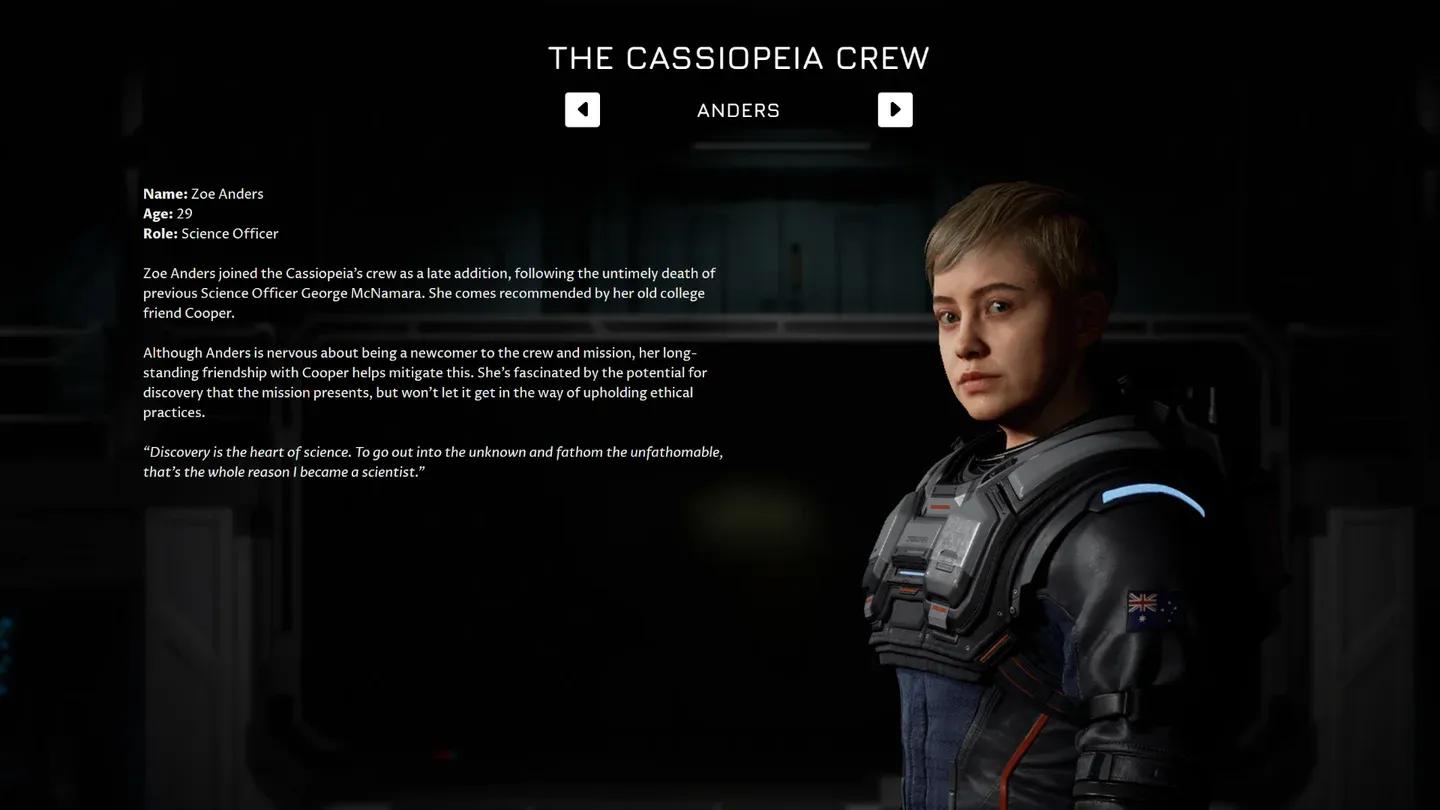
The Cassiopeia crew roster
The mimicry horror escalates well. Early chapters make it fairly obvious who is and is not infected. By the final third, you genuinely stop knowing, and that uncertainty translates into real hesitation during choice moments. That growing paranoia is where the game earns its horror credentials.
Verdict
Directive 8020 is the best argument in years that the Dark Pictures Anthology still has somewhere interesting to go. The sci-fi setting suits Supermassive's strengths, the cast is the most developed the series has produced, and the story's second half delivers the kind of genuine surprises that make you want to replay immediately.
The stealth is the real problem. Not because it is broken, but because it is just good enough to keep and just repetitive enough to wear you down. A game built entirely around the narrative side, with the stealth trimmed to a handful of genuinely tense sequences, would have been something special. What we have instead is something very good with a structural flaw that is hard to ignore across 9 hours.
For fans of adventure games in the horror space, this is worth your time. For Dark Pictures veterans specifically, it is the strongest entry since House of Ashes and a clear sign that Season 2 of the anthology is starting from a better foundation than Season 1 ended on. Check the platform details if you are still deciding which version to pick up.
Directive 8020 Review
7.5/10
Directive 8020 is the shot in the arm the Dark Pictures Anthology needed. After a four-year gap since The Devil in Me, Supermassive came back with a tighter story, better characters, and the most effective horror setup the series has produced. The alien mimicry angle starts predictably but earns its paranoia by the midpoint, and a few genuine bombshell moments reframe everything you thought you understood. The problem is the stealth. It shows up constantly, never really changes, and by hour six you are doing the same hide-and-baton routine for the dozenth time. If you can make peace with that, what surrounds it is genuinely great. Fans of the series should play this without question. If you are new to Dark Pictures, this is actually a fine starting point, though House of Ashes still holds the crown for pure tension. At around 9 hours for a first run, the price-to-content ratio is tight, so catching it on sale is a reasonable call for the more budget-conscious.
7.5
Pros
Best narrative in the Dark Pictures Anthology so far
Genuine paranoia as the alien mimicry escalates convincingly
Strong cast with well-developed, likable characters
Impressive visuals with cinematic lighting and detailed environments
Meaningful branching choices with a satisfying story tree
Cons
Stealth sections repeat without evolving across 6 of 9 hours
Short runtime makes the repetition feel more pronounced
Early chapters telegraph too much before the story finds its footing
Couch co-op only, no online shared story mode
Some facial animations and voice lines feel stiff