


Road to Glory in EA Sports College Football 27 is the most layered player career mode the series has seen. You start in high school, build your tape, earn scholarship offers, and then spend your college years managing everything from exam prep to draft projections. Three new positions, a rebuilt character creation system, and a weekly agenda full of genuine consequences make this year's version worth understanding before you start.
What's new in CFB 27 Road to Glory?
The headline addition is three new playable positions: Tight End (TE), Free Safety (FS), and EDGE Rusher. Combined with the five returning spots, the full position list now reads:
- Quarterback (QB)
- Halfback (HB)
- Wide Receiver (WR)
- Tight End (TE)
- EDGE
- Middle Linebacker (MIKE)
- Cornerback (CB)
- Free Safety (FS)
Beyond positions, the player creation system received a significant overhaul. Archetypes are no longer selected from a menu. They form organically based on how you allocate your Max Potential Points, which means two players at the same position can end up with completely different profiles depending on where you spend your budget.
Customization depth has also expanded with new gear options including hanging mouthpieces, single leg sleeves, team-branded backplates, and an additional rolled jersey style. Notre Dame's "Play Like a Champion" branding appears on backplates for that program, which is a nice touch for authenticity.
How do you create the best Road to Glory player?
Creation breaks into several connected decisions. Each one feeds the next, so the order matters.
Step 1: Choose your journey
Your Journey sets your starting foundation and available Skill Points. There are four options:
Elite and Blue Chip players hit the ground running but have less dramatic development curves. Underdog careers feel more rewarding over time, but you will spend early seasons fighting for playing time.
Step 2: Pick your Player Base
After locking in your position and basic info, you choose between Create Your Own and Use Legend Build.
Create Your Own gives you full control over height, weight, and body type before you ever touch Max Potential. Physique directly affects attribute caps. A heavier build raises the ceiling on strength and power moves but compresses speed and agility potential. A lighter build flips that equation. This is where you make foundational tradeoffs that follow your player for their entire career.
Legend Templates are preset builds inspired by college football stars like Reggie Bush, Vince Young, and Tim Tebow. Each template comes with preset height, weight, body type, and a Max Potential allocation tuned to that player's historical strengths. You can still adjust the Max Potential distribution after selecting a template, so it is less a constraint and more a starting point.
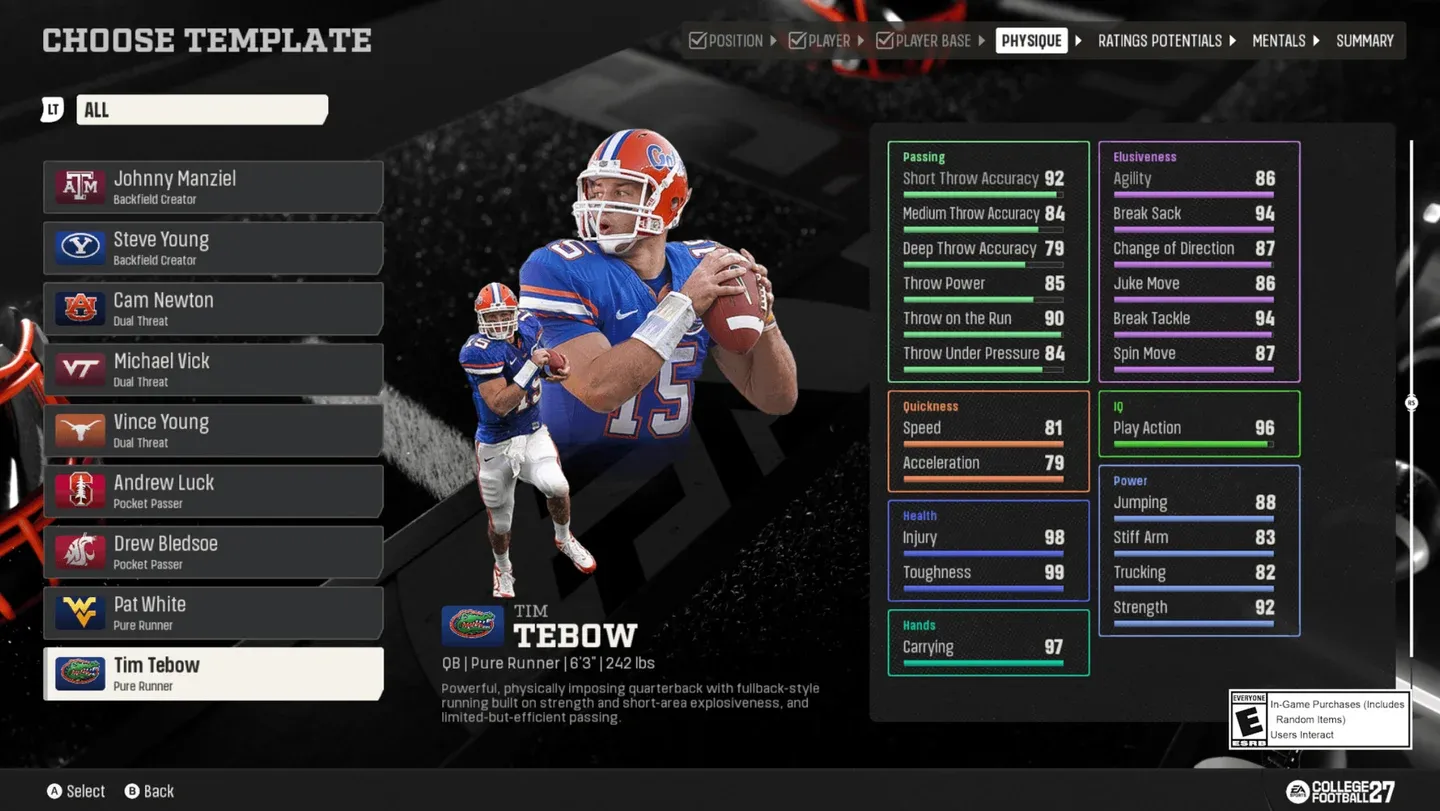
Legend or custom your call
Step 3: Allocate Max Potential Points
This is the most consequential decision in player creation. Max Potential determines how close your player can actually get to each attribute cap set by their physique. If your physique allows a Speed cap of 95 but you only invest enough Max Potential to reach 92, then 92 is your hard ceiling for Speed.
Your Overall Rating (OVR) and archetype update in real time as you spend points, so you can see exactly what kind of player you are building. A few principles worth keeping in mind:
- Concentrating points in one area creates a standout strength but leaves other attributes underdeveloped
- Spreading points evenly produces a more well-rounded player who rarely dominates any single category
- Check the Physical Abilities panel before finalizing. Some abilities require minimum attribute thresholds to unlock
- Your archetype is determined by your final allocation, not chosen directly
Step 4: Choose your Mental Abilities
You select three starting Mental Abilities, one tied to each of your core Weekly Agenda meters: Academics, Leadership, and Brand. All three start at Bronze tier and can be upgraded as your career progresses.
The catch is that each Mental Ability only stays active while its linked meter is healthy. Let your Academics meter drop and your Academics-based ability goes dormant until you recover it. This creates a direct mechanical link between how you manage your weekly schedule and what on-field bonuses you retain.
How does the high school portion work?
The high school phase runs across five games, each with four playable moments. Before each game, you choose which moments to play based on which college scouts are watching and what situations are set up on the field. Objectives are designed around actual football situations rather than arbitrary checklists.
Big plays carry weight independent of formal objectives. A long touchdown, a key tackle, a turnover, or an explosive run can improve your Tape Score even without being tied to a specific goal. Highlight Moments now award partial credit, so missing one component of a challenge does not wipe out your entire effort.
Scholarship offers during this phase are more transparent. Each offer shows exactly what bonuses it provides across Academics, Leadership, Brand, Fitness, Coach Trust, and Skill Points. Those bonuses pay out annually, not just once, and schools can adjust their offer based on how you perform and handle campus life. After narrowing things down to a Top 3, you make your final decision on Signing Day.
Recruiting bonuses pay annually
What are Draft Projection and Legacy Score?
Draft Projection tracks where you would land in the NFL Draft based on your performance, development, OVR, Legacy Score, school year, position, off-field choices, and physical wear. It is not static. A string of strong games and smart weekly decisions can push you up boards. A bad stretch, an injury, or academic trouble can drop you.
Legacy Score measures what you leave behind in college football specifically. Awards, records, rivalry wins, championships, and major career moments all feed into it. Legacy Score also unlocks higher overall ceilings, which means raw grinding is not enough. You have to actually perform when it matters.
The two systems are related but distinct. Draft Projection looks forward toward the NFL. Legacy Score looks backward at what you built in college. Managing both simultaneously is one of the central tensions of the mode.
How does the weekly agenda work in CFB 27 RTG?
The weekly structure runs on energy allocation. You have a limited pool each week and need to distribute it across training, academics, brand, fitness, and other activities. Every choice has a tradeoff.
College Exams are now an actual mechanic. You take them, and if you have not invested energy in studying, the exam gets harder. The game can throw a scenario where the quiz is in Spanish, and if you skipped studying to do something else, that is your problem to deal with. These dilemmas are designed to make every week feel like a real decision rather than a routine button press.
Fitness management replaced direct training XP. Staying in shape improves Coach Happiness, speeds up progression, and provides temporary stat boosts. Falling out of shape slows growth, hurts ratings, and creates a recovery problem that takes multiple weeks to fix.
Practice is now the primary XP source outside of games. The mode includes more than 50 drills covering position-specific work and team situations. Team drills include two-minute scenarios, red zone work, and run-game situations. Position drills cover coverage, blocking, pass rushing, and run-after-catch situations depending on your position.
Per-play grading and gameday
Gameday grading has been rebuilt to focus on what your player individually does rather than leaning on team results. A quarterback gets graded on throw quality. A tight end gets credit for blocking. An EDGE rusher earns recognition for pressure even without a sack. Jump the Snap is a new position-specific mechanic added for EDGE rushers.
Dynamic weather can shift mid-game. A match might start clear, move into snow, and settle back before the final whistle. Between plays, you can SuperSim to your next moment or stay on the sideline and watch the game continue.

Energy allocation drives your week
How do Cap Breakers work?
Cap Breakers let you push an attribute beyond the ceiling set by your Max Potential allocation. You earn them by reaching major milestones, winning awards, breaking records, and hitting elite career accomplishments. The system gives top performers a path to become genuinely exceptional players.
- Maximum Cap Breakers earned across a career: 25
- Maximum Cap Breakers applied to a single attribute: 5
- The point gain per Cap Breaker depends on the attribute's current cap. An attribute capped at 95 may only gain 1 point, while a lower-capped attribute may gain more
What happens at the end of each season?
Season-end meetings with your coach cover your role, development, performance, Coach Happiness, scholarship status, and future plans. A strong Draft Projection can push the conversation toward declaring for the NFL. A poor standing with the program can result in a reduced scholarship or a suggestion to enter the Transfer Portal.
The Transfer Portal gives you a reset option. A new school can offer more playing time, better bonuses, or a cleaner path to a starting role. The cost is starting over somewhere new and proving yourself again from scratch.
For players building custom schools, Team Builder integration extends into Road to Glory. You can replace your high school, opposing schools, and college programs with Team Builder creations, with up to 16 total replacements across the mode. Custom schools participate in recruiting, so you can earn scholarship offers from programs you built yourself. For a full breakdown of how that system works, check out the Dynasty Mode and Team Builder guide.
If you want to experience Road to Glory before committing to a full purchase, the EA Play free trial gives you up to 10 hours with your progress carrying over if you upgrade. For everything else across the game, the full EA Sports College Football 27 guide collection has you covered.