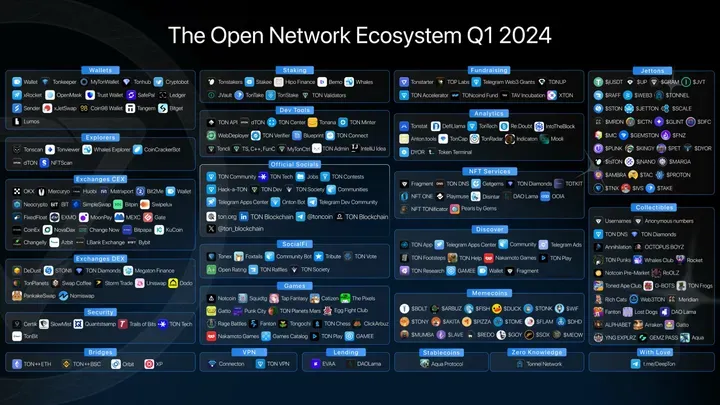

Catizen, a play-to-earn game by Pluto Studio, wrapped up its first major $CATI token airdrop on September 14th, distributing rewards to over 15.2 million players. The drop marked the end of Season One for the Telegram-integrated blockchain game, with players across leagues from Silver to Royal receiving tokens based on their in-game activity.

Catizen Cover Banner on X (Twitter)
What is Catizen?
Catizen is a blockchain game built on The Open Network (TON) and runs through Telegram, making it accessible to a massive user base. The core loop has you managing a virtual cat café where you merge cats to create higher-level versions that generate more vKitty, the in-game currency. The merge-and-grow mechanic drives progression and unlocks additional rewards as you level up.
The $CATI governance token gives players voting power over the game's direction, fitting the decentralized ethos of web3. With more airdrops and content updates planned, the game aims to keep its community engaged long-term.
Catizen Notice to Players
Airdrop Details and $CATI Token
Of the 35.8 million players who tried Catizen, 42% qualified for the airdrop. They split 15% of the total $CATI supply, earning tokens by completing in-game tasks, quests, missions, and daily activities. The distribution didn't go smoothly, though.
Pluto Studio originally said vKitty profit speed (a measure of in-game earnings rate) would be the main factor in determining rewards. On airdrop day, the team pivoted to prioritizing on-chain interactions, task completions, and spending behavior instead.

Details on Airdrop
Managing Expectations and Community Bakclash
The last-minute rule change was meant to stop bot users from gaming the vKitty system. While that makes sense on paper, players who focused on time-based strategies rather than spending real money felt blindsided. Making things worse, only 34% of the total $CATI supply was circulating at launch, not the 43% previously announced.
That discrepancy sparked confusion and accusations of poor communication from the dev team. Pluto Studio clarified that 9% of the supply went to Binance Launchpool, leaving 15% for the first airdrop.
Tim Wong, Chairman of the Catizen Foundation, framed the airdrop as a major milestone despite the backlash. He emphasized that $CATI represents the "core spirit of web3" by letting players shape the game's future through governance.
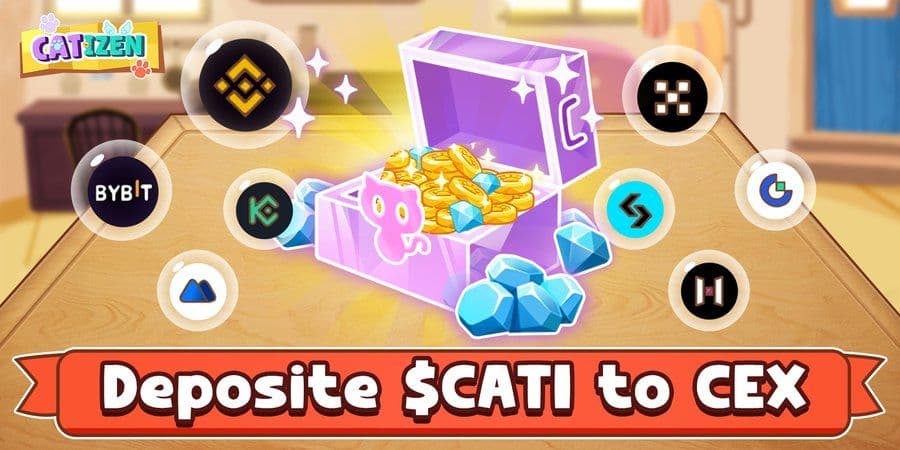
Deposit $CATI to CEX
Tokenomics and Utility
The $CATI token has a hard cap of 1 billion. Pluto Studio allocated 43% to the community and ecosystem, with 34% reserved for airdrops (15% already distributed in Season One). The remaining 19% will release gradually over 12 quarters to keep rewards flowing for current and future players.
Key uses of the $CATI token include:
- Governance: Token holders vote on development decisions and future updates.
- In-Game Purchases: Buying items with $CATI gets you a 30% discount.
- Staking and Rewards: Staking $CATI through Binance Launchpool earns rewards from other projects.
- Fee Discounts: Reduced fees when trading with the Vanilla Trading Bot.
- Meowdrop Rewards: Ongoing rewards for $CATI holders to increase long-term value.
On top of governance benefits, 50% of Catizen's revenue goes toward buying back and burning $CATI tokens, which should reduce circulating supply and push the token's value up over time.
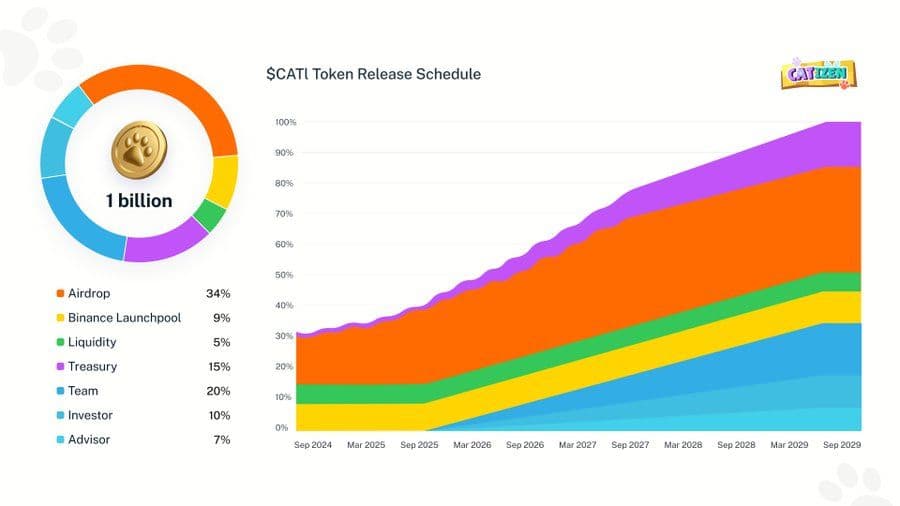
$CATI Token Release Schedule
Final Thoughts
With the first $CATI airdrop wrapped, Catizen is lining up more drops every quarter for both new and returning players. The dev team has plans to expand the ecosystem with new mini-games, additional content, and potential moves into e-commerce and short-form video.
The mix of accessible gameplay, blockchain integration, and community-driven governance keeps Catizen competitive in the play-to-earn space. The focus on long-term tokenomics and player rewards remains central to the project's vision. More information is available here.