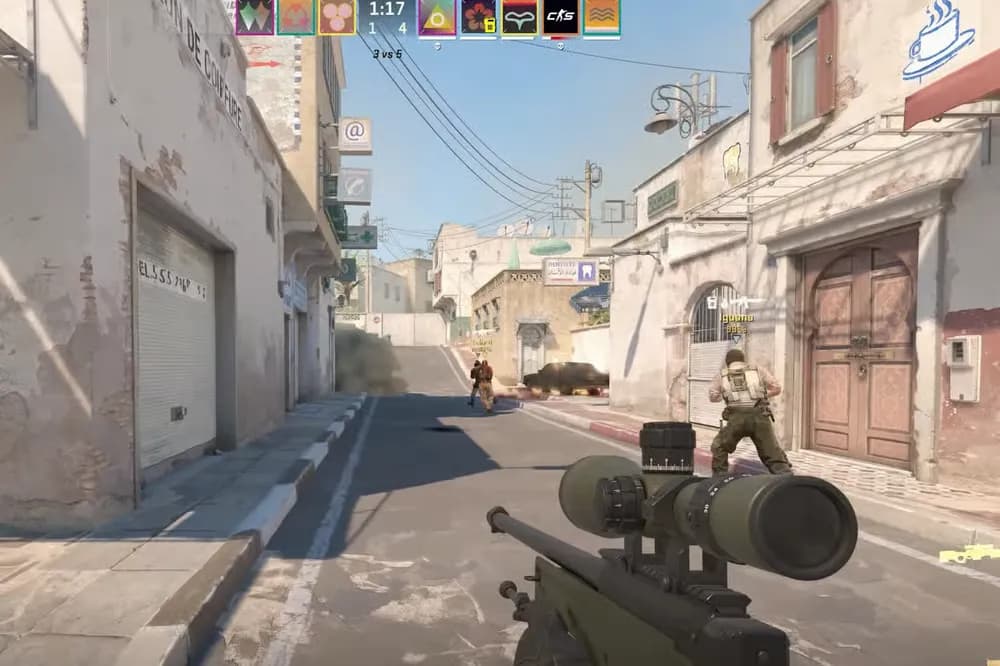

A 22-year-old handheld console with a 480 x 272 display and a fraction of modern hardware's processing power. That's what developer Yifeng Wang decided to run a Counter-Strike clone on, and somehow it works at a locked 60 FPS.
Wang posted footage to X on July 10, 2026, showing the project in action alongside a laptop displaying active development code. The reaction was immediate. The post went wide across gaming communities, with players double-checking that what they were seeing was real.
What Wang actually built here
This wasn't a quick weekend port. Wang constructed the entire technical foundation from scratch. The project, called OpenStrike, runs on a custom Rust-based 3D engine he built called Pocket3D, paired with a JavaScript engine named PocketJS. The result is a Counter-Strike-style FPS that fits inside a 12 MB RAM footprint on hardware that launched in 2004.
All eight of Counter-Strike's original maps have been tested and confirmed working. The current build supports elimination matches against bots. The buying phase isn't in yet, so don't expect to be purchasing an AWP before rounds, but the core loop of moving through familiar geometry and shooting enemies is there.
The PSP's original display runs at 480 x 272 resolution across a 4.3-inch screen. OpenStrike targets that native resolution exactly, which is part of why the performance holds up.
The technical decisions that make this possible
Here's the thing: getting 60 FPS on hardware this old requires making very deliberate tradeoffs, and Wang made smart ones.
Non-visible map areas are culled using Binary Space Partitioning, a technique that predates most modern rendering pipelines but suits constrained hardware perfectly. Rather than calculating lighting in real time or even at load time, graphical assets are pre-processed with lightmaps baked directly into vertex colors. The maps don't look like they just shipped out of a modern engine, but they're recognizable and they run.
The project also runs on the PS Vita, Sony's 2011 handheld, with native graphics support. The Vita's display steps up to 5 inches at 960 x 544 resolution, giving OpenStrike a bit more room to breathe visually.
Why the modding community is paying attention
Projects like OpenStrike matter to the modding scene for a specific reason: they prove that purpose-built engines designed around hardware constraints can do things that straight ports never could. Wang didn't try to squeeze an existing Counter-Strike build onto the PSP. He built a clean-room implementation, a custom engine, a custom scripting layer, and a proof of concept that other developers can now learn from and build on.
The GitHub repository is public, and the open JavaScript mod API means other contributors can extend the project. What most players miss when they see footage like this is that the impressive part isn't just that it runs. It's that the architecture is designed to be extended.
For a game that has defined competitive PC FPS for over two decades, seeing it adapted to hardware this constrained is a reminder of how much of Counter-Strike's appeal is structural. The maps, the movement, the tension of a round. None of that requires a modern GPU.
If you want to go deeper on the game itself, the Counter-Strike strategy guides at GAMES.GG cover the mechanics that have kept the game relevant across every hardware generation, including this one apparently.
Keep an eye on Wang's GitHub for updates to OpenStrike. With bot matches already working and all eight original maps confirmed, the next logical step is weapon purchasing, and that would make this feel a lot closer to the real thing. For more on games pushing unexpected hardware to its limits, browse the gaming guides hub for the latest coverage.