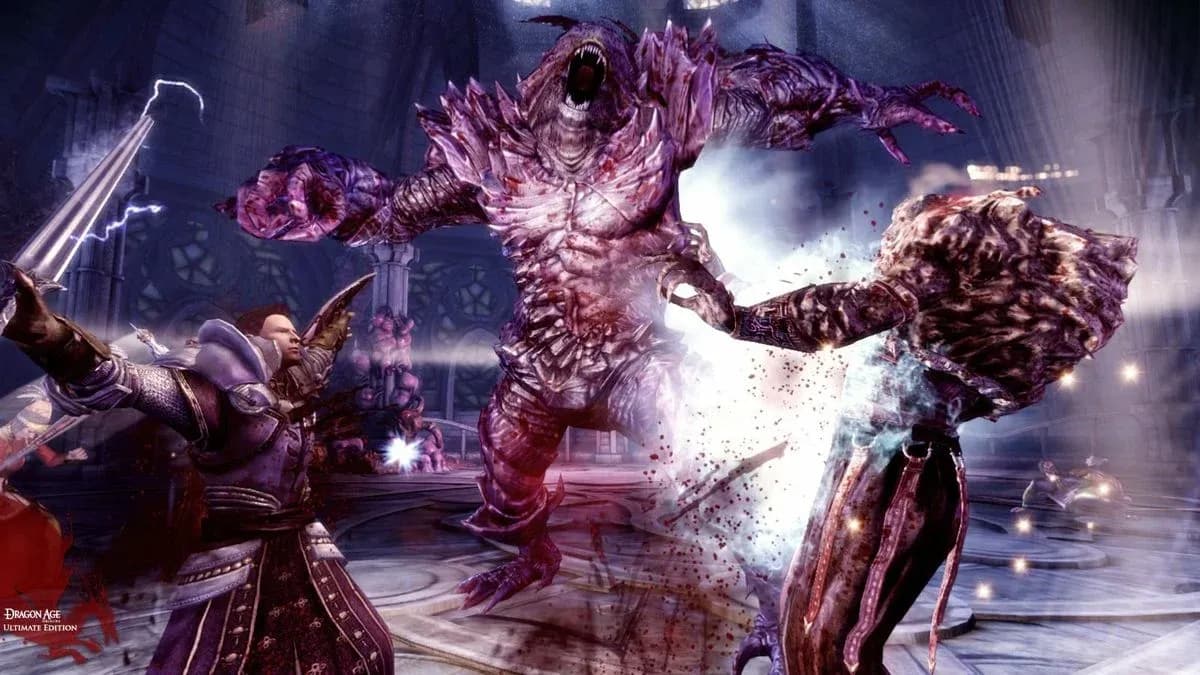

If you ever wondered why Dragon Age kept feeling like it was fighting for its life at BioWare, former series lead writer David Gaider just confirmed your suspicions. Gaider, who wrote on the franchise from Origins through Inquisition before leaving BioWare in 2016, says Dragon Age was perpetually one bad quarter away from being shelved, and that EA had a clear favorite in its stable of BioWare RPGs. That favorite was Mass Effect 3 and the broader Mass Effect franchise, which EA viewed as the modern, action-forward property it actually knew how to market.
EA's two-tier RPG system
Gaider's framing is blunt. "The way EA looked at it was that Mass Effect was the slick, modern RPG that had action, and they could sell really easily. Whereas Dragon Age was old-fashioned and focused on story."
That internal hierarchy had real consequences. When Mass Effect titles underperformed or stumbled, leadership apparently made excuses. When Dragon Age releases exceeded projections, those results got written off as flukes rather than evidence of a healthy franchise. It's the kind of institutional bias that quietly shapes budgets, timelines, and the creative latitude teams actually get.
Here's the thing: Dragon Age kept selling better than EA expected, every single time. "We were always one breath away from the project being shelved," Gaider says. "The thing that happened is that we kept releasing games, and it would sell much better than they thought it should, and it kept surprising them." Surprising the publisher with your own sales numbers is not a sustainable position for any creative team to be in.
What the action combat debate actually reveals
Gaider also touches on something Dragon Age fans have argued about for years: the series never found a stable identity for its combat. Origins went slower and more tactical, later entries swung toward faster action, and neither direction ever fully satisfied EA's vision of what the franchise should be.
"Our action, ranging from Dragon Age: Origins, was a little bit on the slow, cumbersome side, and then was too fast. They never knew what to do with it," Gaider says.
That indecision tracks directly with how the series evolved across four games. Each entry felt like a course correction from the last rather than a natural evolution, which is exactly what happens when a publisher keeps second-guessing a franchise it never fully believed in.
Dragon Age: The Veilguard and what came after
The most recent entry, Dragon Age: The Veilguard, released in 2024 after roughly a decade in development and multiple reported restarts. It received broadly positive critical reception but failed to meet EA's commercial expectations. The publisher moved quickly to gut the BioWare team responsible for it, and EA is now in the middle of a $55 billion acquisition that is widely expected to result in further internal cuts.
Gaider's assessment that Dragon Age continuing at EA is "unlikely" lines up with everything that has happened since The Veilguard shipped. A dedicated modding community has stepped in to preserve and expand the series, which says something about the gap between fan investment and corporate commitment.
The version of Dragon Age Gaider would actually make
Here is where it gets interesting. Gaider, who previously ruled out any return to Dragon Age, has softened that position, with one significant condition: EA cannot be involved.
"If, out of some weird alignment of the stars, somebody handed the Dragon Age franchise back to me and said, 'Breathe the life back into this baby,'" he says he would go back to the basics that made the series connect with players, and then push into darker, more confrontational territory. "Go somewhere dark and dangerous, and do things that will make people upset. I think that's what I would want to do with it."
That is a genuinely compelling pitch. Dragon Age: Origins worked precisely because it did not shy away from consequence or moral weight. The series gradually softened those edges as it chased broader audiences, and the results speak for themselves.
What this means for BioWare fans watching Mass Effect 5
For players who have been waiting years for the next Mass Effect, Gaider's comments add an uncomfortable layer of context. Mass Effect was the franchise EA actually wanted, the one it understood and could sell. That preferential treatment may have benefited the series in terms of resources and continued investment, but it also meant Dragon Age absorbed the institutional skepticism that should have been directed at actual underperformers.
The key here is that both franchises ultimately suffered under a publisher that prioritized marketability over creative consistency. Mass Effect 3 remains a landmark RPG, but the franchise has been dormant for over a decade while EA figures out what to do next. Dragon Age may not get another entry at all.
If you want to revisit what BioWare RPGs looked like before the corporate tug-of-war became this visible, the Mass Effect 3 strategy guides and broader gaming guides on our site are worth bookmarking while the future of both franchises remains unresolved.