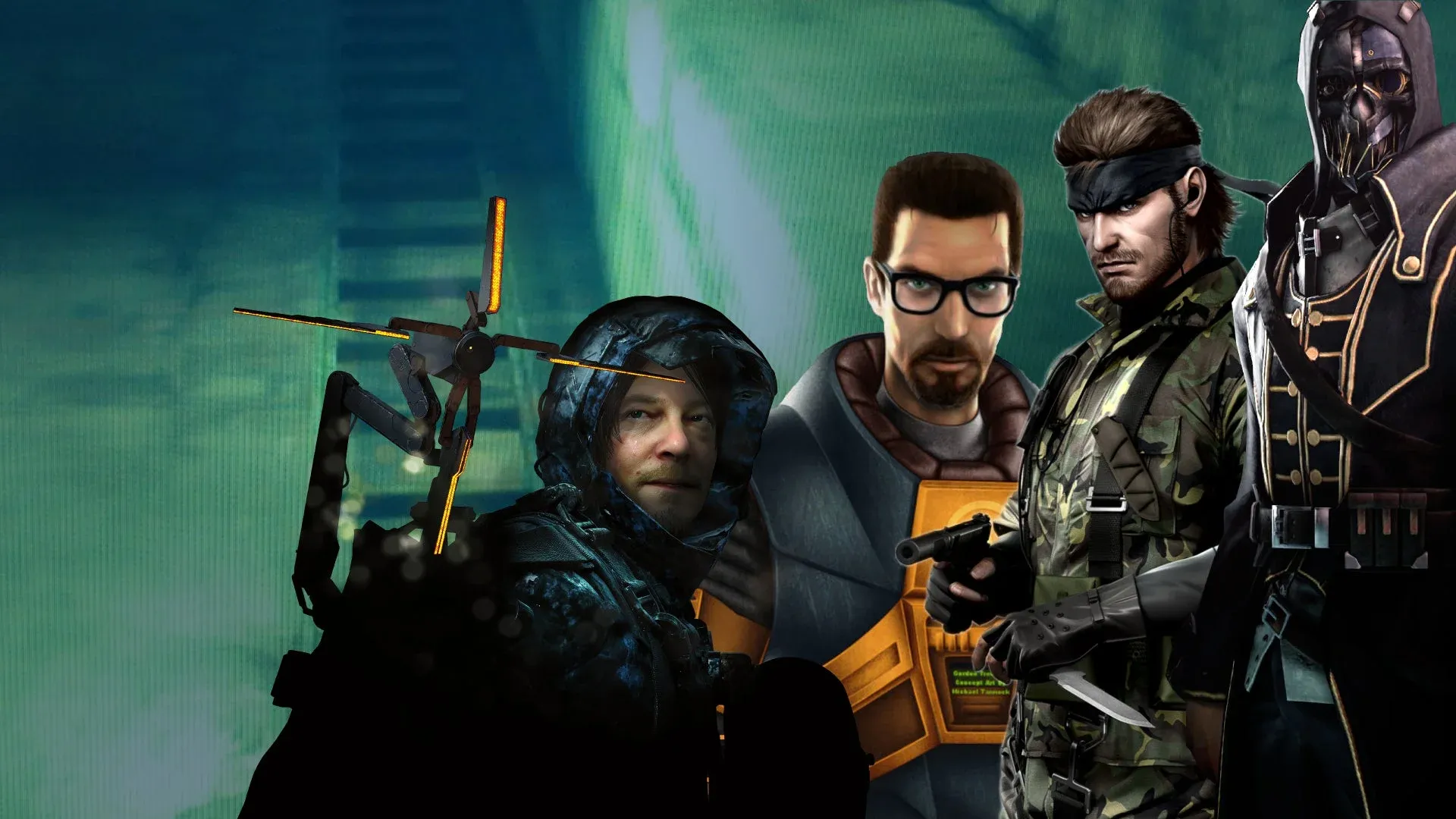


One of the 20 design philosophies plastered on the walls of Arkane Austin read, simply, "Fuck ladders." Before Xbox shut the studio down, that mantra sat alongside motivational poster aesthetics that Harvey Smith mocked up with an online generator. It was funny. It was also completely sincere.
Here's the thing: ladders look like a solved problem. Two rails, some rungs, go up. But ask any game designer who has shipped one and you will hear a very specific kind of exhausted laugh.

Use code TRYHARD33 at checkout to redeem this offer before code expires again.
Get 33% Off GAMES+ Subscription
The mantra that built Dishonored
The "Fuck ladders" philosophy predates Dishonored by years. Harvey Smith and Raphael Colantonio, Arkane's co-creative leads, were trying to get either a Thief or Blade Runner game off the ground when Smith first articulated the studio's design instincts out loud. Neither project materialized, but the philosophy survived.
When the team eventually built Dishonored, they replaced ladders with hanging chains. Colantonio was convinced the chains would be significantly less work to implement. They were not less work. The joke practically writes itself, but it also illustrates exactly why ladders are such a trap: every alternative you reach for comes loaded with its own list of edge cases.
The design questions stack up fast. Does the player see their hands and feet on the rungs? Then you need animations that actually look good. Can they draw a weapon mid-climb? New animation set. Can they slide down, or jump off sideways? What happens when an explosion hits them mid-ladder? Can the AI navigate the same way the player can? Suddenly the two rails and some rungs have spawned a small project of their own.
Why ladders keep breaking games
Liz England, former lead designer at Ubisoft and Insomniac, puts it plainly: "There's always cases where, when you put players in a different move state, there's bugs where they get stuck in that move state. So, you might end up getting just kicked off the ladder, but you also can't pull out a gun anymore. Ladders are horrible."
England is also the designer behind the famous "Door Problem" blog post, which grew out of trying to explain game development complexity to non-gamers over dinner. Doors, she argues, are deceptively complicated in games. Ladders are arguably worse, because they carry an additional burden: visibility.
While working on Resistance 3 at Insomniac, England encountered a single ladder in a trainyard that playtesters kept walking straight past. She added a directional arrow. People still missed it. More arrows. Still nothing. The ladder looked exactly like a real trainyard ladder, which is the problem. It blended into the environment so naturally that players never registered it as interactive. The fix was painting it yellow. High realism costs you readability.
There is also the Source Engine era to reckon with. You did not climb ladders in Source games so much as magnetically press your face to a surface and tilt your head backward until physics carried you upward via some invisible force. Angle slightly wrong and you fell. The sound of that fall is genuinely lost knowledge at this point. Current ladder implementations, with their sticky magnetism and smooth character repositioning, represent decades of accumulated design iteration that most players never consciously notice.
Kojima and the three-minute climb that changed everything
Metal Gear Solid 3: Snake Eater contains what is widely considered the longest ladder in video game history. It was, fittingly, the background image behind the "Fuck ladders" poster at Arkane Austin. The climb takes roughly three minutes. It arrives at the game's midpoint, transitioning between biomes. The sound goes hollow. Water drips. Wind moves through the shaft. Then the music swells into a full a capella Bond-style theme about eating tree frogs, arriving just after one of the game's most intense boss fights.
It is completely absurd and completely effective. No film would hold an unbroken three-minute ladder sequence outside of experimental arthouse, but in a game, the act of holding the stick and watching the rungs pass transforms the context. The player is doing the climbing. The stamina bar is ticking. The question of whether you will make it becomes genuinely present.
Hideo Kojima has not stopped pushing ladders since. In Death Stranding, Kojima Productions rebuilt the ladder as a thematic object. Portable ladders can be placed anywhere in the world at almost any angle. They function as bridges over rivers, ramps across gaps, and genuine connective tissue between locations. Structures built by one player appear in the worlds of others, turning a piece of traversal equipment into a multiplayer communication system. Below a 45-degree angle, you walk up them freely. Get more vertical and you lock in. The system is intuitive precisely because it does not try to be clever. It just works.
Arc Raiders and the ladder that will get you killed
Not every studio is trying to make ladders meaningful. Some are using them to make a point.
In Arc Raiders, there is a ladder on the side of the Research and Administration building at Dam Battlegrounds. Games have spent decades training players to treat ladders as safe spaces. You hold down, you reach the bottom, nothing bad happens. This particular ladder only goes halfway. Hold down past the endpoint and you drop off the bottom and die. You have to stop and jump sideways at the right moment.
It is a deliberate troll from the devs at Embark Studios, and it works. The ladder reinforces the game's core tension: nowhere Topside is genuinely safe, and the moment you go on autopilot is the moment the game punishes you for it. A ladder used as a threat is a ladder doing real design work.
For players who want to get deeper into games that treat traversal and environmental design as first-class mechanics, Terrinoth®: Heroes of Descent approaches spatial navigation from a tabletop-rooted perspective that rewards players who think carefully about every route. The Terrinoth®: Heroes of Descent strategy guides break down how vertical movement and positioning shape outcomes across the game's scenarios.
The broader point is that something as mundane as a ladder can carry weight, theme, humor, or threat depending entirely on the designer's intent. The adventure games genre has long understood this, using traversal as a storytelling device rather than a purely mechanical one. Ladders, it turns out, are just one more tool that rewards the designers willing to ask what they actually want the player to feel at the top.