Intel has launched a cloud-based precompiled shader service for Arc GPU owners, and if you've ever sat through that agonizing first-boot shader compilation screen, this one's for you.
The new Intel Precompiled Shaders Distribution Service works by storing already-compiled shader files on Intel's servers. When you install a supported game, the Intel Graphics Software automatically detects it, pulls down the optimized files for your specific hardware, and caches them locally. No more watching a progress bar crawl across your screen before you've even played a single second.

Use code TRYHARD33 at checkout to redeem this offer before code expires again.
Get 33% Off GAMES+ Subscription
What the Service Actually Does
The system works like this: shaders get compiled and stored in Intel's cloud infrastructure ahead of time, then matched to your GPU and drive configuration when a supported game is detected. The result lands locally on your system and gets used automatically at launch.
Intel says the service can improve first load times by up to 2x on Intel Arc B-series GPUs, Intel Core Ultra Series 3, and Series 2 chips with built-in Arc graphics. There's no bloat added to the driver package itself since the files live in the cloud until you actually need them. You will need an active internet connection and at least 1 GB of free storage depending on your game library, though.
The 13 Games Supported at Launch
The current driver package (32.0.101.8626 WHQL) brings precompiled shader support to 13 titles:
- Black Myth: Wukong
- Borderlands 4
- Call of Duty: Black Ops 6
- Call of Duty: Black Ops 7
- Cyberpunk 2077
- God of War Ragnarök
- Gotham Knights
- Hogwarts Legacy
- NBA 2K26
- Starfield
- S.T.A.L.K.E.R. 2: Heart of Chornobyl
- The Elder Scrolls IV: Oblivion Remastered
- The Outer Worlds 2
It's a solid opening lineup. Heavy hitters like Cyberpunk 2077 and Black Myth: Wukong are notorious for their shader compilation demands, so those two alone make this worth enabling.
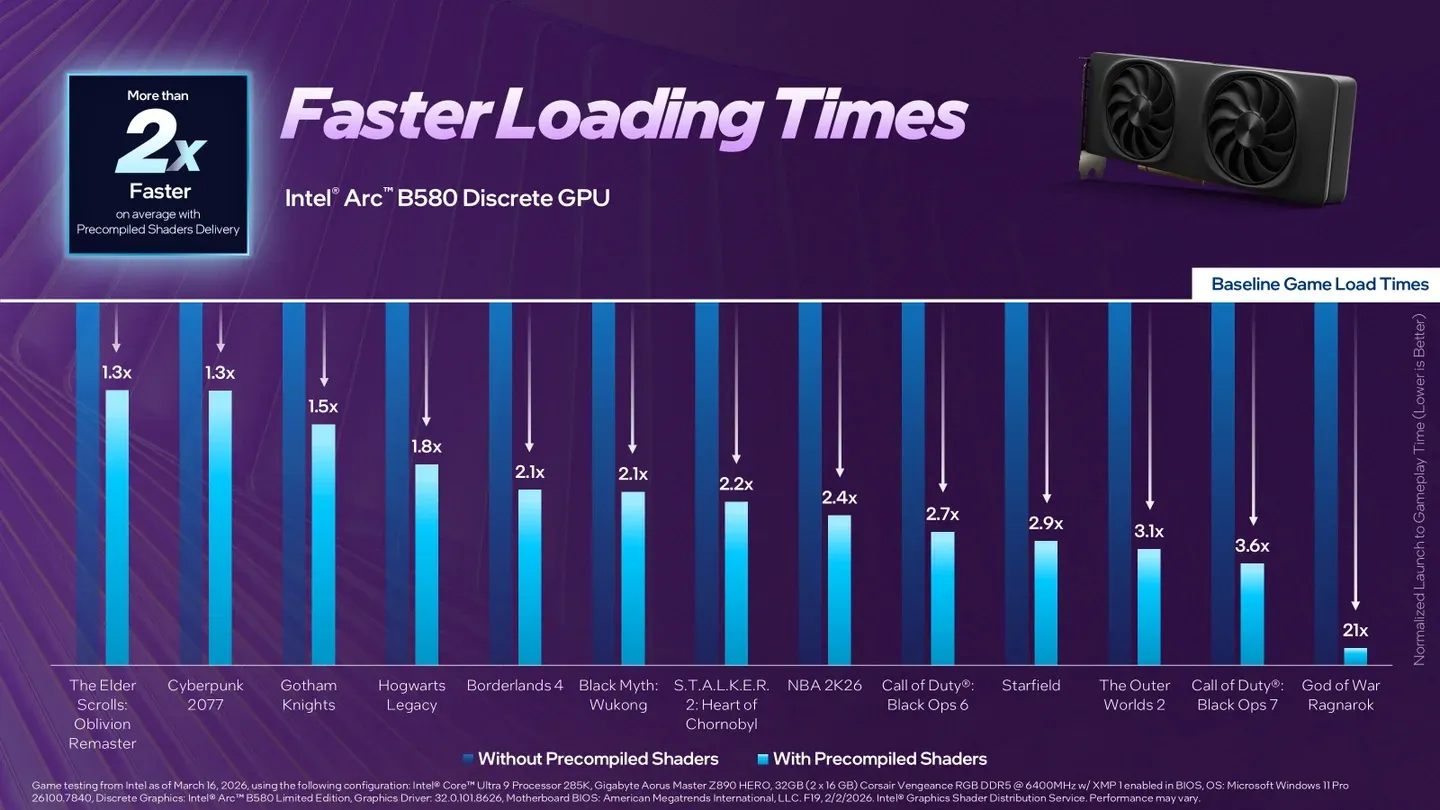
Load time gains on first boot
Intel's Own Thing, Not Microsoft's
Here's the thing worth clarifying: this is not the same as Microsoft's Advanced Shader Delivery initiative, even though Intel is also working on that. The two are separate projects. The Precompiled Shaders service is custom-built and run entirely by Intel, while Advanced Shader Delivery is a broader industry collaboration involving Nvidia and AMD hardware as well, expected to roll out later this year.
The two will eventually work alongside each other. Both services together will give Arc GPU users more game coverage and more ways to reduce the waiting and stuttering caused by shader compilation. Think of Intel's service as the head start while the wider platform catches up.
Nvidia has confirmed it will bring Advanced Shader Delivery to GeForce RTX users later this year, and the feature has already been tested on AMD-powered hardware through the Xbox ROG Ally. So the days of staring at shader compilation screens are numbered for PC gamers broadly, not just Arc owners.
Why This Matters Beyond the Numbers
Shader compilation isn't a problem that's going away on its own. Modern games are visually complex, and the gap between what your GPU needs to render and what can be prepped ahead of time keeps growing. Bundling pre-compiled shaders through driver updates is a practical fix that can also arrive day-and-date with new game releases, meaning you might never see the compilation screen for a supported title at all.
The 13-game list will almost certainly expand as Intel updates its drivers. Make sure to check out more: