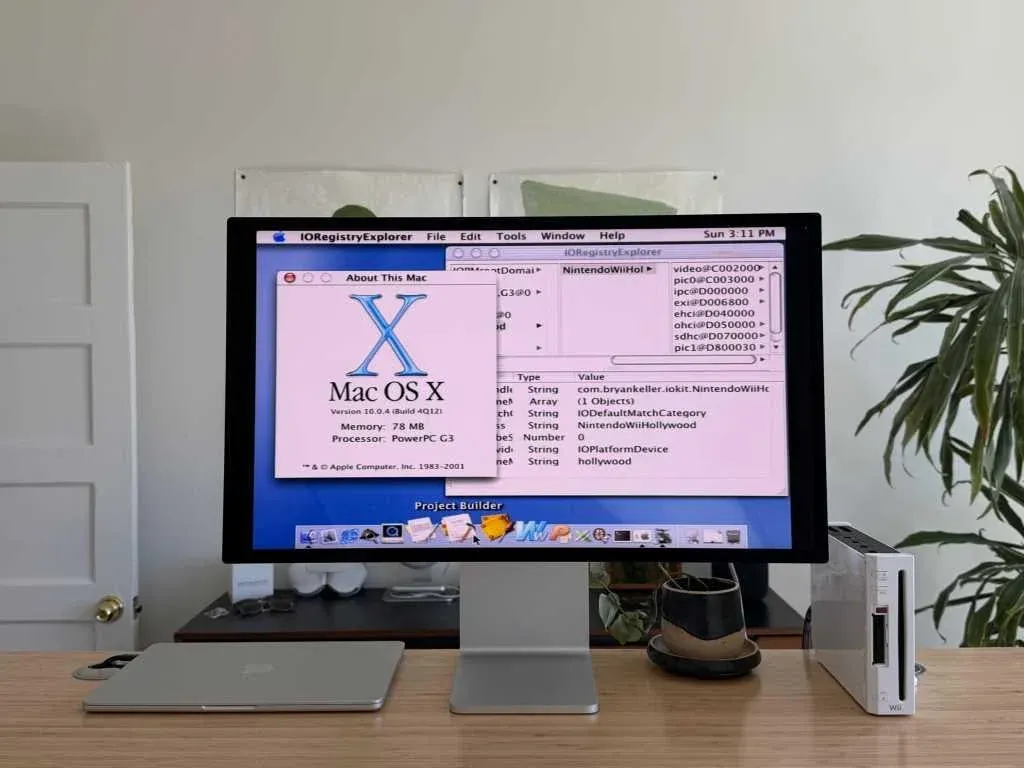

A Nintendo Wii sitting on a desk, booting Mac OS X. That sentence should not be real. And yet, here we are.
Modder Bryan Keller published a massively detailed blog post on April 8 walking through the full development process of getting Mac OS X running on Nintendo's motion-controlled console. The project actually dates back to 2013, when Keller first floated the idea before shelving it. What finally reignited the effort? Another modder porting Windows NT to the Wii. Keller saw that and apparently thought, “hold my soldering iron.”
How a 2013 side project became a working OS port
The development journey Keller documented is not a casual weekend project. Getting Mac OS X to boot on Wii hardware meant wrestling with complex boot loading sequences, kernel compatibility issues, and a parade of bugs that followed Keller onto an actual flight. At one point, attempting to boot the OS from a USB stick nearly bricked the console entirely.
Here's the thing: the Wii uses a PowerPC processor, which is the same architecture Apple used in its hardware before the Intel transition in 2006. Mac OS X 10.4 (Tiger) and earlier versions ran natively on PowerPC chips. The Wii's Broadway CPU is a PowerPC derivative, which is what makes this port theoretically possible rather than completely delusional.
danger
The WiiMac port is still a prototype. Audio output remains unsolved, and you will need a BootMii-jailbroken Wii to run it. The public repository is available on GitHub under the name WiiMac.
Keller's own summary of the project is worth quoting directly: "In the end, I learned (and accomplished) far more than I ever expected - and perhaps more importantly, I was reminded that the projects that seem just out of reach are exactly the ones worth pursuing."
The iMac G3 idea that nobody asked for but everyone needs
The port itself is impressive enough on its own. But the real chaos it has unlocked is the idea of cramming a Wii inside an Apple iMac G3, the iconic translucent all-in-one CRT machine from the late 1990s and early 2000s.
The logic actually tracks. YouTuber Matt Gray previously swapped the internals of an iMac G3 for a Mac Mini, connecting it to the machine's built-in CRT via a proprietary VGA connector and internal USB breakout. The Wii is physically compact enough that it could theoretically slot into the space where the original motherboard sat. Its shape even lines up with the G3's front-loading optical drive bay, meaning disc slots could still function.
iMac G3 internals layout
The Wii's video output and USB connectivity would need adapters to match the G3's proprietary connectors, but that's the same problem Gray already solved with the Mac Mini build. What most players miss is that the iMac G3 and the Wii share an aesthetic era: both are products of that particular late-90s to mid-2000s design period when consumer electronics were colorful, rounded, and unapologetically playful.
So the pitch is simple. Wii inside an iMac G3 shell. Keller's Mac OS X port running on the screen. A retro Apple computer that is secretly a Nintendo console, running Apple's own software from 2001. Completely unnecessary. Absolutely worth doing.
What the WiiMac bootloader actually requires
For anyone curious about trying the port without building a cursed hybrid computer, the requirements are straightforward:
- A BootMii-jailbroken Nintendo Wii (not Wii U)
- Access to the WiiMac bootloader repository on GitHub
- Patience, because audio still does not work and this is a prototype
Keller's blog outlines every step of the development process in technical detail, so anyone with coding experience and a jailbroken console has a real starting point. The project is open, public, and apparently functional enough to boot to a desktop.
The retro modding scene has been on a serious run lately. Between this, the Windows NT Wii port that inspired it, and projects like the PS1 hybrid PCB builds making the rounds, there is a genuine appetite for pushing old hardware into territory it was never designed for. For more unusual hardware projects and retro deep dives, make sure to check out more:
Keller's project started as a 13-year-old idea that nearly bricked a console on a plane. It ended with Mac OS X booting on a Wii. The next logical step, clearly, is getting that Wii inside a translucent CRT Mac. Someone needs to make this happen, and you can find plenty of hardware inspiration by browsing the latest reviews to see what retro builds the community is pulling off right now.