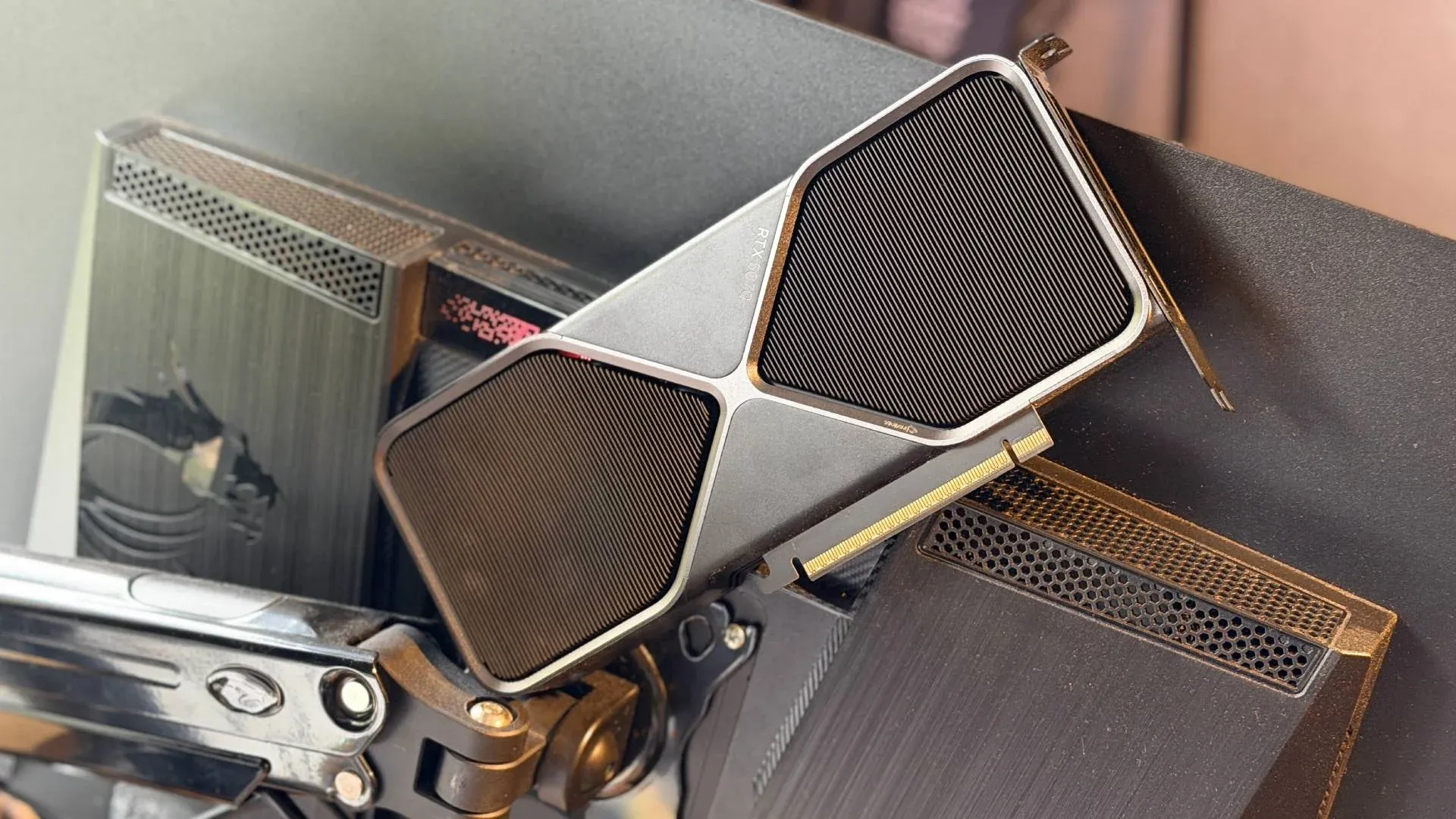


Picture a monitor sitting on your desk. Now picture a full graphics card sticking out the back of it. That is the LP-3201 from Loop, a 32-inch all-in-one PC that debuted at Computex 2026 and is unlike anything else in the display space right now.

Use code TRYHARD33 at checkout to redeem this offer before code expires again.
Get 33% Off GAMES+ Subscription
A monitor that swallowed a PC
The LP-3201 is a WQHD (2,560 x 1,440) panel running at 180Hz with a 32-inch screen. Standard stuff for a gaming monitor. What is absolutely not standard is the slot built into the rear housing that accepts graphics cards up to 330mm in length. On the show floor, Loop had the unit running with an Asus Prime GeForce RTX 5070 OC Edition installed, which gives you a sense of the card tier this machine is designed around.
Here's the thing: the GPU slot is designed around Nvidia's SFF (small form factor) standard, the spec Nvidia introduced to simplify building compact rigs. Cards that push past that 330mm limit, including the larger ROG Astral 50-series boards, simply will not fit. So the beefiest single-GPU configurations are off the table, but a solid mid-to-high-end build is very much on it.
Beyond the GPU, Loop has somehow crammed a Micro ATX motherboard, an Intel Core Ultra 7 265K processor (Arrow Lake), a liquid cooling system, and an 800W PSU into the monitor chassis. Air vents line the back panel to keep thermals in check. It is, in the best possible way, a clown car of PC hardware.
Why this matters more than your average AIO
Most all-in-one PCs are a dead end the moment you buy them. They run on laptop-class components squeezed into a tight chassis, and upgrading anything beyond the RAM or an SSD is typically not possible. The LP-3201 sidesteps that entirely.
Because the internals are full desktop components, you can swap the GPU when a better card comes out. You can upgrade the CPU. The 800W PSU gives you headroom that most AIOs never dream of. What most players miss when they look at all-in-one machines is the upgrade ceiling, and Loop has raised it considerably here.
Design choices that are hard to ignore
Loop is offering the LP-3201 in a standard black colorway, but there is also a bright green variant that leans hard into gaming aesthetics. That green version can be optioned with wooden paneling across the rear air vents, which is an odd but genuinely interesting visual contrast. Loop already sells a curved AIO monitor called the LP 3200 that ships with a GPU included, so the LP-3201 is effectively the next step in that product line.
For now, availability is limited to China, though Loop has signaled interest in expanding to Japan. Whether it reaches North America or Europe is not confirmed. Given how niche the product category is, and how much the bare-bones pricing model depends on local GPU availability, a wider rollout is not guaranteed.
The concept itself is worth watching. PC gaming has been moving toward smaller, more integrated form factors for years, and the LP-3201 takes that logic to its logical extreme without sacrificing upgradeability. You can check out game reviews to see how current GPU generations are actually performing in the titles you care about, which is useful context if you're thinking about what card to drop into something like this.
What comes next for monitor-PC hybrids
Loop's LP-3201 is a proof of concept as much as it is a product. The specs are real, the hardware is real, and a working unit was running on the Computex show floor. But the path from Chinese bare-bones launch to a globally available, fully configured retail product is a long one.
The key here is whether other manufacturers look at this and see an opportunity. The all-in-one PC category has been stagnant for years, and a monitor that accepts desktop-class components, including a swappable GPU, is a genuinely different take on the form factor. If you want to stay across hardware developments like this, the gaming guides hub is a solid place to track how new tech translates into real-world gaming performance.
Loop has built something worth paying attention to. Keep an eye on availability updates if the concept appeals to you.