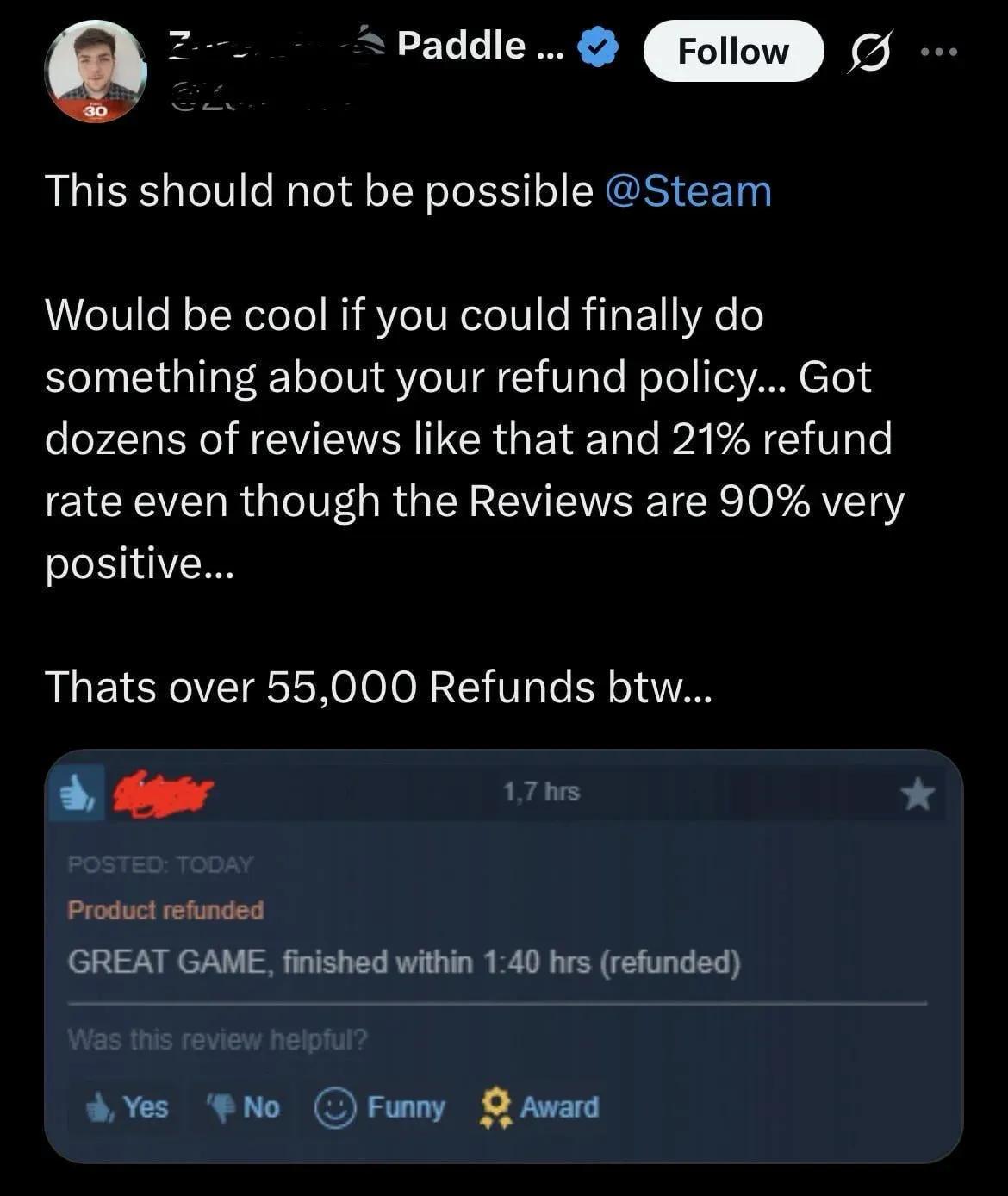

Sometime last Sunday, Mateo, the solo developer behind the co-op friendslop hit Paddle Paddle Paddle, posted something on social media that most devs quietly stew over but never say out loud. His game, a chaotic aquatic riff on Super Monkey Ball priced at $4.99 (frequently on sale for $2.99), had been refunded 55,000 times. Not because players hated it. Because Steam's return window let them play it start to finish and still get their money back.
The post has since racked up over 6.1 million views, and Mateo says he kind of regrets making it. That's the trap, really: speak up and risk looking ungrateful, stay quiet and watch the refund counter climb.
The numbers that made everyone stop scrolling
Paddle Paddle Paddle sits at over 1,300 reviews with a 90% positive rating. The game has a median playtime of under two hours. That combination is the core of the problem. Steam's refund policy allows any game to be returned within two weeks of purchase, provided playtime stays under two hours. For most titles, that window functions as a safety net. For shorter games, it's essentially a free rental.
The gross revenue figure before platform fees and chargebacks sits around $826,000. After refunds, taxes, and Valve's cut, Mateo takes home roughly $250,000. For a 23-year-old who built the game in under two weeks and doesn't make games full-time, that's a remarkable outcome. But the 55,000 figure is harder to ignore when you know a chunk of those refunds came attached to five-star reviews.
Mateo shared one screenshot of a positive review that read "GREAT GAME" from a player who logged about an hour and a half, then refunded it anyway. That specific detail is what turned a developer complaint into a genuine conversation.
What the community actually thinks
The reaction split almost immediately. The top-voted review on Paddle Paddle Paddle's Steam page doesn't exactly defend the developer. It calls the game rushed, compares it to a browser game, and criticizes Mateo for publicly raising the issue at all. That review is sitting at the top of the page, which tells you something about where a vocal portion of the playerbase lands.
The broader discourse is messier. Some players argue that a generous return policy is what makes them willing to take chances on unknown indie titles in the first place, and that without it, many of those sales never happen. Others point out that leaving a positive review and then requesting a refund is a specific kind of behavior that goes beyond consumer protection.
Here's the thing: both positions can be true simultaneously. The policy probably does generate incremental sales for smaller games. It also, demonstrably, allows players to complete a game and return it guilt-free, and in some cases, enthusiastically.
Why shorter games keep losing this fight
This isn't a new complaint. Indie developers have been raising the short-game refund problem for years. The two-hour window made sense when the average Steam game was a 20-hour RPG or a multiplayer shooter you'd sink weeks into. It doesn't map cleanly onto a $5 co-op party game built around a single session.
The argument for a policy adjustment isn't that refunds should disappear. It's that Valve could tie the refund window to the game's price point or expected playtime rather than applying a universal two-hour rule to everything from 200-hour open-world games down to 90-minute indie experiences. Whether Valve moves on that is a separate question entirely.
Mateo has been clear that he supports the refund policy in general. His frustration is narrow and specific: a flat rule that doesn't account for games designed to be played in a single sitting.
What this means for players who care about indie games
Paddle Paddle Paddle is a casual game that found a real audience. It went viral, sold well, and made its developer a meaningful amount of money. By most measures, that's a success story. The refund conversation doesn't erase that.
But if you've ever wondered why some indie developers pad their games, add filler content, or price short experiences higher than they seem worth, the 55,000-refund situation is part of the answer. Developers are designing around a policy rather than purely around the experience they want to create.
For players who want more games like Paddle Paddle Paddle, the most direct thing you can do is keep the copy you enjoyed. If you're looking for something similar in the party game space, Pudgy Party is worth checking out, and there are solid beginner strategies and winning tips to help you get the most out of it from the start.